Reaction equation
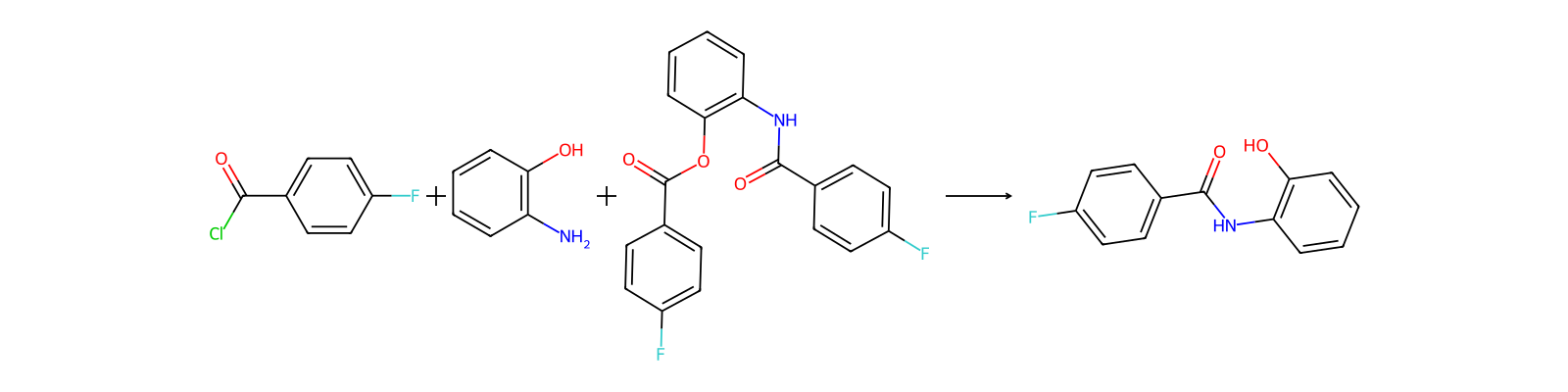
FC1C=CC(C(Cl)=O)=CC=1.NC1C=CC=CC=1O.[F:19][C:20]1[CH:44]=[CH:43][C:23]([C:24]([NH:26][C:27]2[CH:32]=[CH:31][CH:30]=[CH:29][C:28]=2[O:33]C(=O)C2C=CC(F)=CC=2)=[O:25])=[CH:22][CH:21]=1>>[F:19][C:20]1[CH:44]=[CH:43][C:23]([C:24]([NH:26][C:27]2[CH:32]=[CH:31][CH:30]=[CH:29][C:28]=2[OH:33])=[O:25])=[CH:22][CH:21]=1Participants



Procedure
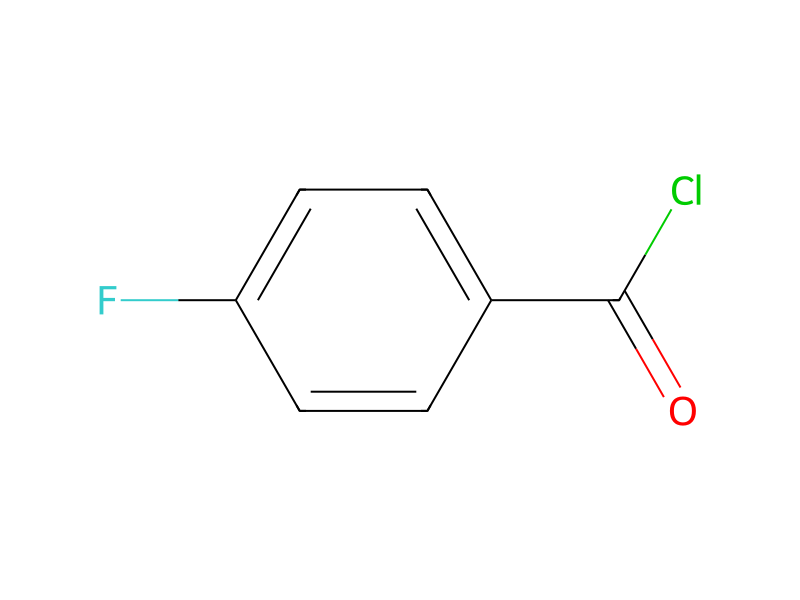
The examples below serve to illustrate the process according to the invention in more detail. 4-fluorobenzoic chloride (B) was added drop wise to a mixture of 2-aminophenol (A) in the respective solvent. The concentration of the 4-fluorobenzoic chloride (B) in the solvent [g/ml] is given in table 1. Afterwards the reaction was stirred under nitrogen. The conditions and results are listed in table 1. The amount of base is given as mol-equivalents based on the amount of 4-fluorobenzoic chloride (B). The reaction mixtures were analyzed after the indicated time by HPLC (254 nm, area %) in particular for determining the amount of 4-fluoro-Benzoic acid 2-[(4-fluorobenzoyl)amino]phenyl ester (i.e. the diacylated product, DAP). Then, 4-Fluoro-N-(2-hydroxyphenyl)-benzamide (IVa) was isolated resulting in the yields as indicated in the table 1 (purity >98% (HPLC at 254 nm)).
Workup
- customThe conditions and results
- customThe reaction mixtures
Sources & evidence
- ORD record
- ord-a26cc490863d4dafa88e7e36d02a3ada
- Source dataset
- uspto-grants-2016_09
- Patent number
- US09440935B2
Linked notes
Loading…