Reaction equation

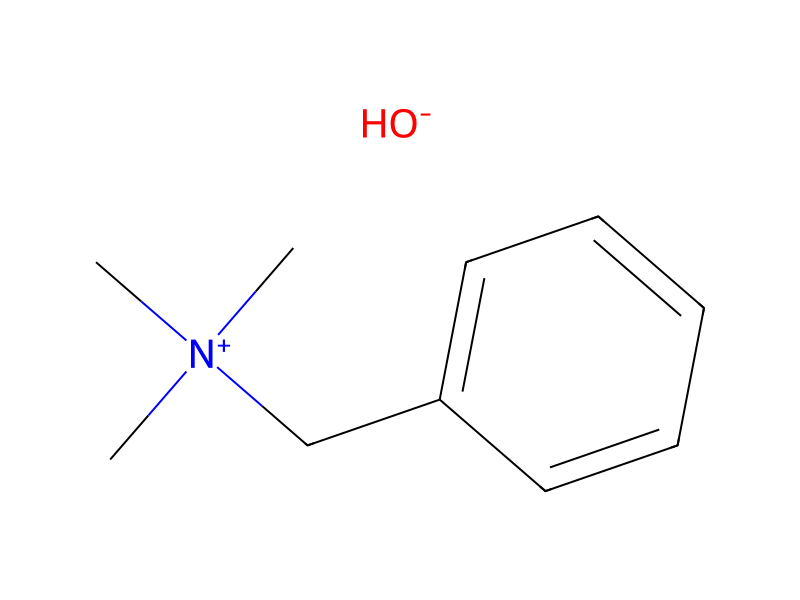
[CH:1]([C:3]1[CH:15]=[CH:14][C:13]2[C:12]3[C:7](=[CH:8][CH:9]=[CH:10][CH:11]=3)[CH2:6][C:5]=2[CH:4]=1)=[CH2:2].[OH-:16].C([N+](C)(C)C)C1C=CC=CC=1>N1C=CC=CC=1>[CH:1]([C:3]1[C:4](=[O:16])[C:5]2[C:13](=[CH:14][CH:15]=1)[C:12]1[C:7](=[CH:8][CH:9]=[CH:10][CH:11]=1)[CH:6]=2)=[CH2:2]Participants
4
Reactant 2

Product 1

Reagents, catalysts & solvents 1

Conditions
- Temperature
- 0 °C
Procedure
The 2-vinylfluorene prepared in Example I is dissolved in 800 milliliters of pyridine and cooled to 0° C. One-half milliliter of a 40% solution of benzyltrimethyl ammonium hydroxide in pyridine is slowly added with air being bubbled through the reaction solution. The initially formed red coloration fades over a period of 1 to 2 hours and the solution is poured into water and extracted with benzene to yield 9 grams (90% theory) of a yellow solid. The residue is chromatographed on alumina (Woehlm basic) and eluted with benzene. Recrystallization from hexane gives 2-vinylfluorenone as a pale yellow material (melting point 69°-70° C). The structure of the product is confirmed by nuclear magnetic resonance and elemental analysis.
Workup
- custombeing bubbled through the reaction solution
- additionthe solution is poured into water
- extractionextracted with benzene
- customto yield 9 grams (90% theory) of a yellow solid
- customThe residue is chromatographed on alumina (Woehlm basic)
- washeluted with benzene
- customRecrystallization from hexane
Sources & evidence
- ORD record
- ord-5050f0d7c04f41ca9cf04023d55c24f4
- Source dataset
- uspto-grants-1977_03
- Patent number
- US04011266
Linked notes
Loading…