Reaction equation

[N+:1]([C:4]1[CH:9]=[CH:8][C:7]([SH:10])=[CH:6][CH:5]=1)([O-:3])=[O:2].[Hg](C#N)C#N.[C:16]([O:19][C@@H:20]1[C@@H:25]([O:26][C:27](=[O:29])[CH3:28])[C@H:24]([O:30][C:31](=[O:33])[CH3:32])[CH2:23][S:22][C@@H:21]1Br)(=[O:18])[CH3:17]>>[C:16]([O:19][C@@H:20]1[C@@H:25]([O:26][C:27](=[O:29])[CH3:28])[C@H:24]([O:30][C:31](=[O:33])[CH3:32])[CH2:23][S:22][C@H:21]1[S:10][C:7]1[CH:8]=[CH:9][C:4]([N+:1]([O-:3])=[O:2])=[CH:5][CH:6]=1)(=[O:18])[CH3:17]Participants
4


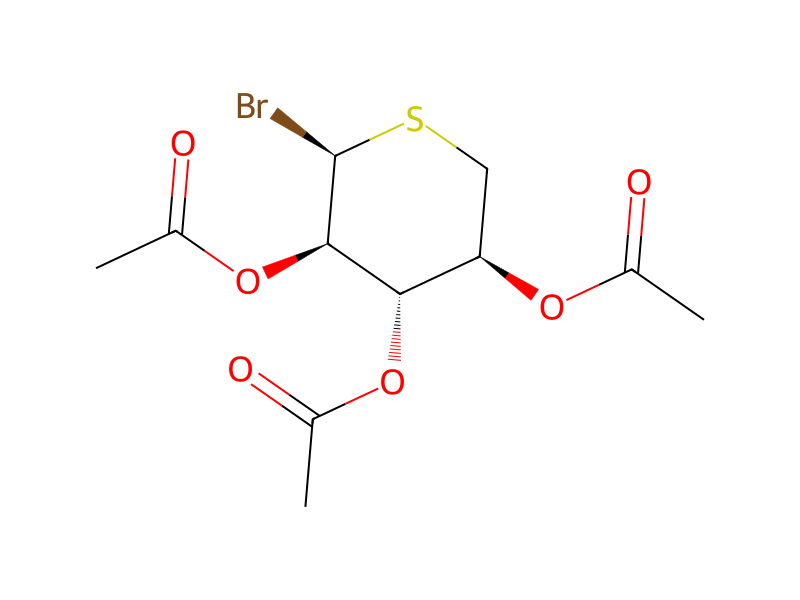

Procedure
If the procedure described in Preparation I is followed starting from 6 g (38.10-3 mol) of 4-nitrobenzenethiol, 10.7 g (42.10-3 mol) of mercuric cyanide, Hg(CN)2, and 15.1 g (42.10-3 mol) of 2,3,4-tri-O-acetyl-5-thio-α-D-xylopyranosyl bromide, 10.8 g (yield: 66%) of the expected product are obtained.
Workup
- customIf the procedure described in Preparation I
Sources & evidence
- ORD record
- ord-6e155a0fcdfe4261a9d6e2ec6bcd8028
- Source dataset
- uspto-grants-1993_09
- Patent number
- US05246961
Linked notes
Loading…