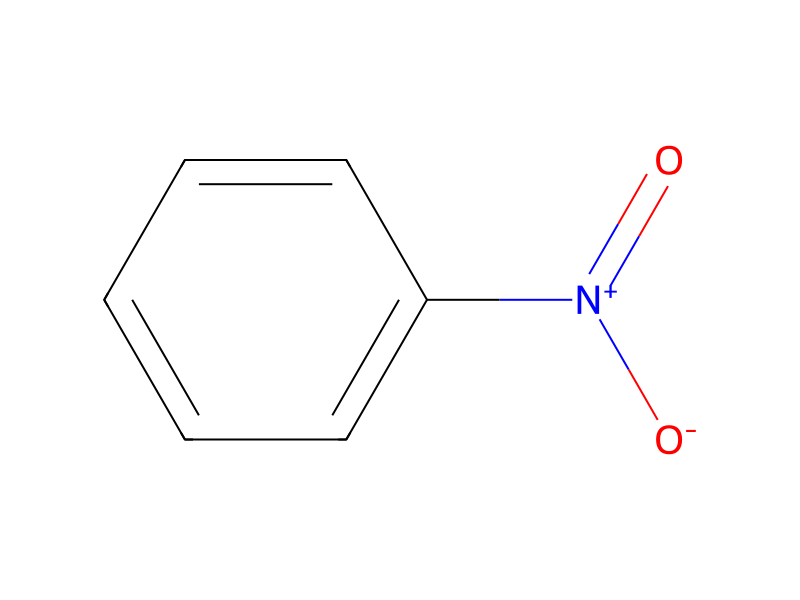
[OH-].[K+].[CH3:3][O:4][C:5]1[CH:10]=[CH:9][C:8]([CH2:11][C:12]#[N:13])=[CH:7][CH:6]=1.[N+:14]([C:17]1[CH:22]=[CH:21][CH:20]=[CH:19][CH:18]=1)([O-])=[O:15].C(O)(=O)C>CO.O>[OH:15][N:14]=[C:17]1[CH:22]=[CH:21][C:20](=[C:11]([C:8]2[CH:9]=[CH:10][C:5]([O:4][CH3:3])=[CH:6][CH:7]=2)[C:12]#[N:13])[CH:19]=[CH:18]180 g of KOH are dissolved in 400 ml of methanol and heated up to 55° C. To the solution are added 50 ml (0.37 mol) of p-methoxyphenylacetonitrile, followed by 35 ml (0.34 mol) of nitrobenzene. The reaction mixture is stirred at 55° C. for 4 hrs. After cooling, 500 ml of water are added with stirring. The resulting solution is acidified by addition of 110 ml of acetic acid in 100 ml of water, leading to a precipitate. The mixture is then filtered, and the solid is washed with a mixture of methanol and water. The crude product is dried in air and recrystallized from 500 ml of ethyl acetate. 45.6 g (53%) of (4-Hydroxyimino-cyclohexa-2,5-dienylidene)-(4-methoxyphenyl)-acetonitrile are obtained in the form of orange crystals having a melting point of 161-163° C. (dec.).