HuagongsheHuagongshe Chemistry Print Report · For research reference only
HRID 613009Generated: October 24, 2026
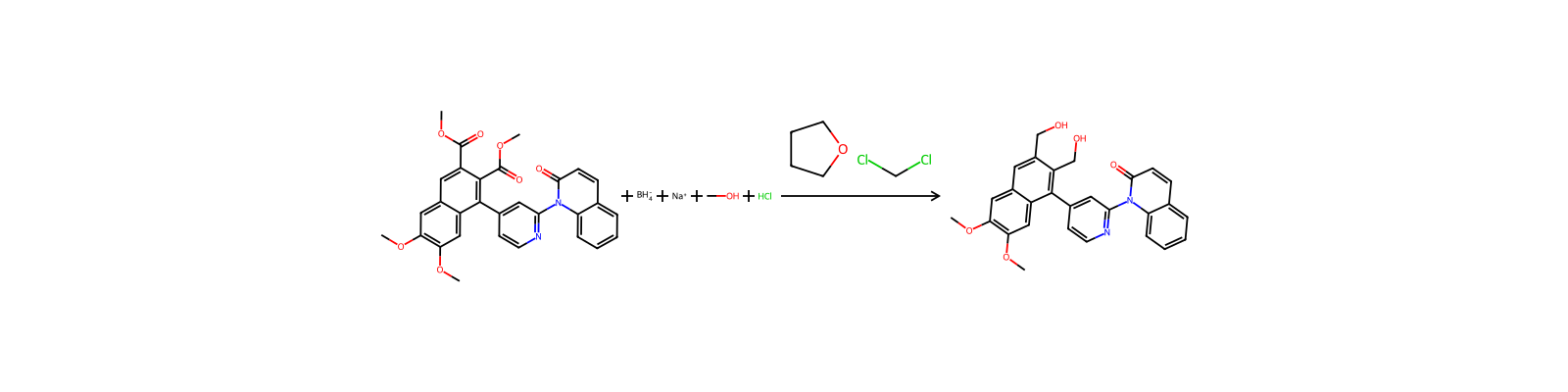
Hydrochloric Acid → 1-[2-(2-Oxo-1,2-dihydroquinolin-1-yl)-4-pyridyl]-2,3-bis(hydroxymethyl)-6,7-dimethoxynaphthalene
https://huagongshe.com/en/reaction/613009
Participants
| Role | Name | HCID | Charge |
|---|
| Reactant | Hydrochloric Acid | HCID 313 | — |
| Reactant | Methanol | HCID 887 | — |
| Reactant | Sodium borohydride | HCID 4311764 | — |
| Reactant | 1-[2-(2-Oxo-1,2-dihydroquinolin-1-yl)-4-pyridyl]-2,3-bis(methoxycarbonyl)-6,7-dimethoxynaphthalene | HCID 22007448 | — |
| Solvent | Dichloromethane | HCID 6344 | — |
| Solvent | Tetrahydrofuran | HCID 8028 | — |
| Product | 1-[2-(2-Oxo-1,2-dihydroquinolin-1-yl)-4-pyridyl]-2,3-bis(hydroxymethyl)-6,7-dimethoxynaphthalene | HCID 9912467 | 50.4% |
Reaction Steps
To a suspension of 1-[2-(2-oxo-1,2-dihydroquinolin-1-yl)-4-pyridyl]-2,3-bis(methoxycarbonyl)-6,7-dimethoxynaphthalene (200 mg) in tetrahydrofuran is added sodium borohydride (36 mg), and the mixture is refluxed. To the mixture is added methanol (0.3 ml) under reflux over a period of one hour. The mixture is cooled to room temperature, and thereto is added sodium borohydride (36 mg). To the mixture is added methanol (0.3 ml) under reflux over a period of one hour. After the reaction is complete, methylene chloride and diluted hydrochloric acid are added to the mixture. The methylene chloride layer is separated, washed, dried and concentrated under reduced pressure to remove the solvent. The residue is purified by silica gel column chromatography (solvent; chloroform:methanol=20:1) to give 1-[2-(2-oxo-1,2-dihydroquinolin-1-yl)-4-pyridyl]-2,3-bis(hydroxymethyl)-6,7-dimethoxynaphthalene (90 mg), which is listed in Table 6.
Provenance & Evidence
| DOI | 10.6084/m9.figshare.5104873.v1 |
|---|
| Patent number | US06005106 |
|---|
| Source dataset | uspto-grants-1999_12 |
|---|
| ORD ID | ord-c87bcfed50f44b9bb0cc38c47dd40454 |
|---|
| Source note | uspto-grants-1999_12 |
|---|