Reaction equation

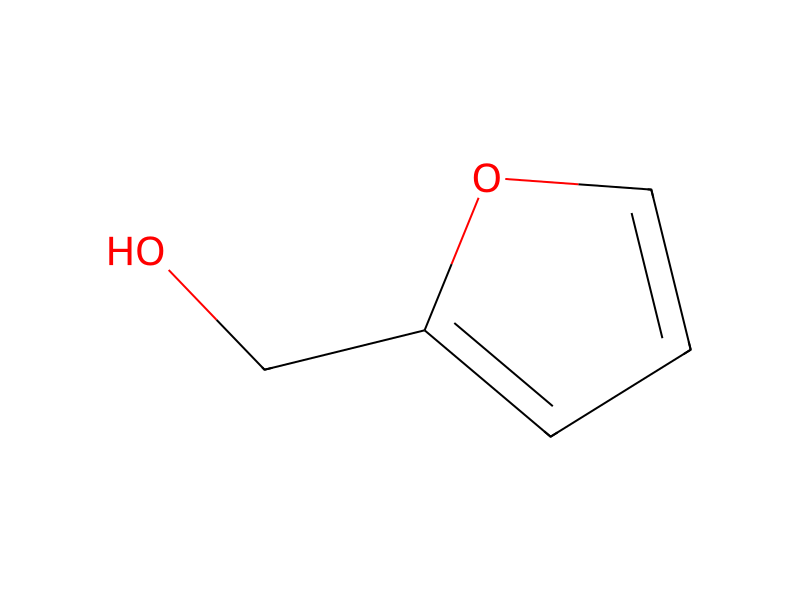
[OH-].[Na+].[OH:3][CH2:4][C:5]1[O:6][CH:7]=[CH:8][CH:9]=1.[Cl:10][C:11]1[CH:16]=[C:15]([C:17]([Cl:20])([Cl:19])[Cl:18])[CH:14]=[C:13](Cl)[N:12]=1>O>[Cl:10][C:11]1[CH:16]=[C:15]([C:17]([Cl:18])([Cl:19])[Cl:20])[CH:14]=[C:13]([O:3][CH2:4][C:5]2[O:6][CH:7]=[CH:8][CH:9]=2)[N:12]=1Participants
Reactant 3


Product 1

Reagents, catalysts & solvents 1

Conditions
- Temperature
- 50 °C
Procedure
To 24 grams (0.6 mole) of sodium hydroxide dissolved in 120 mls of water, was added 300 mls of 2-(hydroxymethyl)furan and the solution warmed to 50° C. In this mixture was added incremently over a 20 minute period, 106.15 grams (0.4 mole) of 2,6-dichloro-4-(trichloromethyl)pyridine. The mixture was heated to ~80° C. for ~3.5 hours and thereafter diluted with water and extracted with hexane. The extract was washed with water and the hexane evaporated off leaving ~114 grams (~87 percent of theoretical) of the desired 2-chloro-6-(2-furanylmethoxy)-4-(trichloromethyl)pyridine product. The product, an oil, had a refractive index of n 25/d = 1.5722 and upon analysis was found to have carbon, hydrogen and nitrogen contents of 40.41, 2.21 and 4.21 percent, respectively, as compared with the theoretical contents of 40.40, 2.16 and 4.28 percent, respectively, as calculated for the above named compound.
Workup
- additionIn this mixture was added incremently over a 20 minute period
- temperatureThe mixture was heated to ~80° C. for ~3.5 hours
- extractionextracted with hexane
- washThe extract was washed with water
- customthe hexane evaporated off
Sources & evidence
- ORD record
- ord-465154c22d344e468baac5ba686cee15
- Source dataset
- uspto-grants-1979_03
- Patent number
- US04143144
Linked notes
Loading…