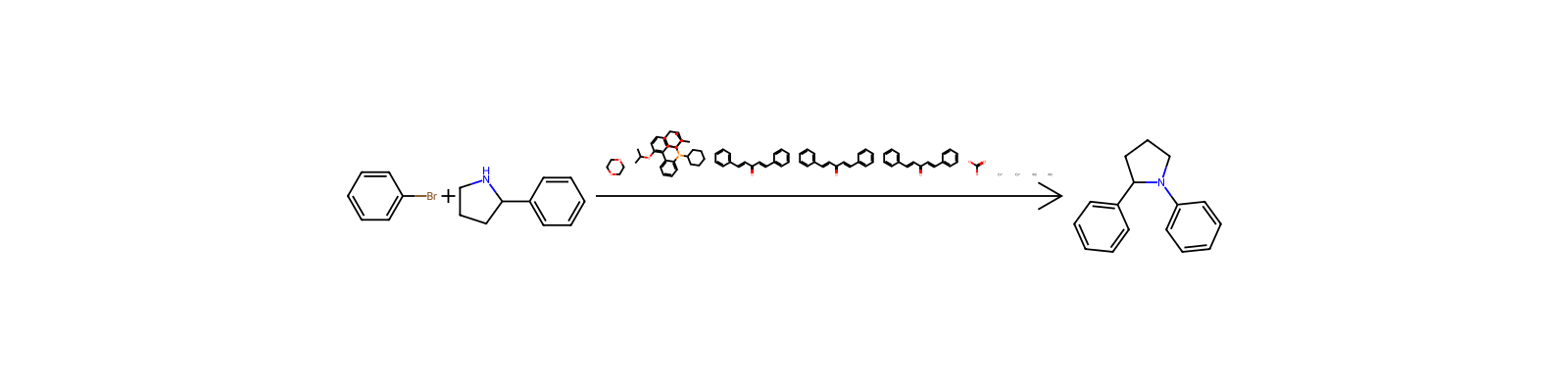
Participants
| Role | Name | HCID | Charge |
|---|
| Reactant | Bromobenzene | HCID 7961 | — |
| Reactant | 2-Phenylpyrrolidine | HCID 261892 | — |
| Reagent | Cesium carbonate | HCID 10796 | — |
| Catalyst | Bis(dibenzylideneacetone)palladium | HCID 9811564 | — |
| Catalyst | 2-Dicyclohexylphosphino-2',6'-diisopropoxybiphenyl | HCID 16217985 | — |
| Solvent | 1,4-Dioxane | HCID 31275 | — |
| Product | Diphenylpyrrolidine | HCID 11218352 | 90.18% |
Reaction Steps
Caesium carbonate (553 mg, 1.70 mmol) was added to bromobenzene (0.059 mL, 0.57 mmol) and 2-phenylpyrrolidine (100 mg, 0.68 mmol) in 1,4-dioxane (2 mL). The reaction was degassed and Tris(dibenzylideneacetone)?dipalladium(0) (12.96 mg, 0.01 mmol) and dicyclohexyl(2',6'-diisopropoxy-[1,1'-biphenyl]-2-yl)phosphine (RuPhos) (13.21 mg, 0.03 mmol) were added. The resulting solution was stirred at 100 °C for 16 hours. LCMS showed the formation of the product. The reaction mixture was diluted with EtOAc, and washed with water. The organic layer was dried over MgSO4, filtered and evaporated to afford crude product. NMR confirmed the presence of the product. The crude product was purified by flash silica chromatography, elution gradient 0 to 15% DCM in MeOH. Pure fractions were evaporated to dryness to afford 1,2-diphenylpyrrolidine (114 mg, 90 %) as a brown oil.
Provenance & Evidence
| Source dataset | 750 AstraZeneca ELN dataset |
|---|
| ORD ID | ord-9faf2ea031204c63b2d52d8ff6231013 |
|---|
| Source note | 750 AstraZeneca ELN dataset |
|---|