Reaction equation
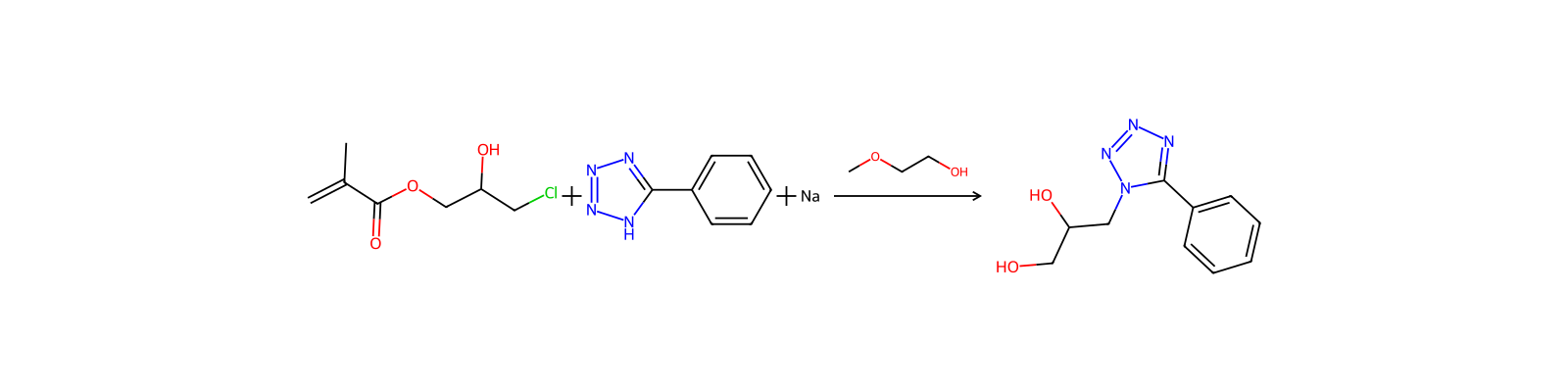
C([O:6][CH2:7][CH:8]([OH:11])[CH2:9]Cl)(=O)C(C)=C.[C:12]1([C:18]2[NH:22][N:21]=[N:20][N:19]=2)[CH:17]=[CH:16][CH:15]=[CH:14][CH:13]=1.[Na]>COCCO>[OH:11][CH:8]([CH2:7][OH:6])[CH2:9][N:22]1[C:18]([C:12]2[CH:17]=[CH:16][CH:15]=[CH:14][CH:13]=2)=[N:19][N:20]=[N:21]1Participants
4
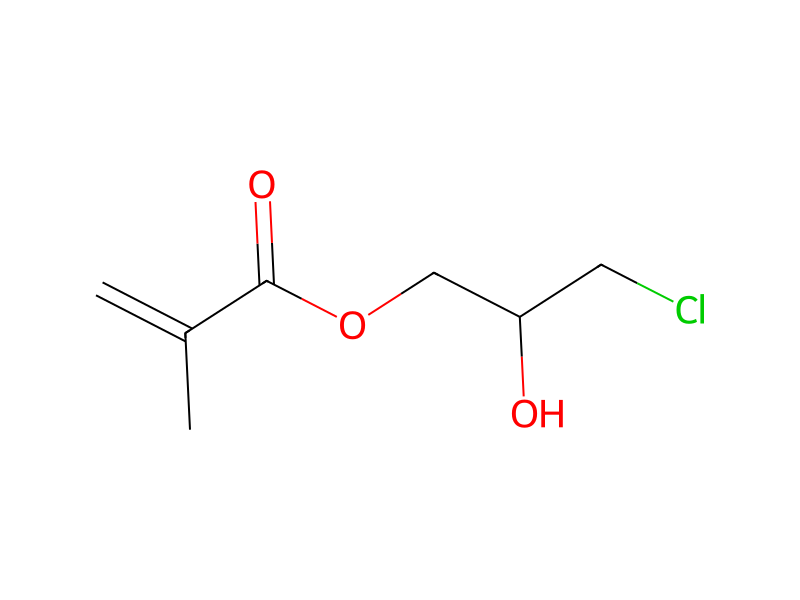
Reactant 2

Product 1

Reagents, catalysts & solvents 1

Conditions
- Temperature
- 100 °C
Procedure
A solution of 3-chloro-2-hydroxypropyl methacrylate (0.50 mole; 89.3 g. and 500 ppm 4-methoxyphenol as inhibitor) in 2-methoxyethanol (300 ml) was added to sodium 5-phenyltetrazole (1.0 mole; 168.2 g) dissolved in 2-methoxyethanol (800 ml) and heated at 100° C. for 14.5 hours. The product solution was quenched with H2O (150 ml), extracted with CH2Cl2 (3×500 ml), the extracts washed with H2O (500 ml) and concentrated to a semi-solid, m.p. 25°-115° C, gas evolution, 219° C.
Workup
- customThe product solution was quenched with H2O (150 ml)
- extractionextracted with CH2Cl2 (3×500 ml)
- washthe extracts washed with H2O (500 ml)
- concentrationconcentrated to a semi-solid, m.p. 25°-115° C, gas evolution, 219° C.
Sources & evidence
- ORD record
- ord-8e8cfecbfcf947ae938ef70d579bfc68
- Source dataset
- uspto-grants-1988_09
- Patent number
- US04774266
Linked notes
Loading…