Reaction equation
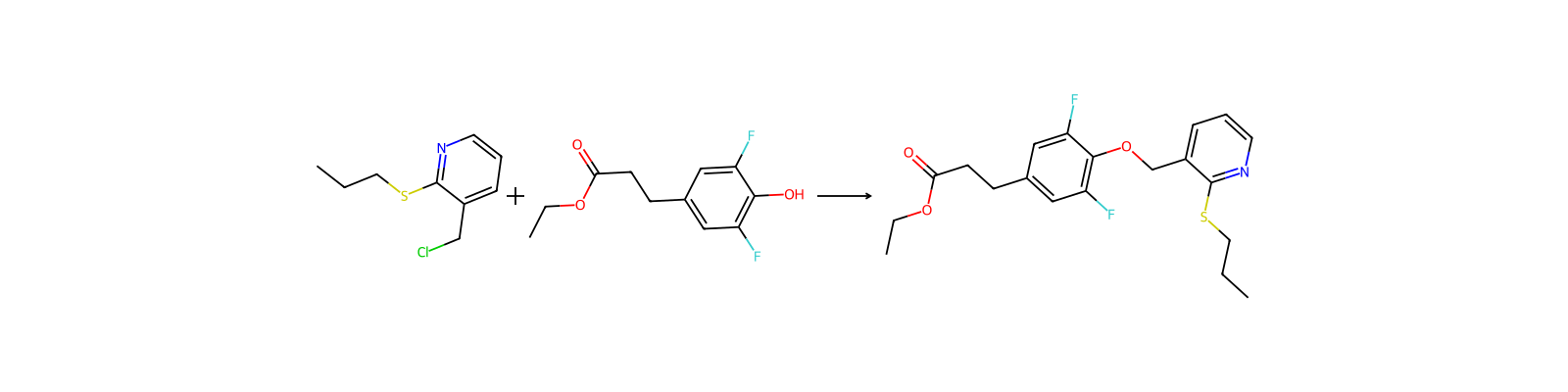
Cl[CH2:2][C:3]1[C:4]([S:9][CH2:10][CH2:11][CH3:12])=[N:5][CH:6]=[CH:7][CH:8]=1.[CH2:13]([O:15][C:16](=[O:28])[CH2:17][CH2:18][C:19]1[CH:24]=[C:23]([F:25])[C:22]([OH:26])=[C:21]([F:27])[CH:20]=1)[CH3:14]>>[CH2:13]([O:15][C:16](=[O:28])[CH2:17][CH2:18][C:19]1[CH:24]=[C:23]([F:25])[C:22]([O:26][CH2:2][C:3]2[C:4]([S:9][CH2:10][CH2:11][CH3:12])=[N:5][CH:6]=[CH:7][CH:8]=2)=[C:21]([F:27])[CH:20]=1)[CH3:14]Participants
3


Procedure
3-Chloromethyl-2-propylsulfanyl-pyridine (0.1 g, 0.49 mmol) obtained in Step C of Preparation Example 14 and 3-(3,5-difluoro-4-hydroxy-phenyl)-propionic acid ethyl ester obtained in Step D of Preparation Example 2 were used to react in the same manner as in Step A of Example 1 to obtain the title compound (0.155 g, 79%).
Workup
- customto react in the same manner as in Step A of Example 1
Sources & evidence
- ORD record
- ord-1a3dc0ff4aa34246ad1cb75c306e9750
- Source dataset
- uspto-grants-2016_09
- Patent number
- US09447044B2
Linked notes
Loading…