Boron tribromide → 1-[4-(5-Hydroxypyrimidin-2-yl)phenyl]-4-pentylbicyclo[2.2.2]octane
HRID 635137
Reaction equation

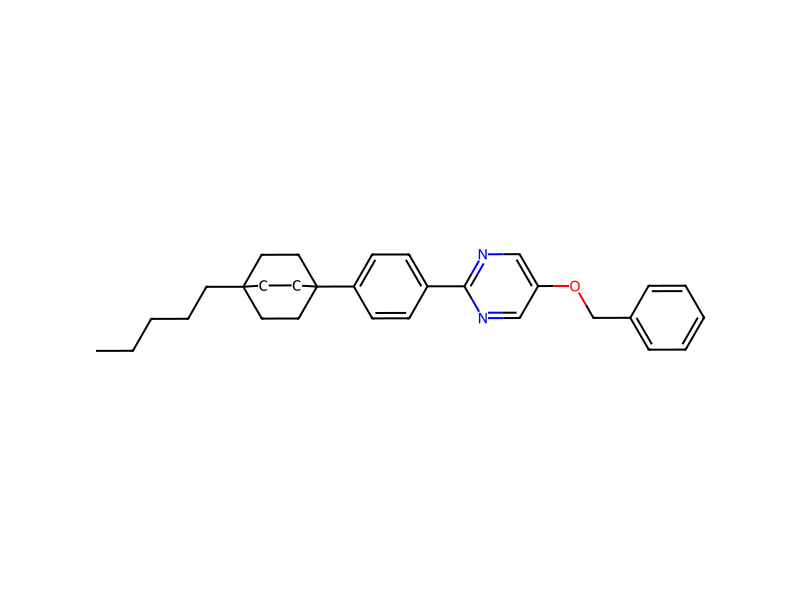
B(Br)(Br)Br.C([O:12][C:13]1[CH:14]=[N:15][C:16]([C:19]2[CH:24]=[CH:23][C:22]([C:25]34[CH2:32][CH2:31][C:28]([CH2:33][CH2:34][CH2:35][CH2:36][CH3:37])([CH2:29][CH2:30]3)[CH2:27][CH2:26]4)=[CH:21][CH:20]=2)=[N:17][CH:18]=1)C1C=CC=CC=1>ClCCl>[OH:12][C:13]1[CH:18]=[N:17][C:16]([C:19]2[CH:20]=[CH:21][C:22]([C:25]34[CH2:32][CH2:31][C:28]([CH2:33][CH2:34][CH2:35][CH2:36][CH3:37])([CH2:29][CH2:30]3)[CH2:27][CH2:26]4)=[CH:23][CH:24]=2)=[N:15][CH:14]=1Participants
4



Procedure
A one molar solution of boron tribromide (120 cm3) is added dropwise to a solution 1-[4-(5-benzyloxypyrimidin-2-yl) phenyl]-4-pentylbicyclo[2.2.2]octane (38.5 g, 100 mmol) in dichloromethane (200 cm3) and cooled using an ice bath. The reaction is stirred overnight at room temperature and then poured onto an ice/water mixture (500 g). The organic layer is separated off and the aqueous layer extracted with dichloromethane (3×100 cm3). The combined organic layers are washed with water (500 cm3), dilute potassium carbonate (200 cm3) and once again with water (500 cm3) then dried (MgSO4), filtered and evaporated. The residue is purified by column chromatography (flash) on silica gel using a 97:3 dichloromethane/methanol mixture as eluent followed by recrystallisation from ethyl acetate to give the 1-[4-(5-hydroxypyrimidin-2-yl)phenyl]-4-pentylbicyclo[2.2.2]octane (14.7 g, 50%).