Reaction equation

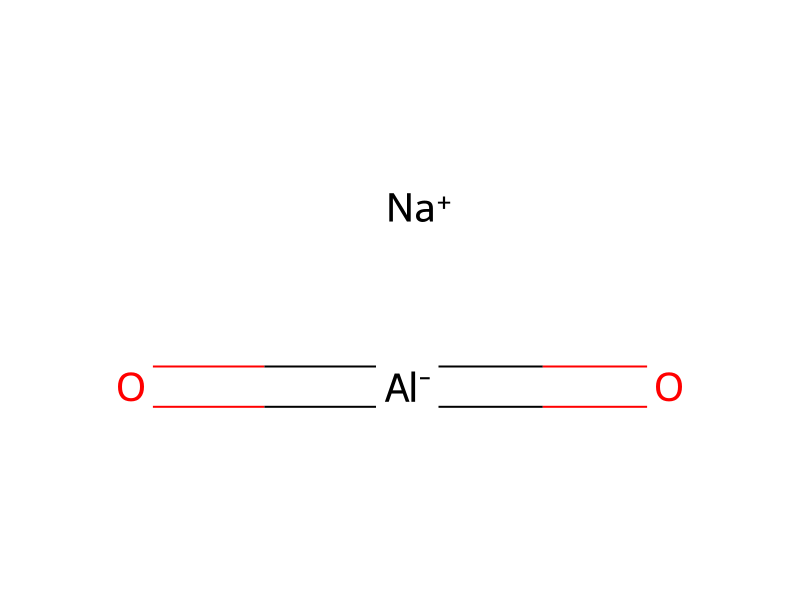
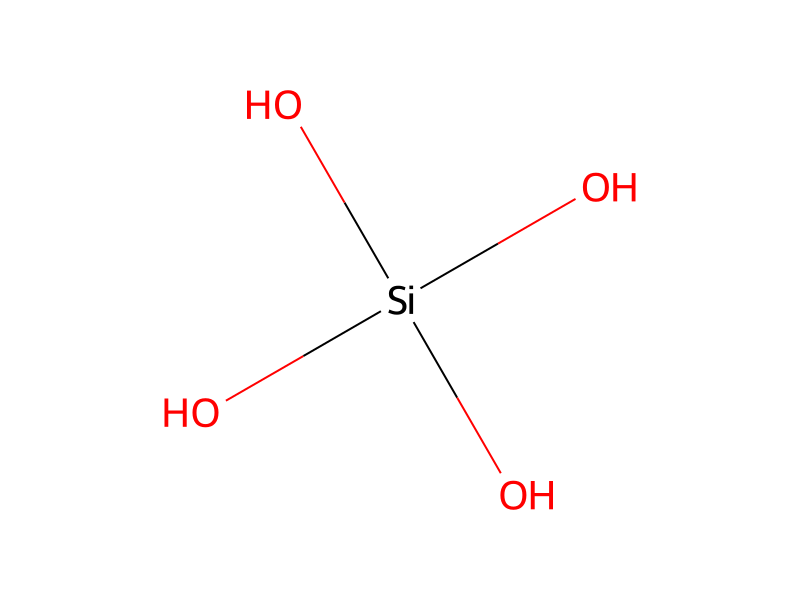
[Si:1](O)([OH:4])([OH:3])[OH:2].[Si:6]([O-])([O-:9])([O-:8])[O-:7].[Na+:11].[Na+].[Na+].[Na+].[H][H].O=[Al-:18]=O.[Na+]>O>[O-:3][Si:1]([O-:4])=[O:2].[O-:8][Si:6]([O-:9])=[O:7].[Na+:11].[Al+3:18]Participants
Reactant 4


Product 1

Reagents, catalysts & solvents 1

Conditions
- Temperature
- 92.5 °C
Procedure
A sol of an amorphous sodium aluminosilicate was prepared as follows. A heel of 1.5 liters of water was heated to reflux. Two feed solutions were added to the heel over a six hour period while maintaining the temperature at 90-95 degrees C. with vigorous agitation. The first feed solution was 1.2 liters of a 2% silicic acid prepared from a sodium silicate solution diluted to 2 percent SiO2 content and passed through a cation exchange resin in the hydrogen form. The second feed solution was 1.2 liters of a sodium aluminate solution prepared by dissolving 42 g of sodium aluminate in distilled water and diluting. The resulting sodium aluminate sol was deionized and concentrated but had a flocculated appearance. The sol was deaggregated by passing the sol through a cation exchange resin in the hydrogen form followed by an anion exchange resin to give a clear-translucent dispersion of the sol. The particle size was measured by transmission electron microscopy to be about 15 nanometers and the solids were found to be 0.72 percent by weight. The sol performed very effectively as a microparticle in a retention and drainage aid system. The performance was equal to that of bentonite.
Workup
- additionTwo feed solutions were added to the heel over a six hour period
- customprepared
- additiondiluting
- concentrationconcentrated
- customto give a clear-translucent dispersion of the sol. The particle size
Sources & evidence
- ORD record
- ord-74f266f4189446ba934f7597dda6da8c
- Source dataset
- uspto-grants-2001_02
- Patent number
- US06193844B1
Linked notes
Loading…