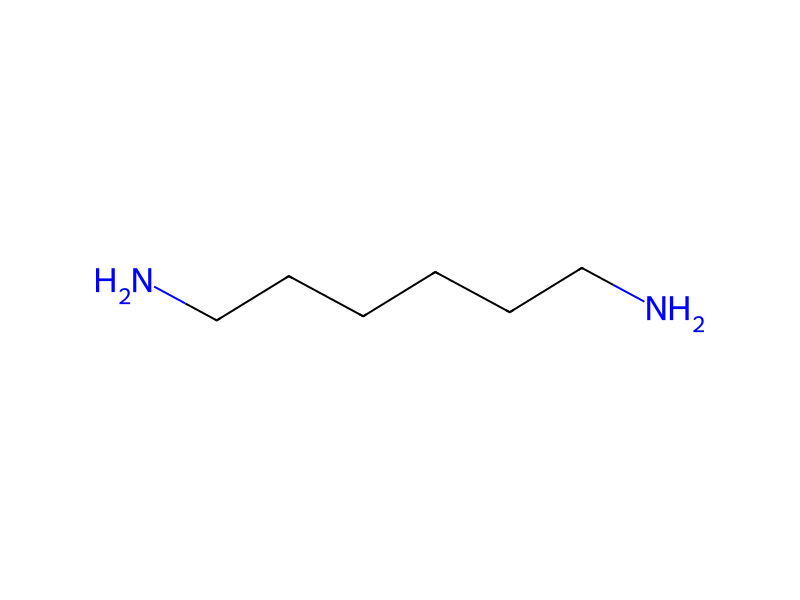
Hexamethylenediamine → 1,6-Diaminohexane 1,4-butanedisulfonyl chloride
HRID 636782
Reaction equation

[CH2:1]([S:9]([Cl:12])(=[O:11])=[O:10])[CH2:2][CH2:3][CH2:4][S:5]([Cl:8])(=[O:7])=[O:6].[NH2:13][CH2:14][CH2:15][CH2:16][CH2:17][CH2:18][CH2:19][NH2:20]>>[NH2:13][CH2:14][CH2:15][CH2:16][CH2:17][CH2:18][CH2:19][NH2:20].[CH2:1]([S:9]([Cl:12])(=[O:10])=[O:11])[CH2:2][CH2:3][CH2:4][S:5]([Cl:8])(=[O:7])=[O:6]Participants
3


Procedure
The base particles, along with helium gas, were cooled and introduced through the particle intake 4 into the vapor atmosphere of 1,4-butanedisulfonyl chloride in the condensing chamber 26. Next, in the mixing section 22, the vapor of 1,4-butanedisulfonyl chloride was cooled, and the introduced base particles were exposed thereto for 5 minutes. Consequently, a polymerization reaction took place on the surface of the base particles between 1,6-diaminohexane and 1,4-butanedisulfonyl chloride, forming a film of 1,6-diaminohexane-1,4-butanedisulfonyl chloride co-polymer.
Workup
- temperature