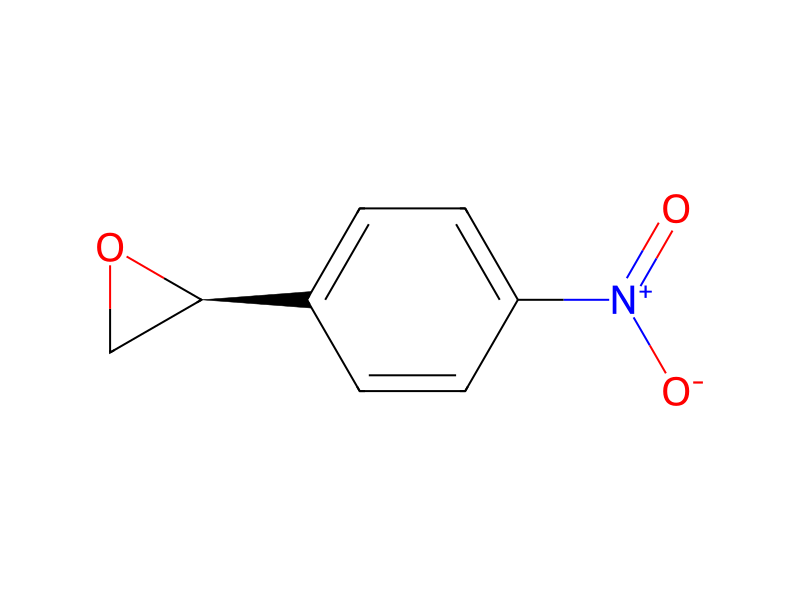
Sodium Azide → (S)-2-(4-Nitrophenyl)oxirane
Reaction equation

[N+:1]([C:4]1[CH:12]=[CH:11][C:7]([CH:8]2[O:10][CH2:9]2)=[CH:6][CH:5]=1)([O-:3])=[O:2].[N-]=[N+]=[N-].[Na+]>>[N+:1]([C:4]1[CH:12]=[CH:11][C:7]([C@@H:8]2[O:10][CH2:9]2)=[CH:6][CH:5]=1)([O-:3])=[O:2]Participants
3


Procedure
To 1 ml of Tris-SO4 buffer (50 mM, pH=7.3) containing 0.25 mM of para-nitro styrene oxide and 0.5 mM of NaN3, 0.7 mg of purified enzyme, obtained according to Example 1, was added. The reaction was stopped after 15 min and the solution was extracted with diethylether. The organic phase was analysed by chiral HPLC. The remaining (S)-para-nitro styrene oxide was obtained with an e.e. >99% and the product (R)-2-azido-1-(para-nitro-phenyl)-ethanol with an e.e. of 96%. The other regio-isomer 2-azido-2-(para-nitro-phenyl)-ethanol was formed in a ratio of 1:217 compared to (R)-2-azido-1-(para-nitro-phenyl)-ethanol. From this we concluded that the enzymatic azidolysis is almost absolutely regioselective (β selectivity>99%). The observed lower regioselectivity during a kinetic resolution on a longer time scale was due to the unwanted chemical side reaction.