Reaction equation

[CH3:1][N+:2]([CH2:5][CH:6]([OH:11])[CH2:7][C:8]([O-:10])=[O:9])([CH3:4])[CH3:3].C([C@@](C(O)=O)(O)[C@@](C(=O)C1C=CC=CC=1)(O)C(O)=O)(=O)C1C=CC=CC=1>CO>[OH:11][C@@H:6]([CH2:7][C:8](=[O:9])[O-:10])[CH2:5][N+:2]([CH3:4])([CH3:1])[CH3:3].[OH:11][C@H:6]([CH2:7][C:8](=[O:9])[O-:10])[CH2:5][N+:2]([CH3:4])([CH3:1])[CH3:3]Participants
Reactant 2


Product 2
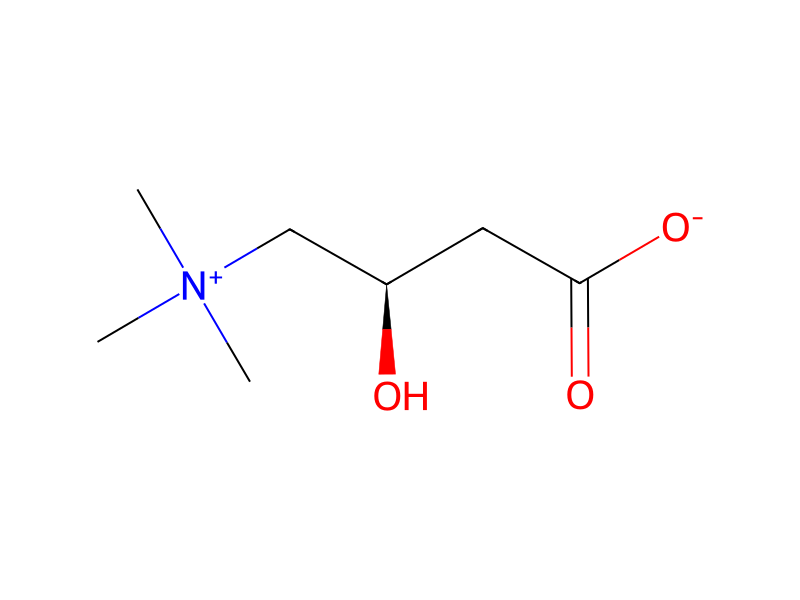
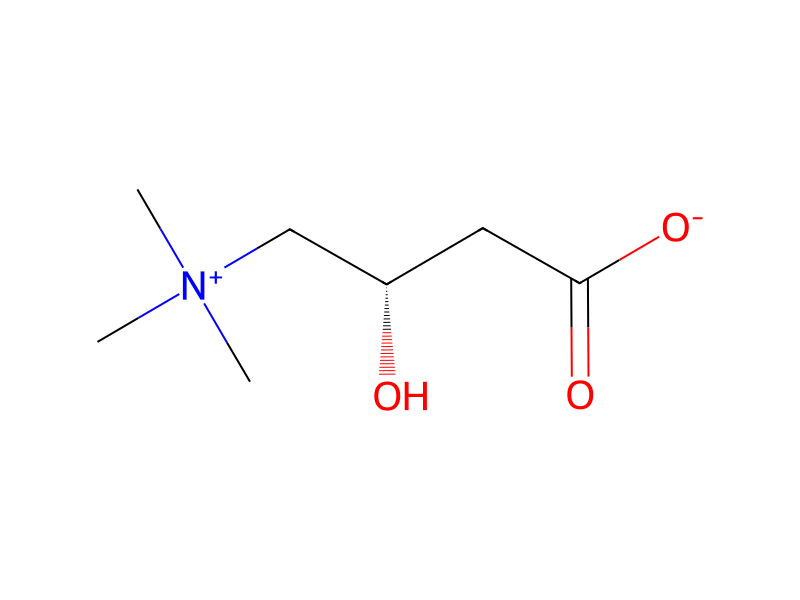
Reagents, catalysts & solvents 1

Procedure
A solution of 35.0 g (0.177 mole) of DL-carnitine hydrochloride in 300 ml of water is passed through OH type strongly basic resin (Dowex-1X8) and the solution is concentrated to give 28.0 g (0.173 mole) of DL-carnitine. To DL-carnitine are added 61.9 g (0.173 mole) of dibenzoyl-L(+)tartaric acid and 90 ml of methanol. The mixture is dissolved under heat to form dibenzoyl-L(+)tartarates of D-carnitine and L-carnitine. The tartarates are cooled from 60° C. to 5° C. over a period of 24 hours to fractionally crystallize L-carnitine dibenzoyl-L(+)tartarate. The tartarate is filtered and washed to give L-carnitine dibenzoyl-L(+)tartarate (yield 39.0 g, purity 92.7%). The tartarate obtained is dissolved under heat in 190 ml of ethanol, and cooled from 60° C. to 25° C. over a period of 24 hours. This recrystallization gives 21.5 g of crystals of L-carnitine dibenzoyl-L(+)tartarate. [α]D25 =-96.2° (c= 1, MeOH), m.p. 154° C. (dec.), purity 99.7%.
Workup
- dissolutionThe mixture is dissolved
- temperatureunder heat
Sources & evidence
- ORD record
- ord-ce23ee910bf44695a47a88639bbf4860
- Source dataset
- uspto-grants-1986_09
- Patent number
- US04610828
Linked notes
Loading…