HomeMCPWorkbenchSkills
HomeWorkbenchNotificationsMe
llms.txt · MCP GuidePrivacy Policy · Terms of Service · Supportv1.8.3
  1. Home
  2. /Reaction

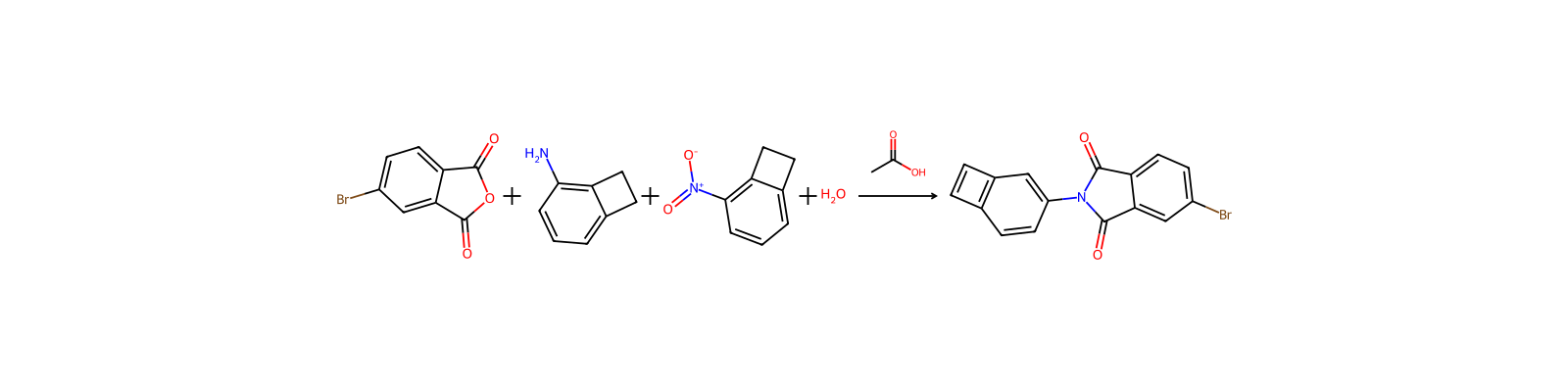
Water → N-4-benzocyclobutenyl 4-bromophthalimide

HRID 653166
Print

Reaction equation

HRID 653166 reaction equation
[Br:1][C:2]1[CH:3]=[C:4]2[C:9](=[O:10])[O:8][C:6](=O)[C:5]2=[CH:11][CH:12]=1.N[C:14]1[CH:21]=[CH:20][CH:19]=[C:16]2[CH2:17][CH2:18][C:15]=12.[N+:22](C1C=CC=C2CCC=12)([O-])=O.O>C(O)(=O)C>[CH:18]1[C:15]2[CH:14]=[CH:21][C:20]([N:22]3[C:9](=[O:10])[C:4]4=[CH:3][C:2]([Br:1])=[CH:12][CH:11]=[C:5]4[C:6]3=[O:8])=[CH:19][C:16]=2[CH:17]=1
ParticipantsProcedureWorkupSources & evidenceReaction notes

Participants

6

Reactant 4

HCID 962WaterHCID 665904-Bromophthalic anhydrideHCID 53748840HCID 53748840, compoundHCID 131715192HCID 131715192, compound

Product 1

HCID 20195685N-4-benzocyclobutenyl 4-bromophthalimide

Reagents, catalysts & solvents 1

HCID 176
Acetic Acid
Solvent

Procedure

A mixture of 4-bromophthalic anhydride (12.4 g, 54.6 mmoles) and 4-amino-benzocyclobutene (6.5 g., 54.5 mmoles), freshly prepared from the catalytic hydrogenation of 4-nitro-benzocyclobutene, were gently refluxed in glacial acetic acid (120 ml) under nitrogen atmosphere for about 17 hrs. The resultant dark but homogeneous reaction mixture was allowed to cool to room temperature under N2 and then poured into approximately 750 ml of H2O. Precipitation of gray solid immediately took place. Then, about 200 ml of CH2Cl2 was added to the mixture to deliver a two-phase, homogeneous solution. Subsequently, the CH2Cl2 layer was separated and the aqueous layer was extracted further with CH2Cl2 (2×50 ml). The combined CH2Cl2 extract was first concentracted to about 100 ml and then passed through a chromotography column (internal diameter, 2 cm., approximately 110 g silica gel, saturated with hexane). Elution of the column with hexane led to the isolations of the desired product, which crystallized out as beige microcrystals upon rotary evaporation. The product was collected, washed with hexane and dried in vacuo at 75° C. overnight. Yield: 11.7 g (65.4%, based on 4-aminobenzocyclobutene). M.P.=167°-168° C. Calculate for C16H10BrNO2 : 58.56% C; 3.07% H; 4.27% N; 24.35% Br. Found: 58.03% C; 3.20% H; 4.20% N; 24.26% Br. Mass spectroscopy: 327,329 (31.24%, 35.51%, M+). Proton nmr (δ values in ppm): 3.24 (singlet; benzocyclobutenyl aliphatic protons, 4); 7.17, 8.06 (complex; aromatic protons, 6H). IR (KBr; in cm-1) 2990 vw, 2975 w (aliphatic C--H stretches); 1775 m, 1718 vs (imide linkage stretches).

Workup

  1. customPrecipitation of gray solid immediately took place
  2. additionThen, about 200 ml of CH2Cl2 was added to the mixture
  3. customSubsequently, the CH2Cl2 layer was separated
  4. extractionthe aqueous layer was extracted further with CH2Cl2 (2×50 ml)
  5. extractionThe combined CH2Cl2 extract
  6. washElution of the column with hexane
  7. customcrystallized out as beige microcrystals upon rotary evaporation
  8. customThe product was collected
  9. washwashed with hexane
  10. customdried in vacuo at 75° C. overnight

Sources & evidence

ORD record
ord-2a21e9cb719c41078b70a063f9488e8c
Source dataset
uspto-grants-1987_06
DOI
10.6084/m9.figshare.5104873.v1
Patent number
US04675370

Reaction notes

On this pageParticipantsProcedureWorkupSources & evidenceReaction notes
