Reaction equation

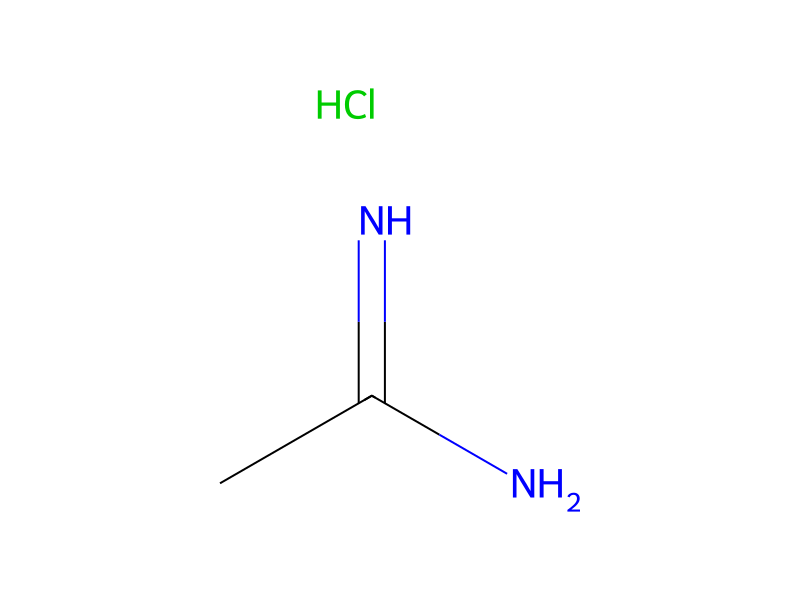
Cl.[C:2]([NH2:5])(=[NH:4])[CH3:3].[OH-].[Na+].[CH:8]([S:16](Cl)(=[O:18])=[O:17])=[CH:9][C:10]1[CH:15]=[CH:14][CH:13]=[CH:12][CH:11]=1>CC(C)=O>[CH:8]([S:16]([NH:4][C:2](=[NH:5])[CH3:3])(=[O:18])=[O:17])=[CH:9][C:10]1[CH:15]=[CH:14][CH:13]=[CH:12][CH:11]=1Participants
Reactant 3


Product 1

Reagents, catalysts & solvents 1

Procedure
A mixture of acetamidine hydrochloride (28.8 g., 0.15 mole) and 50% sodium hydroxide (12.0 g., 0.15 mole) in 150 ml. of acetone is stirred for a period of 10 min. to liberate the free base. A solution of styrylsulfonyl chloride (10.1 g., 0.05 mole) in 50 ml. of acetone is added dropwise to the mixture at a temperature of 20°-25° C. with stirring. After further stirring for 10 min., the mixture is concentrated under reduced pressure to remove acetone, the concentrate diluted with 200 ml. of water and acidified with 3N hydrochloric acid to provide a precipitate. The precipitate is collected, dissolved in chloroform and the chloroform extract dried. Evaporation of the chloroform solvent under reduced pressure provides a white solid, m.p. 130°-134° C. which is crystallized from isopropyl acetate affording 8.5 g. (76% yield) of N-(STYRYLSULFONYL)ACETAMIDINE, m.p. 134.5°-137.0° C. (corr.).
Workup
- stirringAfter further stirring for 10 min.
- concentrationthe mixture is concentrated under reduced pressure
- customto remove acetone
- additionthe concentrate diluted with 200 ml
- customto provide a precipitate
- customThe precipitate is collected
- dissolutiondissolved in chloroform
- extractionthe chloroform extract
- customdried
- customEvaporation of the chloroform solvent under reduced pressure
- customprovides a white solid, m.p. 130°-134° C. which
- customis crystallized from isopropyl acetate affording 8.5 g
Sources & evidence
- ORD record
- ord-aa709b6c2bbc49e9bec13499010138ec
- Source dataset
- uspto-grants-1978_12
- Patent number
- US04130663
Linked notes
Loading…