HuagongsheHuagongshe Chemistry Print Report · For research reference only
HRID 6813Generated: October 23, 2026
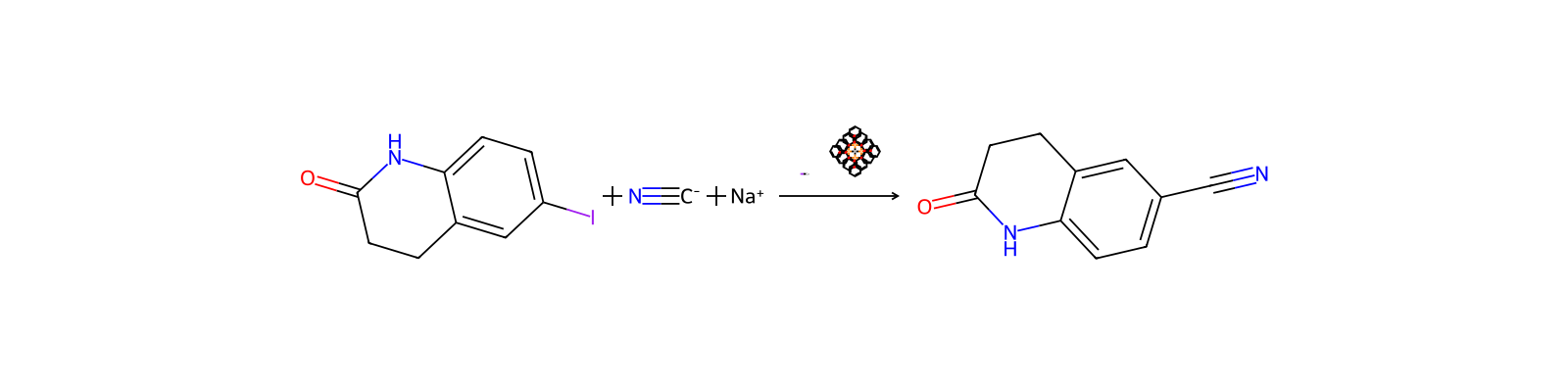
Sodium Cyanide → 2-Oxo-1,2,3,4-tetrahydroquinoline-6-carbonitrile
https://huagongshe.com/en/reaction/6813
Participants
| Role | Name | HCID | Charge |
|---|
| Reactant | Sodium Cyanide | HCID 8929 | — |
| Reactant | 6-Iodo-3,4-dihydroquinolin-2(1H)-one | HCID 22018951 | — |
| Catalyst | Copper(1+) iodide; Copper(I) iodide; Cuprous iodide; Cuprous iodide (CuI) | HCID 24350 | — |
| Catalyst | HCID 178418397 | HCID 178418397 | — |
| Product | 2-Oxo-1,2,3,4-tetrahydroquinoline-6-carbonitrile | HCID 15270576 | — |
Reaction Steps
6-Iodo-3,4-dihydroquinolin-2(1H)-one (1.50 g; 5.50 mmol), sodium cyanide (0.54 g; 11.0 mmol), copper (I) iodide (0.105 g; 0.5 mmol) and tetrakis(triphenylphosphine)palladium(0) (0.32 g; 0.3 mmol) were combined in a flask equipped with a reflux condenser. The flask was subjected to several evacuation-nitrogen purge cycles followed by the addition of acetonitrile (25 mL). The reaction was heated to reflux for 5 hours. After cooling, the reaction was diluted with ethyl acetate (200 mL), filtered through CELITE diatomaceous earth and rinsed with copious amounts of ethyl acetate. The organic solution was washed twice with brine (50 mL), dried over sodium sulfate, filtered through a fritted funnel, and the volatiles were removed under vacuum. The crude residue was crystallized from methanol, which afforded the title compound.
Provenance & Evidence
| DOI | 10.6084/m9.figshare.5104873.v1 |
|---|
| Patent number | US07084156B2 |
|---|
| Source dataset | uspto-grants-2006_08 |
|---|
| ORD ID | ord-dc386eeb65804bc3a3674cae524f7269 |
|---|
| Source note | uspto-grants-2006_08 |
|---|