HuagongsheHuagongshe Chemistry Print Report · For research reference only
HRID 710Generated: October 23, 2026
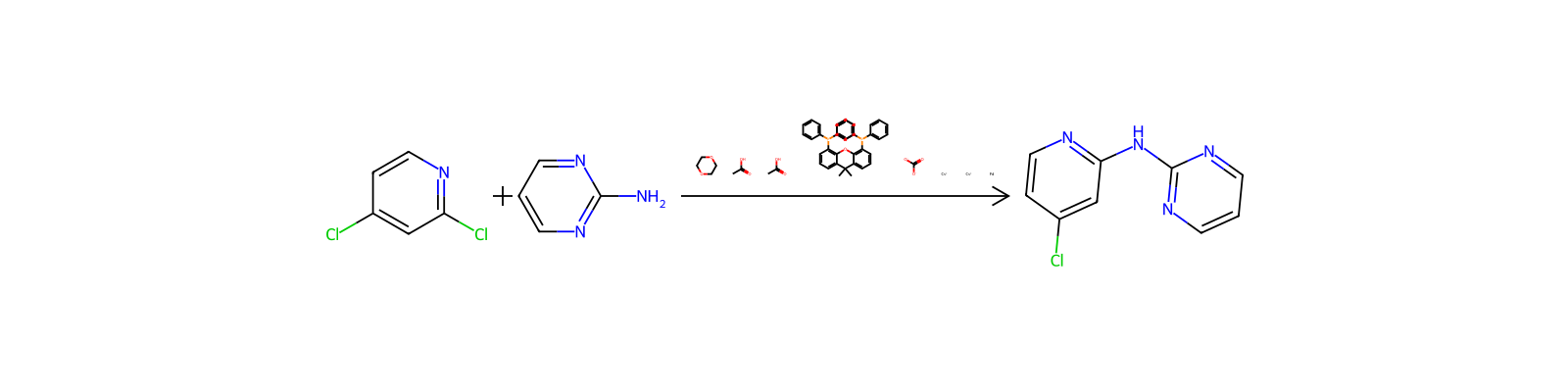
2-Aminopyrimidine → N-(4-chloro-2-pyridinyl)pyrimidin-2-amine
https://huagongshe.com/en/reaction/710
Participants
| Role | Name | HCID | Charge |
|---|
| Reactant | 2-Aminopyrimidine | HCID 7978 | — |
| Reactant | 2,4-Dichloropyridine | HCID 33515 | — |
| Reagent | Cesium carbonate | HCID 10796 | — |
| Catalyst | 1,1'-(9,9-Dimethyl-9H-xanthene-4,5-diyl)bis(1,1-diphenylphosphine) | HCID 636044 | — |
| Catalyst | Palladium (II) acetate | HCID 4144353 | — |
| Solvent | 1,4-Dioxane | HCID 31275 | — |
| Product | N-(4-chloro-2-pyridinyl)pyrimidin-2-amine | HCID 118249159 | 55.35% |
Reaction Steps
Palladium(II) acetate (0.607 g, 2.70 mmol) was added to 2,4-dichloropyridine (5.00 g, 33.79 mmol), 2-Aminopyrimidine (3.21 g, 33.79 mmol), 9,9-Dimethyl-4,5-bis(diphenylphosphino)xanthene (2.346 g, 4.05 mmol) and Cesium carbonate (22.02 g, 67.57 mmol) in dioxane (15 mL) at 20ºC under nitrogen. The resulting suspension was stirred at 100 °C for 90 minutes. Complete reaction by LCMS, cooled to room temperature. The reaction mixture was then filtered, washed with DCM and filtrate concentrated _in vacuo_ to give a yellow gum. This was then dissolved in DCM (200 mL), washed with water (200 mL) and brine (200 mL). The organic layer was passed through phase separating cartridge and concentrated under reduced pressure. The crude material was suspended in DCM, solid filtered off and dried to give EN01580-46-2 N-(4-chloropyridin-2-yl)pyrimidin-2-amine (2.975 g, 42.6 %). The filtrate was purified by silica gel chromatography, elution gradient 0 to 50% EtOAc in isohexane. Pure fractions were evaporated to dryness to afford EN01580-46-1, N-(4-chloropyridin-2-yl)pyrimidin-2-amine (0.889 g, 12.73 %) as a white solid.
Provenance & Evidence
| Source dataset | 750 AstraZeneca ELN dataset |
|---|
| ORD ID | ord-89c8603d021344778ef0d6ba16c5f635 |
|---|
| Source note | 750 AstraZeneca ELN dataset |
|---|