HuagongsheHuagongshe Chemistry Print Report · For research reference only
HRID 7145Generated: October 23, 2026
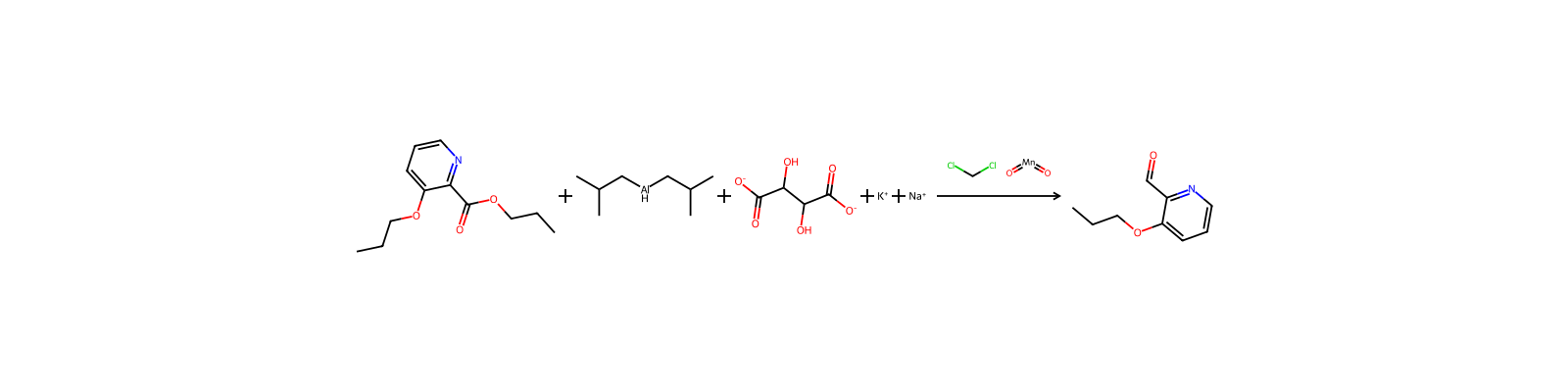
Diisobutylaluminum hydride → 3-Propoxypicolinaldehyde
https://huagongshe.com/en/reaction/7145
Participants
| Role | Name | HCID | Charge |
|---|
| Reactant | Diisobutylaluminum hydride | HCID 14487 | — |
| Reactant | Potassium sodium tartarate | HCID 9855836 | — |
| Reactant | Propyl 3-Propoxypyridine-2-carboxylate | HCID 19756120 | — |
| Catalyst | Manganese dioxide | HCID 14801 | — |
| Solvent | Dichloromethane | HCID 6344 | — |
| Product | 3-Propoxypicolinaldehyde | HCID 22018851 | 113.5% |
Reaction Steps
To a stirred solution of 3-n-propoxypicolinic acid n-propyl ester (0.1209 g, 0.541 mmol) in dry CH2Cl2 (5 mL) at −78° C. was added DIBAL-H (1.0 M, 2.5 mL, 2.5 mmol). The mixture was stirred at −78° C. for 1 hr, then at room temperature for 3 hrs. The mixture was poured into saturated aqueous sodium potassium tartrate (15 mL), diluted with CH2Cl2 (15 mL) and stirred vigorously for 65 hrs. The phases were separated and the aqueous phase extracted with CH2Cl2 (3×20 mL). The combined organic phases were dried (Na2SO4) and concentrated to give a yellow oil. The yellow oil was dissolved in CH2Cl2 (5 mL) and treated with MnO2 (˜85%, 0.4549 g, 4.45 mmol). The mixture was stirred for 19 hrs then filtered through celite. The filtrate was concentrated to give 0.1014 g of 3-n-propoxypyridine-2-carboxaldehyde as an orange oil. 1H NMR (CDCl3) d 1.09 (t, 3H, J=7.4 Hz), 1.91 (sextet, 2H, J=7.1 Hz), 4.07 (t, 2H, J=6.6 Hz), 7.38–7.47 (m, 2H), 8.39 (dd, 2H, J=4.4, 1.4 Hz), 10.43 (s, 1H).
Provenance & Evidence
| DOI | 10.6084/m9.figshare.5104873.v1 |
|---|
| Patent number | US07084155B2 |
|---|
| Source dataset | uspto-grants-2006_08 |
|---|
| ORD ID | ord-41a445326c2b4979809438ee5d7e9725 |
|---|
| Source note | uspto-grants-2006_08 |
|---|