HuagongsheHuagongshe Chemistry Print Report · For research reference only
HRID 7196Generated: October 25, 2026
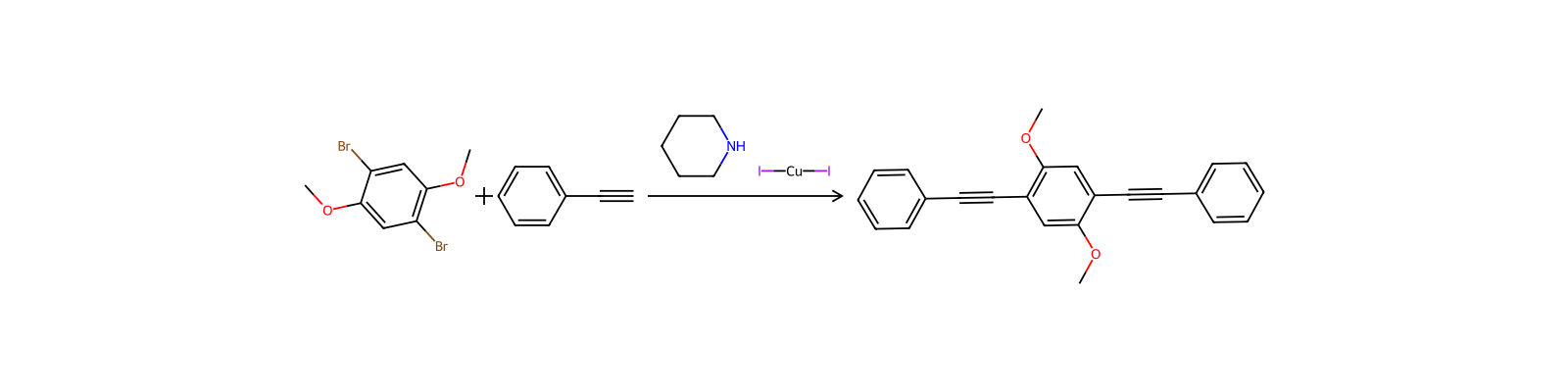
Phenylacetylene → 1,4-Bis(phenylethynyl)-2,5-dimethoxybenzene
https://huagongshe.com/reaction/7196
Participants
| Role | Name | HCID | Charge |
|---|
| Reactant | Phenylacetylene | HCID 10821 | — |
| Reactant | 1,4-Dibromo-2,5-dimethoxybenzene | HCID 231240 | — |
| Catalyst | Copper iodide | HCID 83717 | — |
| Solvent | Piperidine | HCID 8082 | — |
| Product | 1,4-Bis(phenylethynyl)-2,5-dimethoxybenzene | HCID 12660477 | 75.7% |
Reaction Steps
50 g (160 mmol) of 1,4-dibromo-2,5-dimethoxy benzene, 3.6 g (0.005 mol) of bistriphenylphosphine palladium dichloride and 0.97 g (0.005 mol) of copper iodide were put into a 1 litter 3-neck flask equipped with a stirrer, a thermometer and a reflux condenser under an argon atmosphere, and dissolved in 500 ml of piperidine. 43 g (0.422 mol) of phenylacetylene was then slowly added dropwise at room temperature. The reaction temperature was slowly raised to 80° C. and then the reaction mixture was stirred at the same temperature for 12 hours. When the reaction was completed, the reaction mixture was cooled down to room temperature, and then generated salt was filtered off. The solvent was removed under a reduced pressure, and then the residue was extracted with methylene chloride. Organic layer was washed with water several times and dried with anhydrous magnesium sulfate, and then the solvent was removed to obtain yellow solid. This solid was recrystallized from ethyl acetate to obtain yellow crystal, which was sufficiently dried in a vacuum oven at 40° C. to give 41 g (yield: 72%) of the desired product, and its melting point was 172° C.–174° C.
Provenance & Evidence
| DOI | 10.6084/m9.figshare.5104873.v1 |
|---|
| Patent number | US07084231B2 |
|---|
| Source dataset | uspto-grants-2006_08 |
|---|
| ORD ID | ord-69e50f4a0a4148ad88f1efb062fdfe32 |
|---|
| Source note | uspto-grants-2006_08 |
|---|