Reaction equation
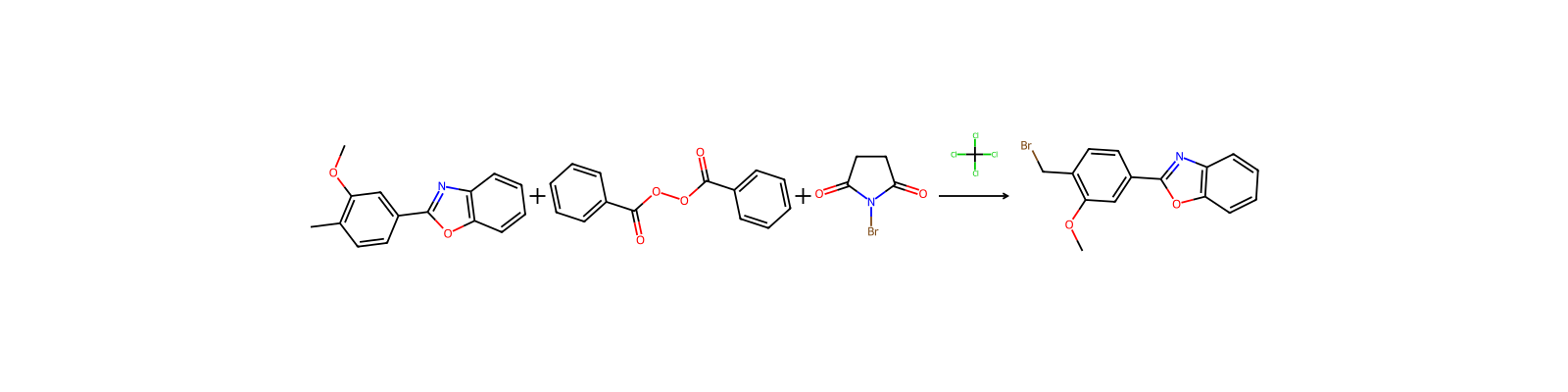
[CH3:1][O:2][C:3]1[CH:4]=[C:5]([C:10]2[O:11][C:12]3[CH:18]=[CH:17][CH:16]=[CH:15][C:13]=3[N:14]=2)[CH:6]=[CH:7][C:8]=1[CH3:9].C(OOC(=O)C1C=CC=CC=1)(=O)C1C=CC=CC=1.[Br:37]N1C(=O)CCC1=O>C(Cl)(Cl)(Cl)Cl>[Br:37][CH2:9][C:8]1[CH:7]=[CH:6][C:5]([C:10]2[O:11][C:12]3[CH:18]=[CH:17][CH:16]=[CH:15][C:13]=3[N:14]=2)=[CH:4][C:3]=1[O:2][CH3:1]Participants
5



Procedure
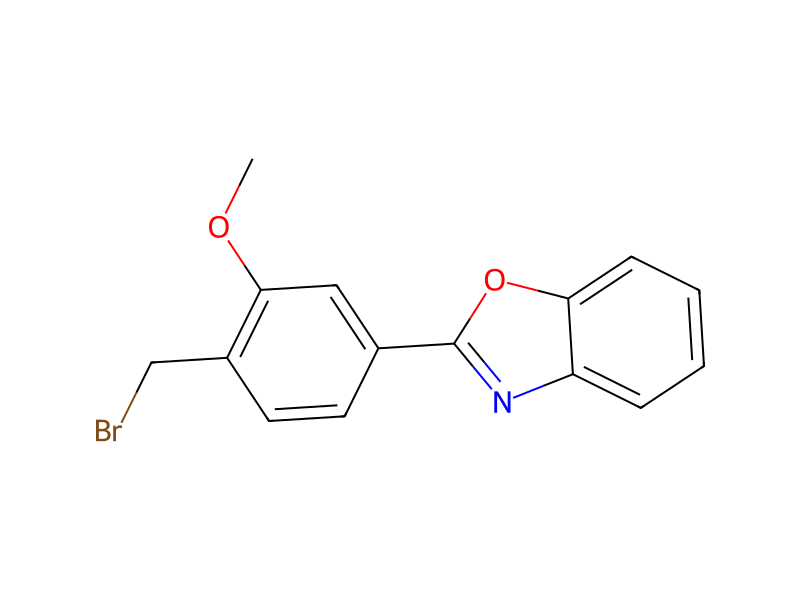
2-(3-Methoxy-4-methylphenyl)-1,3-benzoxazole (1.0 g, 4.1 mmol), carbon tetrachloride (18 mL), benzoyl peroxide (66 mg, 0.3 mmol) and N-bromosuccinimide (970 mg, 5.4 mmol) was heated to reflux conditions under argon and placed under a UV light. After one hour, no starting material was observed by TLC. After cooling mixture to rt, filtered, washing with dichoromethane. After concentrating filtrate in vacuo, the resulting colorless solid was purified by flash chromatography, using a gradient elution of 1:4 EtOAc:hexanes to EtOAc. This afforded the desired intermediate, 2-[4-(bromomethyl)-3-methoxyphenyl]-1,3-benzoxazole, as a colorless solid.
Workup
- temperatureto reflux conditions under argon
- filtrationfiltered
- washwashing with dichoromethane
- concentrationAfter concentrating filtrate in vacuo
- customthe resulting colorless solid was purified by flash chromatography
- washa gradient elution of 1:4 EtOAc
Sources & evidence
- ORD record
- ord-a804c7f51ce54084918ff23496b95166
- Source dataset
- uspto-grants-2006_08
- Patent number
- US07087601B2
Linked notes
Loading…