Reaction equation

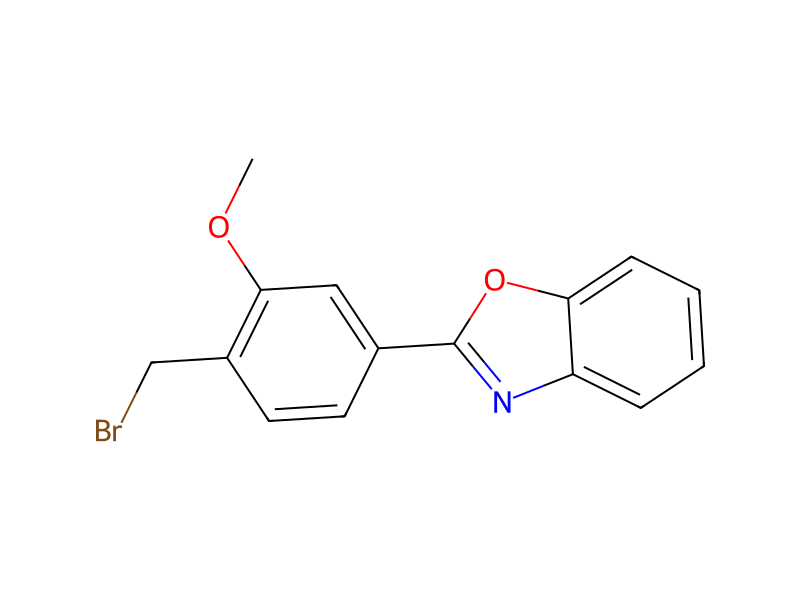
[CH3:1][O:2][C:3]1[CH:4]=[C:5]([C:10]2[O:11][C:12]3[CH:18]=[CH:17][CH:16]=[CH:15][C:13]=3[N:14]=2)[CH:6]=[CH:7][C:8]=1[CH3:9].C(OOC(=O)C1C=CC=CC=1)(=O)C1C=CC=CC=1.[Br:37]N1C(=O)CCC1=O>C(Cl)(Cl)(Cl)Cl>[Br:37][CH2:9][C:8]1[CH:7]=[CH:6][C:5]([C:10]2[O:11][C:12]3[CH:18]=[CH:17][CH:16]=[CH:15][C:13]=3[N:14]=2)=[CH:4][C:3]=1[O:2][CH3:1]Participants
5



Procedure
2-(3-Methoxy-4-methylphenyl)-1,3-benzoxazole (1.0 g, 4.1 mmol), carbon tetrachloride (18 mL), benzoyl peroxide (66 mg, 0.3 mmol) and N-bromosuccinimide (970 mg, 5.4 mmol) was heated to reflux conditions under argon and placed under a UV light. After 1 h, no starting material was observed by TLC. After cooling mixture to rt, filtered, washing with dichoromethane. After concentrating filtrate in vacuo, the resulting colorless solid was purified by flash chromatography, using a gradient elution of 1:4 EtOAc:hexanes to EtOAc. This afforded the desired intermediate, 2-[4-(bromomethyl)-3-methoxyphenyl]-1,3-benzoxazole, as a colorless solid.
Workup
- temperatureto reflux conditions under argon
- filtrationfiltered
- washwashing with dichoromethane
- concentrationAfter concentrating filtrate in vacuo
- customthe resulting colorless solid was purified by flash chromatography
- washa gradient elution of 1:4 EtOAc
Sources & evidence
- ORD record
- ord-7b5dc4ac04c6402099cfcfbd4e02fa1a
- Source dataset
- uspto-grants-2006_08
- Patent number
- US07087601B2
Linked notes
Loading…