Reaction equation
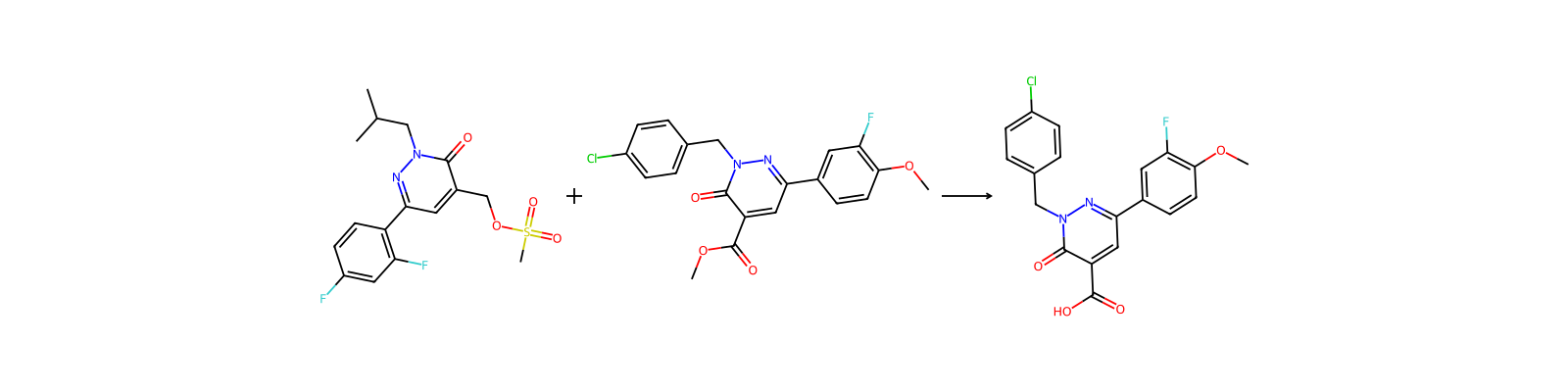
FC1C=C(F)C=CC=1C1C=C(COS(C)(=O)=O)C(=O)N(CC(C)C)N=1.[Cl:26][C:27]1[CH:53]=[CH:52][C:30]([CH2:31][N:32]2[C:37](=[O:38])[C:36]([C:39]([O:41]C)=[O:40])=[CH:35][C:34]([C:43]3[CH:48]=[CH:47][C:46]([O:49][CH3:50])=[C:45]([F:51])[CH:44]=3)=[N:33]2)=[CH:29][CH:28]=1>>[C:39]([C:36]1[C:37](=[O:38])[N:32]([CH2:31][C:30]2[CH:29]=[CH:28][C:27]([Cl:26])=[CH:53][CH:52]=2)[N:33]=[C:34]([C:43]2[CH:48]=[CH:47][C:46]([O:49][CH3:50])=[C:45]([F:51])[CH:44]=2)[CH:35]=1)([OH:41])=[O:40]Participants
3
Reactant 2


Product 1

Procedure
Following the procedure of Example 1 (7), 2-(4-chlorobenzyl)-6-(3-fluoro-4-methoxyphenyl)-4-methoxycarbonyl-2H-pyridazin-3-one was reacted to yield the title compound as a pale yellow crystalline powder (yield: 96.0%).
Workup
- customwas reacted
Sources & evidence
- ORD record
- ord-d6d1219af12d4e5e8426d879ab02395b
- Source dataset
- uspto-grants-2006_08
- Patent number
- US07087606B2
Linked notes
Loading…