Reaction equation
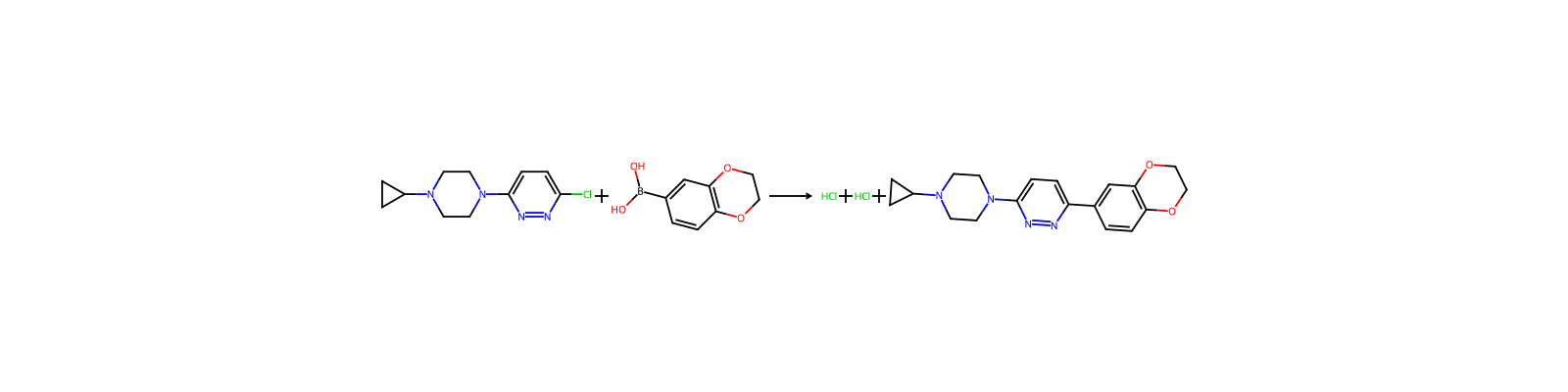
[Cl:1][C:2]1[N:3]=[N:4][C:5]([N:8]2[CH2:13][CH2:12][N:11]([CH:14]3[CH2:16][CH2:15]3)[CH2:10][CH2:9]2)=[CH:6][CH:7]=1.[O:17]1[C:22]2[CH:23]=[CH:24][C:25](B(O)O)=[CH:26][C:21]=2[O:20][CH2:19][CH2:18]1>>[ClH:1].[ClH:1].[CH:14]1([N:11]2[CH2:12][CH2:13][N:8]([C:5]3[N:4]=[N:3][C:2]([C:25]4[CH:24]=[CH:23][C:22]5[O:17][CH2:18][CH2:19][O:20][C:21]=5[CH:26]=4)=[CH:7][CH:6]=3)[CH2:9][CH2:10]2)[CH2:16][CH2:15]1Participants
3


Procedure
The title compound was prepared by a similar procedure to that described in Example 68, starting from 3-chloro-6-(4-cyclopropyl-piperazin-1-yl)-pyridazine and 1,4-benzodioxane-6-boronic acid. 1H NMR (400 MHz, DMSO-d6) δ 8.38 (d, 1H), 7.95 (d, 1H), 7.63 (m, 1H), 7.58 (m, 1H), 7.05 (d, 1H), 4.57 (broad m, 2H), 4.32 (m, 4H), 3.63 (broad m, 4H), 3.39 (broad m, 2H), 2.88 (broad m, 1H), 1.23 (m, 2H), 0.82 (m, 2H).
Sources & evidence
- ORD record
- ord-e8a25d83d6734cd6bb157d13a96e3023
- Source dataset
- uspto-grants-2014_09
- Patent number
- US08846677B2
Linked notes
Loading…