HuagongsheHuagongshe Chemistry Print Report · For research reference only
HRID 8232Generated: October 25, 2026
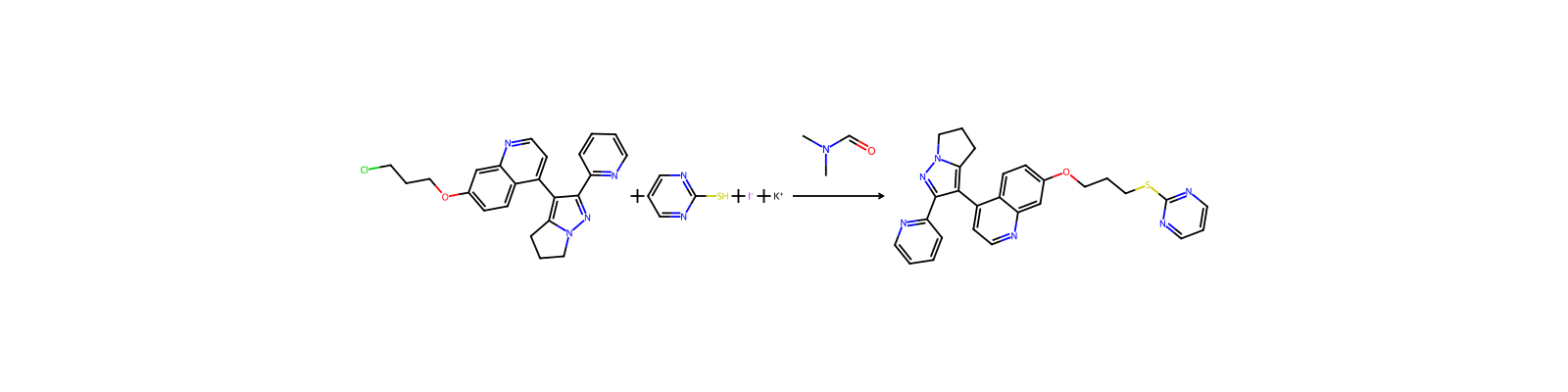
Potassium Iodide → 4-(2-Pyridin-2-yl-5,6-dihydro-4H-pyrrolo[1,2-b]pyrazol-3-yl)-7-[3-(pyrimidin-2-ylsulfanyl)-propoxy]-quinoline
https://huagongshe.com/reaction/8232
Participants
| Role | Name | HCID | Charge |
|---|
| Reactant | Potassium Iodide | HCID 4875 | — |
| Reactant | 7-(3-Chloro-propoxy)-4-(2-pyridin-2-yl-5,6-dihydro-4H-pyrrolo[1,2-b]pyrazol-3-yl)-quinoline | HCID 21992563 | — |
| Reactant | HCID 178418793 | HCID 178418793 | — |
| Solvent | Dimethylformamide | HCID 6228 | — |
| Product | 4-(2-Pyridin-2-yl-5,6-dihydro-4H-pyrrolo[1,2-b]pyrazol-3-yl)-7-[3-(pyrimidin-2-ylsulfanyl)-propoxy]-quinoline | HCID 21992620 | 76% |
Reaction Steps
7-(3-Chloro-propoxy)-4-(2-pyridin-2-yl-5,6-dihydro-4H-pyrrolo[1,2-b]pyrazol-3-yl)-quinoline (0.060 g, 0.148 mmol), 2-mercaptopyrimidine (0.033 g, 0.296 mmol, 2.0 equiv) and potassium iodide (0.010 g, 0.120 mmol, 0.80 equiv) are combined in N,N-dimethylformamide (1.0 mL) and the reaction is heated at 60° C. for 72 h. The mixture is placed on a 10 g SCX resin column. The resin is washed sequentially with 9:1 dichloromethane: methanol (2×120 mL), 4:1 dichloromethane: methanol (2 N ammonia) (2×125 mL), and methanol (2 N ammonia) (125 mL). The ammonia washes are evaporated to dryness and the residue is subjected to chromatography on silica gel (20 g, 99:1 dichloromethane: methanol (2 N ammonia)) to yield 0.054 g (76%) of the desired product as a tan solid.
Provenance & Evidence
| DOI | 10.6084/m9.figshare.5104873.v1 |
|---|
| Patent number | US07087626B2 |
|---|
| Source dataset | uspto-grants-2006_08 |
|---|
| ORD ID | ord-b3764ff29850433d878043b9dcb90022 |
|---|
| Source note | uspto-grants-2006_08 |
|---|