Reaction equation
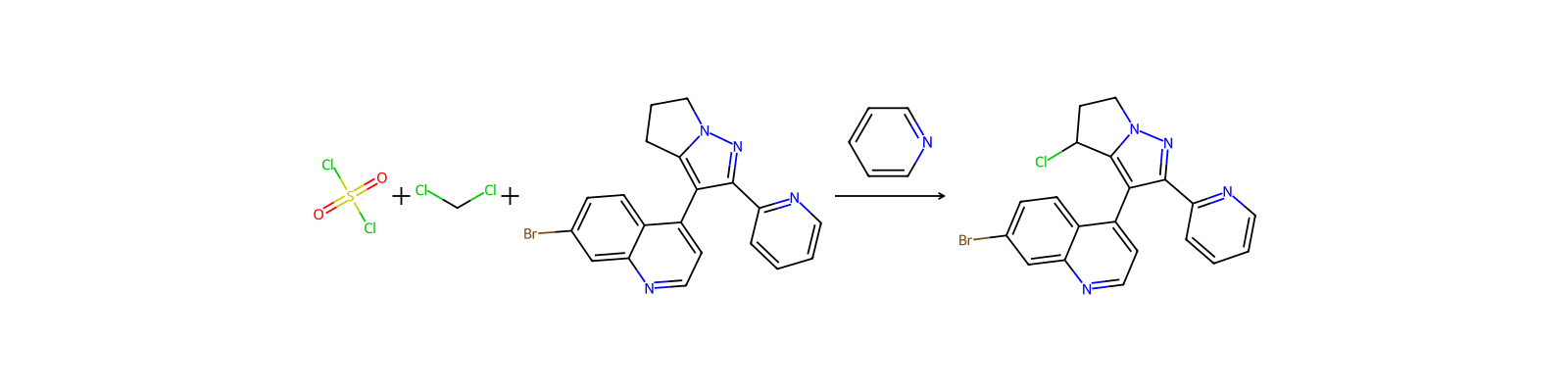
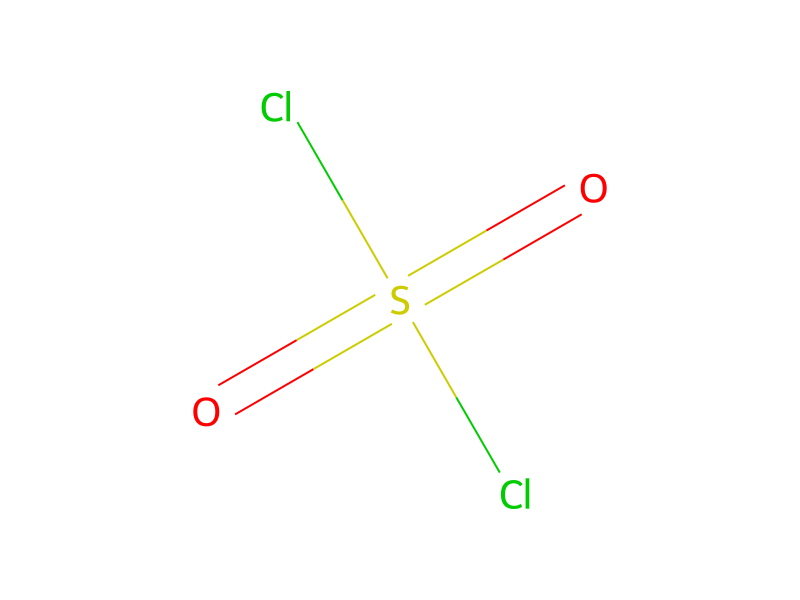
S(Cl)(Cl)(=O)=O.Cl[CH2:7][Cl:8].[Br:9][C:10]1[CH:19]=[C:18]2[C:13]([C:14]([C:20]3[C:24]([C:25]4[CH:30]=[CH:29][CH:28]=[CH:27][N:26]=4)=[N:23][N:22]4[CH2:31][CH2:32]C[C:21]=34)=[CH:15][CH:16]=[N:17]2)=[CH:12][CH:11]=1>N1C=CC=CC=1>[Br:9][C:10]1[CH:19]=[C:18]2[C:13]([C:14]([C:20]3[C:24]([C:25]4[CH:30]=[CH:29][CH:28]=[CH:27][N:26]=4)=[N:23][N:22]4[CH2:31][CH2:32][CH:7]([Cl:8])[C:21]=34)=[CH:15][CH:16]=[N:17]2)=[CH:12][CH:11]=1Participants
5
Reactant 3


Product 1

Reagents, catalysts & solvents 1

Procedure
A solution of 1 M sulfuryl chloride in dichloromethane (20 mL, 20 mmol) is added to a solution of 7-bromo-4-(2-pyridin-2-yl-5,6-dihydro-4H-pyrrolo[1,2-b]pyrazol-3-yl)-quinoline (2.2 g, 5.62 mmol) in dry pyridine (50 mL). The mixture is stirred for 18 h and concentrated in vacuo. The residue is partitioned between chloroform and saturated sodium chloride. The organic layer is dried (sodium sulfate), filtered, concentrated in vacuo, and the residue chromatographed on SiO2 (dichloromethane to 20% methanol in dichloromethane) to yield the title compound as a red solid, 1.8 g (75%).
Workup
- concentrationconcentrated in vacuo
- customThe residue is partitioned between chloroform and saturated sodium chloride
- dry with materialThe organic layer is dried (sodium sulfate)
- filtrationfiltered
- concentrationconcentrated in vacuo
- customthe residue chromatographed on SiO2 (dichloromethane to 20% methanol in dichloromethane)
Sources & evidence
- ORD record
- ord-5117de9338de4a369384dbd7fc1bb107
- Source dataset
- uspto-grants-2006_08
- Patent number
- US07087626B2
Linked notes
Loading…