HuagongsheHuagongshe Chemistry Print Report · For research reference only
HRID 83Generated: October 23, 2026
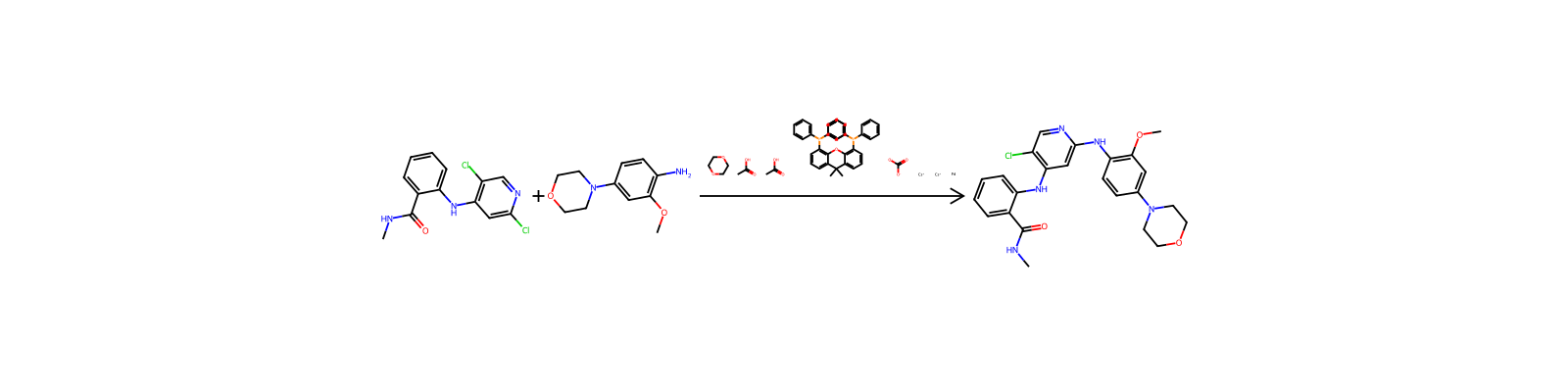
2-Methoxy-4-morpholinoaniline → 2-[[5-chloro-2-(2-methoxy-4-morpholin-4-ylanilino)-4-pyridinyl]amino]-N-methylbenzamide
https://huagongshe.com/en/reaction/83
Participants
| Role | Name | HCID | Charge |
|---|
| Reactant | 2-Methoxy-4-morpholinoaniline | HCID 414960 | — |
| Reactant | 2-[(2,5-Dichloro-4-pyridinyl)amino]-N-methylbenzamide | HCID 57516891 | — |
| Reagent | Cesium carbonate | HCID 10796 | — |
| Catalyst | 1,1'-(9,9-Dimethyl-9H-xanthene-4,5-diyl)bis(1,1-diphenylphosphine) | HCID 636044 | — |
| Catalyst | Palladium (II) acetate | HCID 4144353 | — |
| Solvent | 1,4-Dioxane | HCID 31275 | — |
| Product | 2-[[5-chloro-2-(2-methoxy-4-morpholin-4-ylanilino)-4-pyridinyl]amino]-N-methylbenzamide | HCID 44200209 | 81.43% |
Reaction Steps
2-methoxy-4-morpholinoaniline (158 mg, 0.76 mmol), 2-(2,5-dichloropyridin-4-ylamino)-N-methylbenzamide (150 mg, 0.51 mmol),diacetoxypalladium (5.69 mg, 0.03 mmol), (9,9-dimethyl-9H-xanthene-4,5-diyl)bis(diphenylphosphine) (29.3 mg, 0.05 mmol) and cesium carbonate (330 mg, 1.01 mmol) were weighed out in a microwave vial and sealed. dioxane (3 mL) was added and argon was let to bubble for 5 minutes at rt. The resulting mixture was stirred at 110 °C for 1 hour. The reaction mixture was allowed to cool to room temperature and concentrated in presence of decalite speed plus. The crude product was purified by flash chromatography on silica gel eluting with 0 to 4% methanol in ethyl acetate/DCM (1/1). The solvent was evaporated to dryness. The foam was triturated in terbutyl methyl ether and the resulting precipitate was collected by filtration and washed with tBuOMe to afford 2-(5-chloro-2-(2-methoxy-4-morpholinophenylamino)pyridin-4-ylamino)-N-methylbenzamide (193 mg, 81 %) as a pale pink solid.
Provenance & Evidence
| Source dataset | 750 AstraZeneca ELN dataset |
|---|
| ORD ID | ord-3d64643dd74a4d9290119a9c4f05506f |
|---|
| Source note | 750 AstraZeneca ELN dataset |
|---|