HomeMCPWorkbenchSkills
HomeWorkbenchNotificationsMe
llms.txt · MCP GuidePrivacy Policy · Terms of Service · Supportv1.8.3
  1. Home
  2. /Reaction

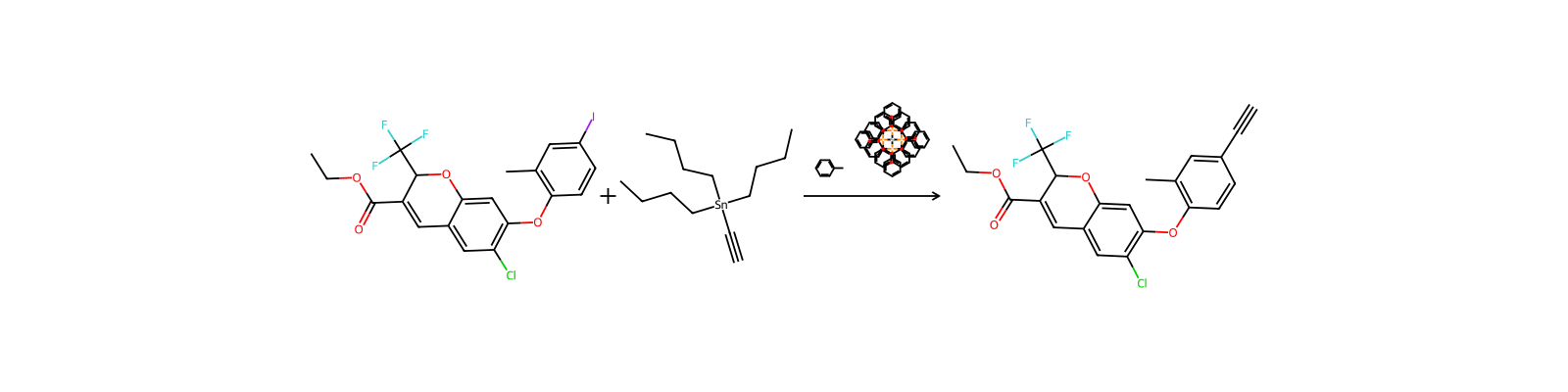
Ethynyltributyltin → ethyl 6-chloro-7-(4-ethynyl-2-methylphenoxy)-2-(trifluoromethyl)-2H-chromene-3-carboxylate

HRID 855010
Print

Reaction equation

HRID 855010 reaction equation
[Cl:1][C:2]1[CH:3]=[C:4]2[C:9](=[CH:10][C:11]=1[O:12][C:13]1[CH:18]=[CH:17][C:16](I)=[CH:15][C:14]=1[CH3:20])[O:8][CH:7]([C:21]([F:24])([F:23])[F:22])[C:6]([C:25]([O:27][CH2:28][CH3:29])=[O:26])=[CH:5]2.[CH2:30]([Sn](CCCC)(CCCC)C#C)[CH2:31]CC>C1(C)C=CC=CC=1.C1C=CC([P]([Pd]([P](C2C=CC=CC=2)(C2C=CC=CC=2)C2C=CC=CC=2)([P](C2C=CC=CC=2)(C2C=CC=CC=2)C2C=CC=CC=2)[P](C2C=CC=CC=2)(C2C=CC=CC=2)C2C=CC=CC=2)(C2C=CC=CC=2)C2C=CC=CC=2)=CC=1>[Cl:1][C:2]1[CH:3]=[C:4]2[C:9](=[CH:10][C:11]=1[O:12][C:13]1[CH:18]=[CH:17][C:16]([C:30]#[CH:31])=[CH:15][C:14]=1[CH3:20])[O:8][CH:7]([C:21]([F:24])([F:23])[F:22])[C:6]([C:25]([O:27][CH2:28][CH3:29])=[O:26])=[CH:5]2
ParticipantsConditionsProcedureWorkupSources & evidenceReaction notes

Participants

5

Reactant 2

HCID 621176EthynyltributyltinHCID 58935024ethyl 6-chloro-7-(2-methyl-4-iodophenoxy)-2-(trifluoromethyl)-2H-chromene-3-carboxylate

Product 1

HCID 86599479ethyl 6-chloro-7-(4-ethynyl-2-methylphenoxy)-2-(trifluoromethyl)-2H-chromene-3-carboxylate

Reagents, catalysts & solvents 2

HCID 178418397HCID 178418397, compoundCatalyst
HCID 1140
Toluene
Solvent

Conditions

Temperature
110 °C

Procedure

To a solution of 0.28 g (0.52 mmol) of ethyl 6-chloro-7-(2-methyl-4-iodophenoxy)-2-(trifluoromethyl)-2H-chromene-3-carboxylate and 12 mg (0.0104 mmol) of tetrakistriphenylphosphine-palladium in 3.5 mL of anhydrous toluene was added 168 uL (0.586 mmol) of tributyl(ethynyl)tin. The resulting solution was heated to 110° C. and shaken for three hrs. LC-MS indicated that the reaction was complete. After cooling to room temperature, the reaction was quenched with addition of 20% aqueous ammonium fluoride. The product was extracted with ethyl acetate. The organic phase was separated and washed with brine, dried over anhydrous magnesium sulfate. After removing the volatiles, the residues were purified by silica gel chromatography with EtOAc/hexane (1:9). The product was carried on to the next step.

Workup

  1. temperatureAfter cooling to room temperature
  2. customthe reaction was quenched with addition of 20% aqueous ammonium fluoride
  3. extractionThe product was extracted with ethyl acetate
  4. customThe organic phase was separated
  5. washwashed with brine
  6. dry with materialdried over anhydrous magnesium sulfate
  7. customAfter removing the volatiles
  8. customthe residues were purified by silica gel chromatography with EtOAc/hexane (1:9)

Sources & evidence

ORD record
ord-132404e7bbf6496684b6a5a38921a9eb
Source dataset
uspto-grants-2007_08
DOI
10.6084/m9.figshare.5104873.v1
Patent number
US07259266B2

Reaction notes

On this pageParticipantsConditionsProcedureWorkupSources & evidenceReaction notes