Reaction equation

Cl[C:2]1[C:15]2[C:14](=[O:16])[C:13]3[C:8](=[CH:9][CH:10]=[CH:11][C:12]=3Cl)[C:7](=[O:18])[C:6]=2[CH:5]=[CH:4][CH:3]=1.[NH2:19][CH2:20][CH2:21][C:22]1[CH:27]=[CH:26][C:25]([OH:28])=[CH:24][CH:23]=1>ClC1C=CC=CC=1Cl>[OH:28][C:25]1[CH:26]=[CH:27][C:22]([CH2:21][CH2:20][NH:19][C:2]2[C:15]3[C:14](=[O:16])[C:13]4[C:8](=[CH:9][CH:10]=[CH:11][C:12]=4[NH:19][CH2:20][CH2:21][C:22]4[CH:27]=[CH:26][C:25]([OH:28])=[CH:24][CH:23]=4)[C:7](=[O:18])[C:6]=3[CH:5]=[CH:4][CH:3]=2)=[CH:23][CH:24]=1Participants
4
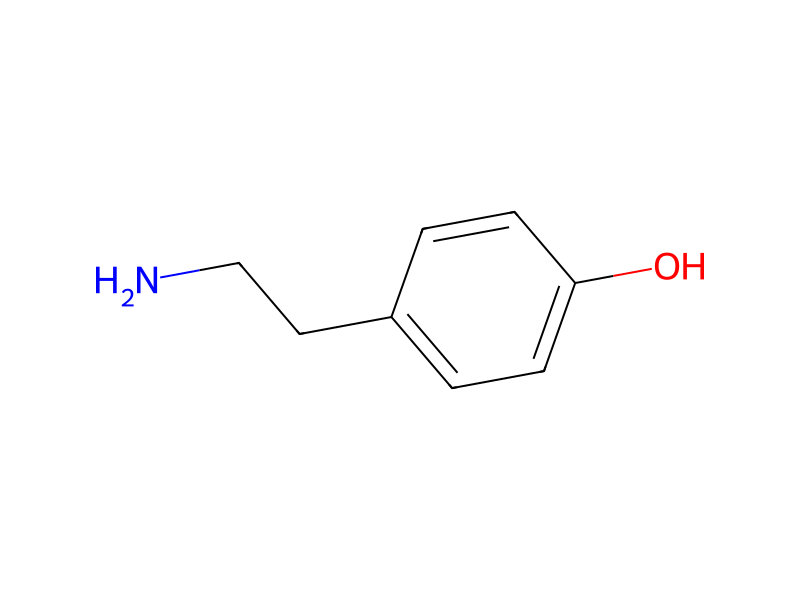
Reactant 2

Product 1

Reagents, catalysts & solvents 1

Conditions
- Temperature
- 160 °C
Procedure
A mixture of 27.7 grams (0.1 mole) of 1,8-dichloroanthraquinone, 30 grams (0.22 mole) of p-(2-aminoethyl)phenol in 200 milliliters of o-dichlorobenzene was heated to 160° C. for 18 hours. The mixture was cooled to room temperature, and the product was collected by filtration. Thereafter, the aforementioned product was recrystallized from isopropanol to yield 29 grams (62 percent) of 1,8-bis[2-(p-hydroxyphenyl)ethylamino]anthraquinone as a red powder, m.p. 181° to 182° C.; vis (DMF), λmax 520 nm (ε 12,000); ms 478 (M+); Analysis Calculated for C30H26N2O4 : C, 75.29; H, 5.48; N, 5.86; O, 13.38. Found: C, 74.94; H, 5.30; N, 5.63; O, 13.17.
Workup
- temperatureThe mixture was cooled to room temperature
- filtrationthe product was collected by filtration
- customThereafter, the aforementioned product was recrystallized from isopropanol
Sources & evidence
- ORD record
- ord-ee879dc178ef42e59c7cf456bf50c4df
- Source dataset
- uspto-grants-1988_10
- Patent number
- US04778742
Linked notes
Loading…