Reaction equation
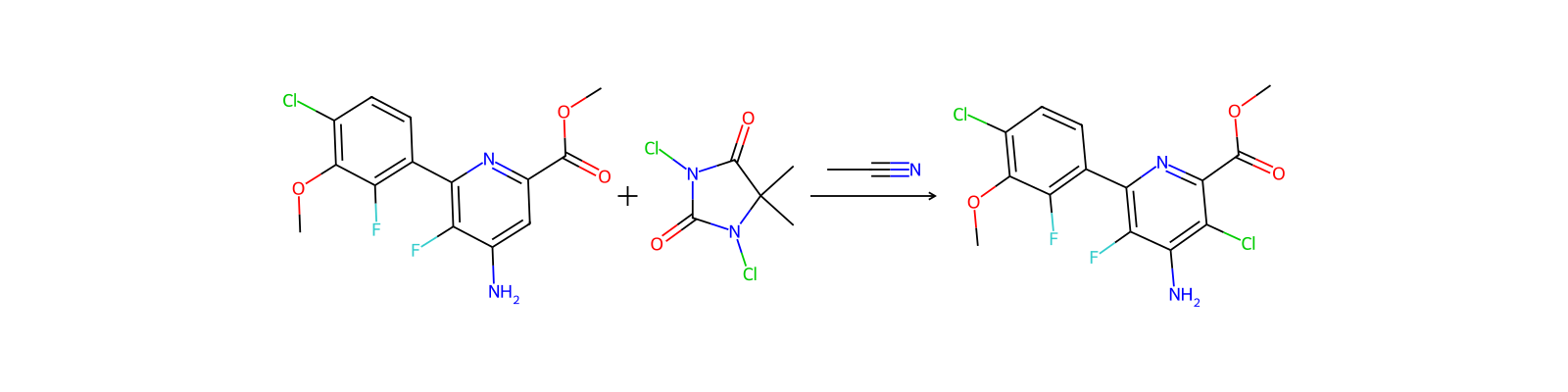
[NH2:1][C:2]1[C:7]([F:8])=[C:6]([C:9]2[CH:14]=[CH:13][C:12]([Cl:15])=[C:11]([O:16][CH3:17])[C:10]=2[F:18])[N:5]=[C:4]([C:19]([O:21][CH3:22])=[O:20])[CH:3]=1.[Cl:23]N1C(C)(C)C(=O)N(Cl)C1=O>C(#N)C>[NH2:1][C:2]1[C:7]([F:8])=[C:6]([C:9]2[CH:14]=[CH:13][C:12]([Cl:15])=[C:11]([O:16][CH3:17])[C:10]=2[F:18])[N:5]=[C:4]([C:19]([O:21][CH3:22])=[O:20])[C:3]=1[Cl:23]Participants
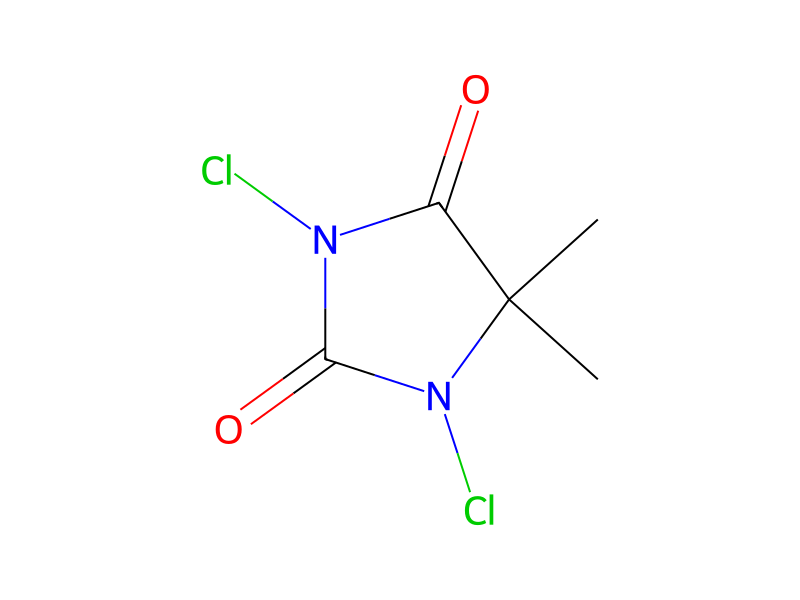
Reactant 2

Product 1
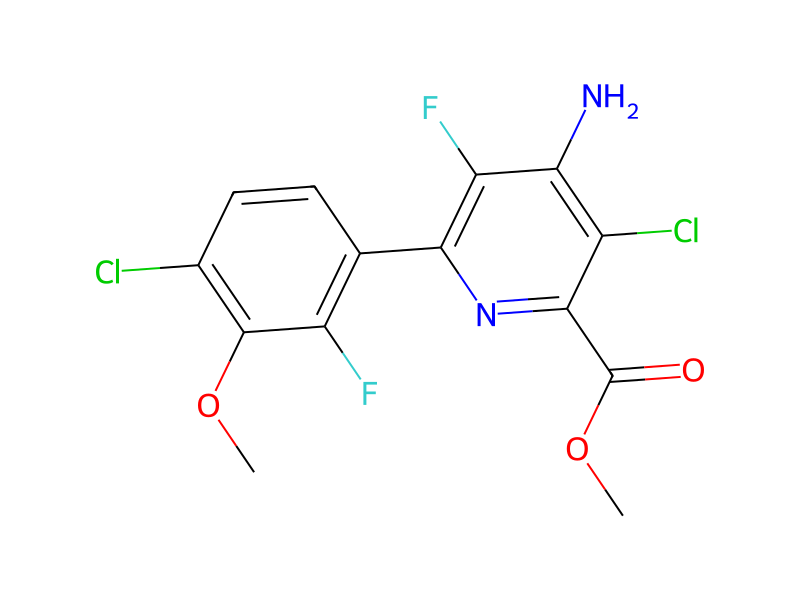
Reagents, catalysts & solvents 1

Procedure
A mixture of methyl 4-amino-5-fluoro-6-(4-chloro-2-fluoro-3-methoxyphenyl)-picolinate (0.5 g, 1.52 mmol) and 1,3-dichloro-5,5-dimethylimidazolidine-2,4-dione (0.30 g, 1.52 mmol) in acetonitrile (10 mL) was heated to reflux for 1.5 h. Upon cooling to room temperature, the reaction mixture was concentrated under vacuum and then purified by silica gel chromatography (100% hexane to 100% EtOAc gradient) to give a light brown solid (0.53 g, 100%): mp 169-170.5° C.; 1H NMR (400 MHz, DMSO-d6) δ 7.48 (d, J=8.4 Hz, 1H), 7.32 (t, J=7.7 Hz, 1H), 7.15 (s, 2H), 3.96 (s, 3H), 3.90 (s, 3H). 13C NMR (101 MHz, DMSO-d6) δ 164.8 (s), 153.1 (d, J=253 Hz), 146.3 (s), 144.5 (d, J=4 Hz), 143.7 (s), 142.8 (dd, J=227, 14 Hz), 136.4 (d, J=13 Hz), 128.6 (d, J=3 Hz), 125.9 (s), 125.5 (d, J=4 Hz), 122.9 (dd, J=14, 4 Hz), 113.0 (d, J=3 Hz), 61.6 (d, J=4 Hz), 52.7 (s). Anal. Calcd for C14H10Cl2F2N2O3: C, 46.30; H, 2.78; N, 7.71. Found: C, 46.60; H, 2.68; N, 7.51.
Workup
- temperaturewas heated
- temperatureto reflux for 1.5 h
- concentrationthe reaction mixture was concentrated under vacuum
- custompurified by silica gel chromatography (100% hexane to 100% EtOAc gradient)
Sources & evidence
- ORD record
- ord-feea3b2a90924e83922618393002e8c0
- Source dataset
- uspto-grants-2015_03
- Patent number
- US08993772B2
Linked notes
Loading…