HuagongsheHuagongshe Chemistry Print Report · For research reference only
HRID 9246Generated: October 26, 2026
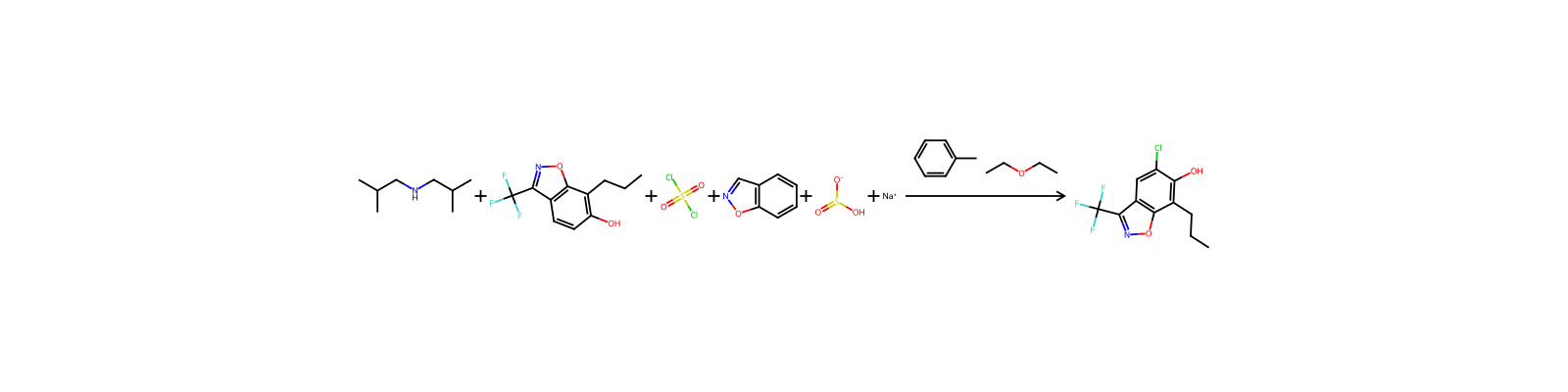
Diisobutylamine → 5-Chloro-6-hydroxy-7-propyl-3-trifluoromethyl-1,2-benzisoxazole
https://huagongshe.com/reaction/9246
Participants
| Role | Name | HCID | Charge |
|---|
| Reactant | Diisobutylamine | HCID 8085 | — |
| Reactant | Sulfuryl chloride | HCID 24648 | — |
| Reactant | 1,2-Benzisoxazole | HCID 71073 | — |
| Reactant | Sodium Bisulfite | HCID 23665763 | — |
| Reactant | 7-Propyl-3-(trifluoromethyl)benzo[d]isoxazol-6-ol | HCID 135800812 | — |
| Solvent | Toluene | HCID 1140 | — |
| Solvent | Diethyl Ether | HCID 3283 | — |
| Product | 5-Chloro-6-hydroxy-7-propyl-3-trifluoromethyl-1,2-benzisoxazole | HCID 135723522 | — |
Reaction Steps
Diisobutylamine (0.8 ml, 0.10 eq) and 6-hydroxy-7-propyl-3-trifluoromethylbenzisoxazole (11 gm, 1.0 eq) were dissolved in toluene (275 ml) at room temperature. Slow addition of sulfuryl chloride (4.20 ml, 1.15 eq) results in a suspension which was stirred overnight. Additional diisobutylamine (total 1.6 ml, 0.4 eq) was added in four equal portions over 24 hr until no further starting benzisoxazole was detected by analytical TLC. The reaction mixture was poured into saturated sodium bisulfite (500 ml) and ethyl ether (700 ml). The phases were separated. The ether phase was washed with brine and dried over Na2SO4. The solvent was evaporated in vac to give an orange solid which was purified by chromatography on silica gel eluting with acetone:hexane (2:98) to give the title compound.
Provenance & Evidence
| DOI | 10.6084/m9.figshare.5104873.v1 |
|---|
| Patent number | US07091230B2 |
|---|
| Source dataset | uspto-grants-2006_08 |
|---|
| ORD ID | ord-07cdbdf55f0e4eb6803123ffb55d89c6 |
|---|
| Source note | uspto-grants-2006_08 |
|---|