HuagongsheHuagongshe Chemistry Print Report · For research reference only
HRID 943Generated: October 23, 2026
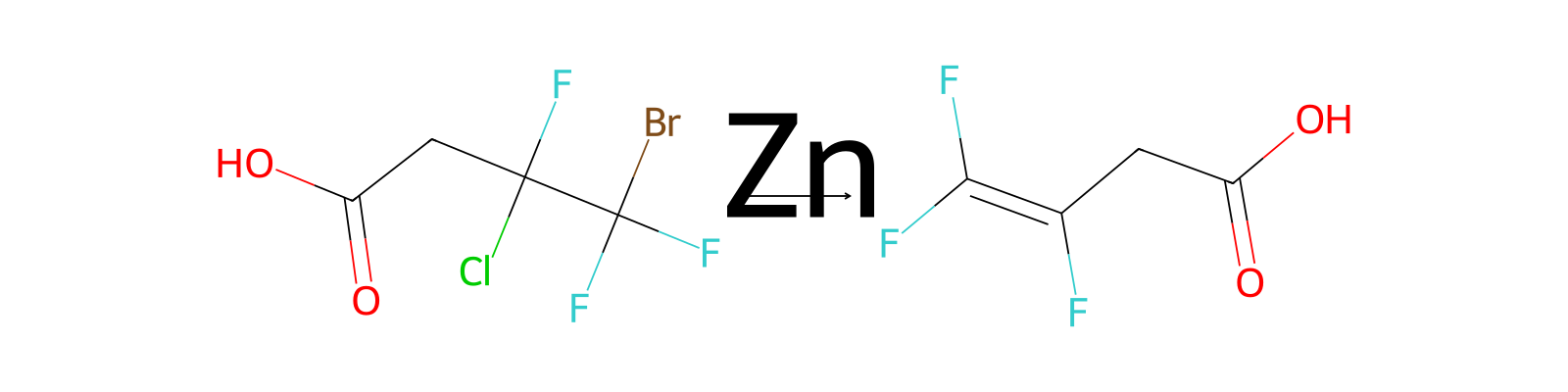
4-Bromo-3-chloro-3,4,4-trifluorobutanoic acid → 3,4,4-Trifluoro-3-butenoic acid
https://huagongshe.com/en/reaction/943
Participants
| Role | Name | HCID | Charge |
|---|
| Reactant | 4-Bromo-3-chloro-3,4,4-trifluorobutanoic acid | HCID 10912127 | — |
| Catalyst | Zinc | HCID 23994 | — |
| Product | 3,4,4-Trifluoro-3-butenoic acid | HCID 15239174 | — |
Reaction Steps
In the second method the synthesis of 4-bromo-3-chloro-3,4,4-trifiuoro-butanoic acid (VIII) is followed by zinc dehalogenation to produce 3,4,4-trifiuoro-3-butenoic acid (IV). This compound is prepared by reacting 1-chloro-1,2-dibromotrifiuoroethane (VI) with ethyl vinyl ether in the presence of sodium dithionite and sodium bicarbonate in a manner analogous to that described in the Literature [Huang, Weiyuan; lu, long; Zhang, Yuanfa; Chin. J. Chem. 1990, (3), 281]. However, it is now found that the 4-bromo-3-chloro-3,4,4-trifluorobutanal intermediate (VII) is oxidized without isolation with sodium chlorite/hydrogen peroxide. In other words, instead of oxidation with Jones reagent, this method advantageously provides a process which can be carried out in one reaction vessel using preferred reagents and gives an unexpectedly high yield.
Provenance & Evidence
| DOI | 10.6084/m9.figshare.5104873.v1 |
|---|
| Patent number | US05723470 |
|---|
| Source dataset | uspto-grants-1998_03 |
|---|
| ORD ID | ord-f069e64d90a346f186352335c52bd727 |
|---|
| Source note | uspto-grants-1998_03 |
|---|