Reaction equation
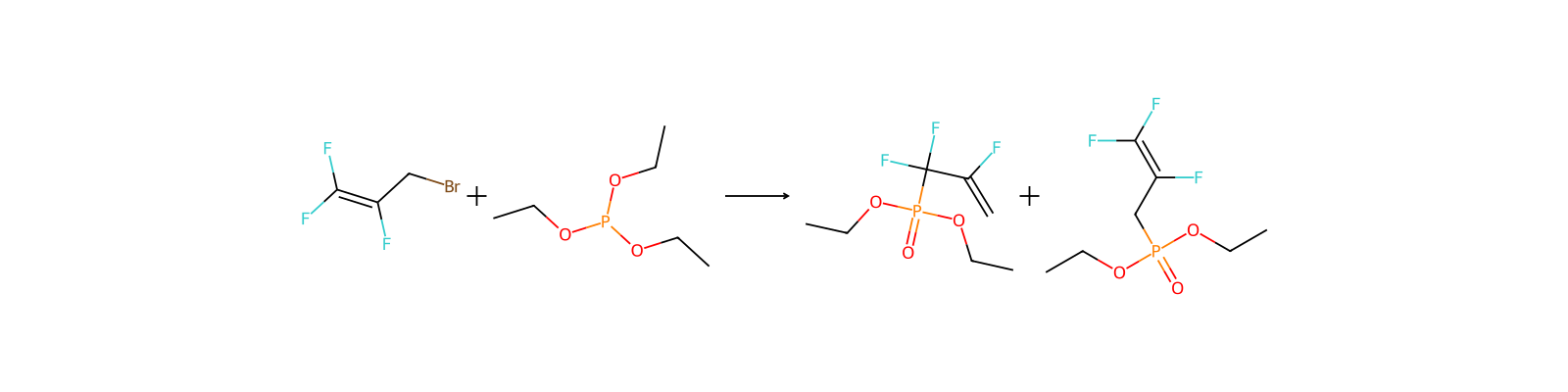
[F:1][C:2](=[C:5]([F:7])[F:6])[CH2:3]Br.[P:8]([O:15][CH2:16][CH3:17])([O:12][CH2:13][CH3:14])[O:9][CH2:10][CH3:11]>>[F:6][C:5]([P:8](=[O:15])([O:12][CH2:13][CH3:14])[O:9][CH2:10][CH3:11])([F:7])[C:2]([F:1])=[CH2:3].[F:1][C:2](=[C:5]([F:7])[F:6])[CH2:3][P:8](=[O:9])([O:12][CH2:13][CH3:14])[O:15][CH2:16][CH3:17]Participants
4



Procedure
A solution of 2,3,3-trifluoro-2-propenyl bromide (5.25 g, 30 mmol) and triethyl phosphite (4.15 g, 25 mmol) in acetonltrile (15 mL) was heated at reflux for overnight. The residue obtained after evaporation of the solvent was chromatographed over silica gel (hexanes/ethyl acetate/ethanol, 80/20/1) to give diethyl (1,1,2-trifluro-2-propenyl)phosphonate (0.8 g, 11%) and diethyl (2,3,3-trifluro-2-propenyl)phosphonate (1.0 g, 14%).
Workup
- temperatureat reflux for overnight
- customThe residue obtained
- customafter evaporation of the solvent
- customwas chromatographed over silica gel (hexanes/ethyl acetate/ethanol, 80/20/1)
Sources & evidence
- ORD record
- ord-69bdc7c6a2fb4d4987a431b8e37f7f33
- Source dataset
- uspto-grants-1998_03
- Patent number
- US05723470
Linked notes
Loading…