Reaction equation

CO.[F:3][C:4]1[C:11]([F:12])=[C:10]([CH2:13]Br)[C:9]([F:15])=[C:8]([F:16])[C:5]=1[CH2:6][OH:7]>[Pd].O>[F:3][C:4]1[C:11]([F:12])=[C:10]([CH3:13])[C:9]([F:15])=[C:8]([F:16])[C:5]=1[CH2:6][OH:7]Participants
Reactant 2

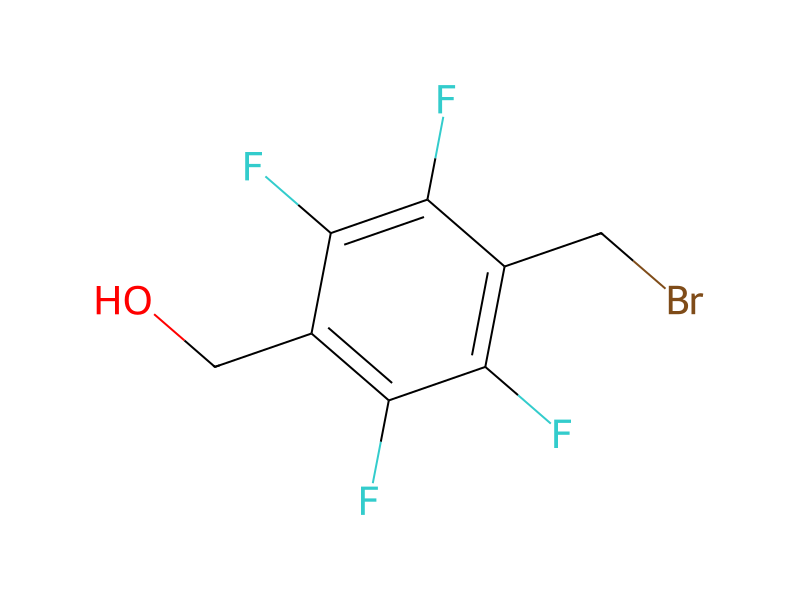
Product 1
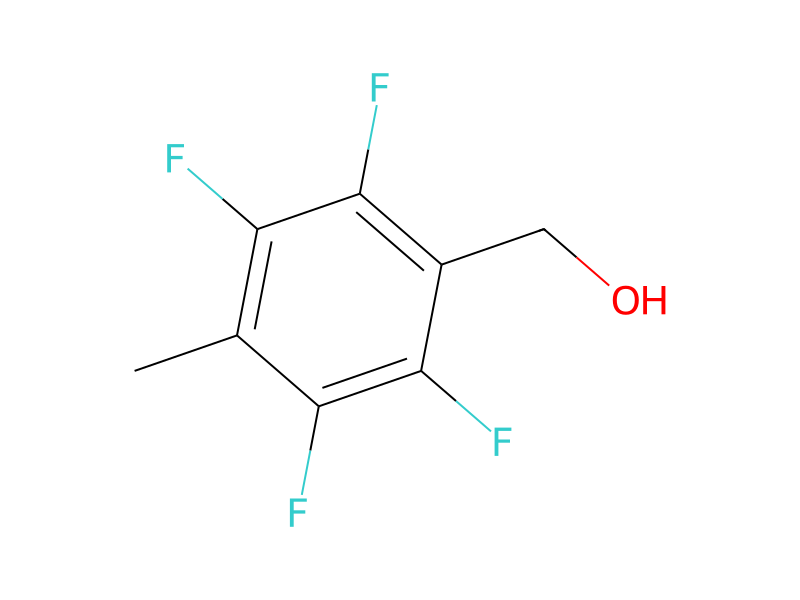
Reagents, catalysts & solvents 2


Procedure
The following procedures were carried out in a 1 litre glass autoclave (working volume 350-500 mls) fitted with a dispersion agitator (1000 rpm). H2 gas was fed through a dip-pipe via a Buchi gas controller (Type 6002). The increase/decrease of the temperature is controlled by a Jelabo FP40 external heating/cooling bath. Methanol (362 g, water (6 g, 2,3,5,6-tetrafluoro-4-(bromomethyl)benzyl alcohol (95.1 g 100% wt.), MgO (18.1 g and 5% palladium/carbon catalyst (0.8 g, 100 wt %; Type 58, provided by Johnson Matthey) were charged to the autoclave. The lid was sealed and the autoclave was initially purged with nitrogen to remove residual oxygen (nearly 0), then pressurized to 2.5 bar with hydrogen, and stirred. The pressure was maintained at 2.5 bar by the Buchi controller. The reaction temperature was controlled at 50° C. throughout the reaction by means of the external heating/cooling bath. The reaction was continued until the consumption of hydrogen ceased (typically 60 to 90 minutes). The residual pressure was released and the autoclave purged with nitrogen. The contents of the autoclave were discharged, followed by a small methanol (30 g wash. The spent catalyst and inorganic salts were removed and recovered by filtration. The filter cake was washed with a small amount of methanol (2×30 g. The filtrates and filter-cake washes were combined. On analysis, the reaction had produced 60.4 g of 2,3,5,6-tetrafluoro-4-methylbenzyl alcohol with a yield of 89.4%.
Workup
- customfitted with a dispersion agitator (1000 rpm)
- temperatureThe increase/decrease of the temperature
- customis controlled by a Jelabo FP40 external heating/cooling bath
- customThe lid was sealed
- customthe autoclave was initially purged with nitrogen
- customto remove residual oxygen (nearly 0),
- temperatureThe pressure was maintained at 2.5 bar by the Buchi controller
- customThe reaction temperature was controlled at 50° C. throughout the reaction by means of the external heating/cooling bath
- customThe reaction was continued until the consumption of hydrogen
- customtypically 60 to 90 minutes
- customthe autoclave purged with nitrogen
- washwash
- customThe spent catalyst and inorganic salts were removed
- filtrationrecovered by filtration
- washThe filter cake was washed with a small amount of methanol (2×30 g
- filtrationThe filtrates and filter-cake washes
Sources & evidence
- ORD record
- ord-fa0ca8c33fcd414dafb1468ac0f1e1d2
- Source dataset
- uspto-grants-2007_12
- Patent number
- US07312366B2
Linked notes
Loading…