Reaction equation
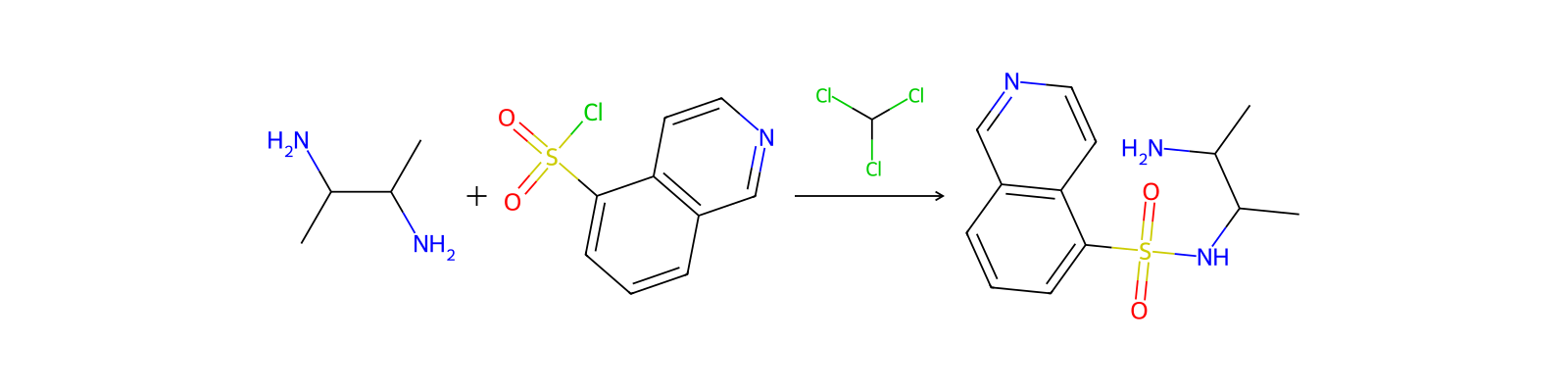
[NH2:1][CH:2]([CH:4]([NH2:6])[CH3:5])[CH3:3].[CH:7]1[C:16]2[CH:15]=[CH:14][CH:13]=[C:12]([S:17](Cl)(=[O:19])=[O:18])[C:11]=2[CH:10]=[CH:9][N:8]=1>C(Cl)(Cl)Cl>[NH2:1][CH:2]([CH3:3])[CH:4]([NH:6][S:17]([C:12]1[C:11]2[CH:10]=[CH:9][N:8]=[CH:7][C:16]=2[CH:15]=[CH:14][CH:13]=1)(=[O:18])=[O:19])[CH3:5]Participants
4
Reactant 2


Product 1

Reagents, catalysts & solvents 1

Procedure
In 100 ml of chloroform was dissolved 12.9 g of 2,3-diaminobutane and to the solution was added dropwise 10 ml of a chloroform solution containing 4.0 g of 5-isoquinolinesulfonyl chloride under cooling with ice. After the dropwise addition of the chloroform solution, the mixed solution was stirred at a temperature of 20° C. to 25° C. for two hours, and the reaction mixture solution was washed with water and dried with anhydrous sodium carbonate. The chloroform was distilled therefrom under reduced pressure, and the residue thus obtained was subjected to a column chromatography [silica gel: 160 g; solvent: chloroform] to give 3.92 g of N-(2-amino-1-methylpropyl)-5-isoquinolinesulfonamide in a yield of 80%.
Workup
- temperatureunder cooling with ice
- washthe reaction mixture solution was washed with water
- dry with materialdried with anhydrous sodium carbonate
- distillationThe chloroform was distilled
- customunder reduced pressure, and the residue thus obtained
Sources & evidence
- ORD record
- ord-7c19baa7d1c445cba8ab5daebd50addf
- Source dataset
- uspto-grants-1987_01
- Patent number
- US04634770
Linked notes
Loading…