Quinoline → 4-[2-(4-Fluorophenyl)thiophen-3-yl]pyridine
Reaction equation

N1C2C(=CC=CC=2)C=CC=1.C([C:14]1[S:18][C:17]([C:19]2[CH:24]=[CH:23][C:22]([F:25])=[CH:21][CH:20]=2)=[C:16]([C:26]2[CH:31]=[CH:30][N:29]=[CH:28][CH:27]=2)[CH:15]=1)(O)=O>[Cu]>[F:25][C:22]1[CH:21]=[CH:20][C:19]([C:17]2[S:18][CH:14]=[CH:15][C:16]=2[C:26]2[CH:31]=[CH:30][N:29]=[CH:28][CH:27]=2)=[CH:24][CH:23]=1Participants
4
Reactant 2

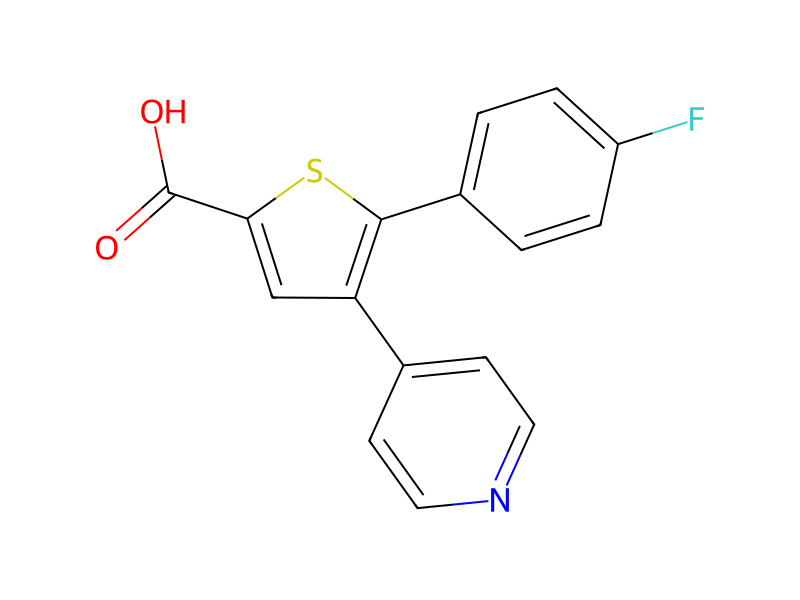
Product 1

Reagents, catalysts & solvents 1

Conditions
- Temperature
- 240 °C
Procedure
Quinoline (42 ml) and copper powder (2.95 g, 46.4 mmol) were added to 5-carboxy-2-(4-fluorophenyl)-3-(pyridin-4-yl)thiophene (12.64 g (42.2 mmol), prepared as described in 2))), and the resulting mixture was stirred at 240° C. for 2.5 hours. At the end of this time, the reaction mixture was cooled to room temperature and was filtered off. The filtrate was partitioned between ethyl acetate and a saturated aqueous solution of ammonium chloride. The organic layer was washed with water, dried over anhydrous magnesium sulfate and the solvent was removed by distillation under reduced pressure. The residue was purified by column chromatography through silica gel (eluent, hexane:ethyl acetate=1:1), to give the title compound (11.81 g) as a brown powder (yield quantitative).