
ニンヒドリン
Ninhydrin
データを補完しています。しばらくしてからページを更新すると最新の内容を表示できます

基本情報
- CAS
485-47-2- 標準SMILES
O=C1c2ccccc2C(=O)C1(O)O- InChIKey
FEMOMIGRRWSMCU-UHFFFAOYSA-N- 分子式
- C9H6O4
- 平均分子量
- 178.14 g/mol
- 単同位体質量
- 178.02660867
名称と識別子
- 優先名称
- Ninhydrin
- IUPAC
- 2,2-dihydroxyindene-1,3-dione
- 現地名
- ニンヒドリン
- 英語名
- Ninhydrin hydrate
- 分子式
- C9H6O4
- 分子量
- 178.14
名称と別名
NINHYDRIN485-47-2Ninhydrin hydrate1,2,3-Indantrione monohydrate2,2-Dihydroxy-1H-indene-1,3(2H)-dione1H-Indene-1,3(2H)-dione, 2,2-dihydroxy-Triketohydrindene hydrate2,2-Dihydroxy-1,3-indandione2,2-Dihydroxy-1,3-indanedione1,2,3-Indantrione, 2-hydrateDTXSID70257161,3-Indandione, 2,2-dihydroxy-
名称をさらに表示
ニンヒドリン (エタノール溶液)ニンヒドリン スプレートリケトヒドリンデン水和物1,2,3-トリケトヒドリンデンヒドラート2,2-ジヒドロキシインダン-1,3-ジオン2,2-ジヒドロキシ-1H-インデン-1,3(2H)-ジオン1,2,3-インダントリオンヒドラート2,2-ジヒドロキシ-1,3-インダンジオン2,2-ジヒドロキシ-2,3-ジヒドロ-1H-インデン-1,3-ジオンニンヒドリンスプレーニンヒドリンスプレー (0.5%1-ブタノール溶液)1,2,3-トリケトヒドリンデン一水和物ニンヒドリン水和物ニンヒドリン, 99%ニンヒドリン1,2,3-トリケトヒドリンデン2,2-Dihydroxyindane-1,3-dione1H-Indene-1,2,3-trione2,2-dihydroxyindene-1,3-dioneNinhydrin, reagent ACS 25GRNINNinthydrin
HCL6S9K23ADTXCID605716CHEBI:86374Indantrione MonohydrateMonohydrate, IndantrioneRefChem:854157207-618-1Ninhydrine
データベース識別子
- CAS
485-47-2- PubChem CID
- 10236
- DTXSID
DTXSID7025716- ChEMBL
CHEMBL1221925- ChEBI
CHEBI:86374- UNII
- HCL6S9K23A
- Nikkaji
- J6.001A
物性
構造計算による物性補完中
- XLogP
- 0.1
- 極性表面積
- 74.6 Ų
- 水素結合供与体数
- 2
- 水素結合受容体数
- 4
- 回転可能結合数
- 0
- 重原子数
- 13
- 形式電荷
- 0
- 複雑度
- 243
物理化学的性質
- 融点
- 250 °C · 250 °C (dec.) (lit.)
- 沸点
- 230.35 °C · 230.35°C (rough estimate)
- 比重(密度)
- 0.862 · 0.862
- 蒸気密度
- 6.16 · 6.16 (vs air)
- 屈折率
- 1.4209 · 1.4209 (estimate)
- 闪点
- 13 °C · 13 °C
- 貯蔵温度
- Keep in dark place,Inert atmosphere,Room temperature
- 溶解性
- 100 mg/mL · エタノール:ソリュブル100mg/mL
- 外見
- 粉体・固形
- 酸解離定数(Pka)
- 8.47 · 8.47±0.20(Predicted)
- 比重
- 0.788 · 0.788
- 色
- 白色から茶褐色の結晶
- PH
- 4.6 · 4.6-5.0 (10g/l, H2O, 20℃)
- 臭い (Odor)
- 無臭
- 水溶解度
- 20 ℃で0.1~0.5g/100mL · 20℃で0.1~0.5g/100mL
- Merck
- 14 · 14,6554
- BRN
- 1910963 · 1910963
- 安定性
- 安定。アミン、アルカリ、強塩基とは相容れない。光に敏感。
- 化粧品成分の機能
- 還元剤
- InChI
- 1S/C9H6O4/c10-7-5-3-1-2-4-6(5)8(11)9(7,12)13/h1-4,12-13H
安全と法規制
安全情報は参考情報です。供給元の安全データシート(SDS)、適用法令、専門家による評価に代わるものではありません。
安全データ
- F
- 8
- wgk
- 3
- tsca
- TSCA listed
- rtecs
- NK5425000
- ridadr
- UN 1170 3/PG 2
- 毒性
- LD50 orally in Rabbit: 600 mg/kg
- hs_code
- 29144000
- risk_code
- 22-36/37/38-39/23/24/25-20/21/22-11
- 化審法
- (4)-584
- 安衛法
- 有機則 第二種有機溶剤等
- 消防法
- 危-4-A-II
- hazard_code
- Xn,T,F
- safety_code
- 26-28A-45-16-36
- hazard_class
- 3
- packing_group
- II
- Hazard Classifications
- Acute Tox. 4 OralEye Irrit. 2Skin Irrit. 2
- ストレージクラス
- 11 - Combustible Solids
化学と産業
応用分野
解説ニンヒドリン,柱状晶.分解点239~240 ℃.各種のアミノ酸と反応して赤紫色に呈色するので,アミノ酸の検出,定量に使われる(ニンヒドリン反応).プロリン,ヒドロキシプロリンなどのイミノ化合物では,黄色となる.森北出版「化学辞典(第2版)
説明Ninhydrin is historically the most common reagent for processing fingerprints on porous substrates. It has been used as a fingerprint reagent since the 1950s but has been used as a cell stain since the early 1900s. Ninhydrin molecules form a complex with amino acids resulting in a purple product known as Ruhmann's purple. Purple fingerprints are easily visible on light-colored porous substrates but may be difficult to see on patterned or dark-colored substrates. DFO reacts with amino acids to produce a fluorescent product that is not readily seen with the naked eye. This makes it a useful reagent on dark or patterned porous items. DFO prints are viewed with an alternate light source or laser set to 530–570 nm (green light) through a red barrier filter. 1,2-indanedione is an emerging fingerprint reagent that results in visible pink fingerprints that are also fluorescent. The fluorescence is viewed under the same conditions as DFO. These chemicals can be used on their own or in sequence to develop latent prints on porous substrates. If they are used in sequence, they are used in the following order: indanedione, DFO, ninhydrin. If a reagent is used out of sequence, it will inhibit or limit the effectiveness of the other reagents. In this laboratory exercise you will develop fingerprints on a porous substrate using indanedione, DFO, and ninhydrin. ninhydrin structure
来歴Ninhydrin was discovered in 1910 by the German-English chemist Siegfried Ruhemann (1859–1943). In the same year, Ruhemann observed ninhydrin's reaction with amino acids. In 1954, Swedish investigators Oden and von Hofsten proposed that ninhydrin could be used to develop latent fingerprints.
一般的な説明White to light yellow crystals or powder. Becomes anhydrous with reddening at 257-266°F.
調製方法
純化方法Crystallise ninhydrin from hot water (charcoal). Dry it under vacuum and store it in sealed brown containers. [Beilstein 7 IV 2786.]
上流・下流製品情報
上流原料
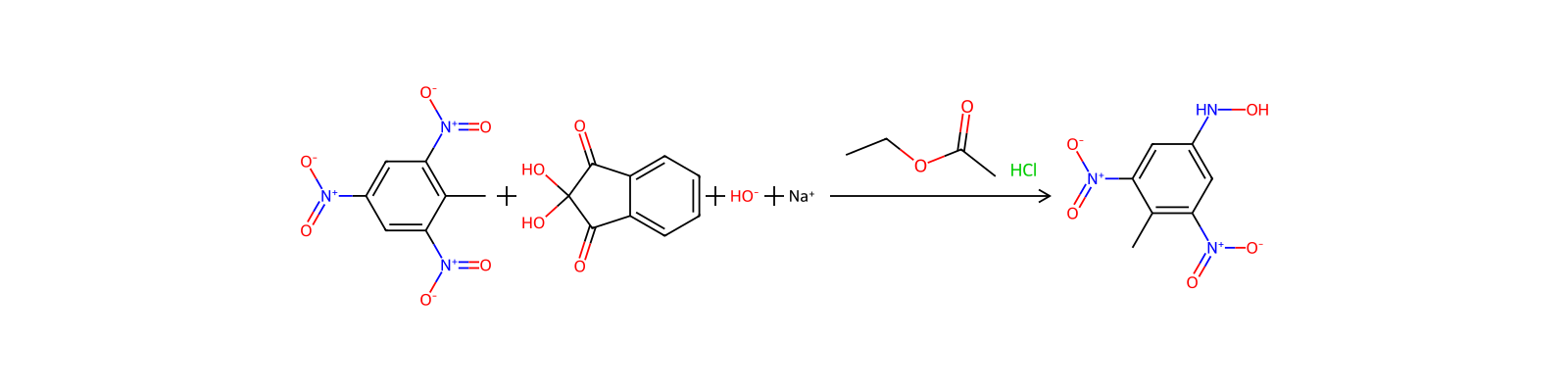
関連反応
256 件


化合物ノート
読み込み中…