
基本情報
- CAS
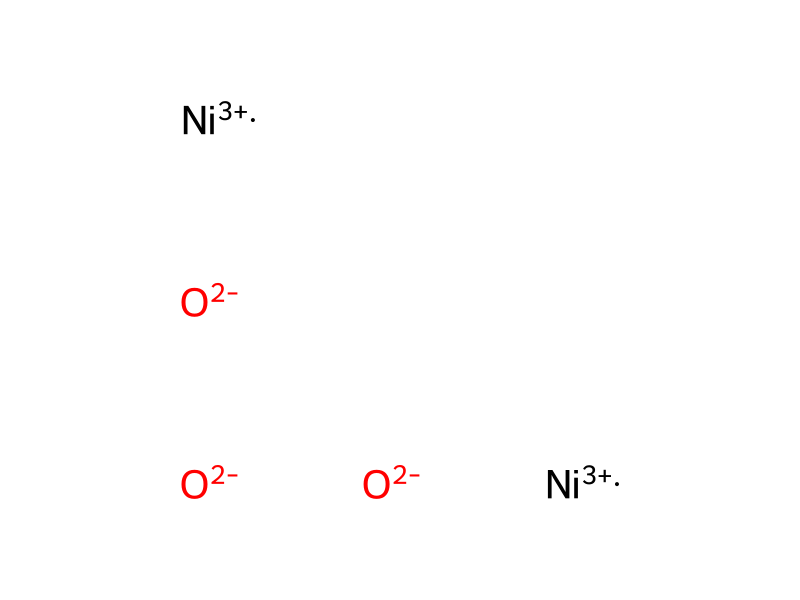
1314-06-3- 標準SMILES
[Ni+3].[Ni+3].[O-2].[O-2].[O-2]- InChIKey
GNMQOUGYKPVJRR-UHFFFAOYSA-N- 分子式
- Ni2O3
- 平均分子量
- 165.385 g/mol
- 単同位体質量
- 163.85542966
名称と識別子
- 優先名称
- Nickel oxide (Ni2O3)
- IUPAC
- bis(nickel(3+));tris(oxygen(2-))
- 現地名
- ニッケル オキシド
- 英語名
- Nickel oxide
- 分子式
- Ni2O3
- 分子量
- 165.385
名称と別名
1314-06-3Nickel oxide (Ni2O3)Nickel sesquioxideDinickel trioxide07BD7540U5DTXSID60893854RefChem:1092356DTXCID701323894215-217-8NICKEL(III) OXIDENickel peroxideNickelic oxide
名称をさらに表示
セスキ酸化ニッケル三酸化二ニッケルニッケル(III)オキシドニッケル オキシド酸化ニッケル(Ⅲ)酸化ニッケル(III)三二酸化ニッケルPowderNICKEL (III) OXIDEGreyblackoxonickelketonickelNICKEL OXIDENickel(Ⅲ)oxidenickeltrioxideNicke(III) oxide
Nickel(III)oxideNickel oxide peroxideNickel() oxidenickel(3+);oxygen(2-)UNII-07BD7540U5MFCD00011143Nickel oxide blackEINECS 215-217-8
データベース識別子
- CAS
1314-06-3- PubChem CID
- 10313272
- DTXSID
DTXSID60893854- UNII
- 07BD7540U5
- EC Number
- 215-217-8
物性
構造計算による物性
- 極性表面積
- 3 Ų
- 水素結合供与体数
- 0
- 水素結合受容体数
- 3
- 回転可能結合数
- 0
- 重原子数
- 5
- 形式電荷
- 0
- 複雑度
- 0
実験および物理化学的性質
Chemical ClassesMetals -> Nickel Compounds, Inorganic
SpringerMaterials Propertiescrystal structure
Physical DescriptionGray-black solid, soluble in water; [Merck Index] Insoluble in water; [Hawley]
物理化学的性質
- 融点
- 600 ℃ · decomposes at ~600℃ [CRC10]
- 比重(密度)
- 4.83 · 4.83
- 貯蔵温度
- Store at room temperature, keep dry and cool
- 溶解性
- 2 O; · insoluble in H2O; soluble in hot acid solutions
- 外見
- 灰黒色の立方晶
- 色
- gray-black cubic crystals, crystalline
- 水溶解度
- 2 O · H2O に溶けない; 冷たい酸にほとんど溶けない; 熱い HCl に溶けて Cl2 を放出する; 熱い H2SO4 または HNO3 溶液に溶けて O2 を生成する [MER06]
- 安定性
- 安定。
- InChI
- InChI=1S/Ni.O/q+2;-2
- InChIKey
- KVAWBJDCAFOHRG-UHFFFAOYSA-N
- SMILES
- [Ni+2].[O-2]
- CAS データベース
- 1314 · 1314-06-3(CAS DataBase Reference)
安全と法規制
GHS分類
GHS Classification
Danger
H317: May cause an allergic skin reaction [Warning Sensitization, Skin]
P203, P260, P261, P264, P270, P272, P273, P280, P302+P352, P318, P319, P321, P333+P317, P362+P364, P405, and P501 (click each P-code to see the statement)
Danger
H317 (100%): May cause an allergic skin reaction [Warning Sensitization, Skin]
P203, P260, P261, P264, P270, P272, P273, P280, P302+P352, P318, P319, P321, P333+P317, P362+P364, P405, and P501 (click each P-code to see the statement)
危険有害性情報
Regulatory Information
Chemical: Nickel oxide (Ni2O3)
Hazard Traits - Carcinogenicity
Restricted substance: Dinickel trioxide
Other Safety InformationIMAP assessments - Nickel oxide (Ni2O3): Human health tier I assessment
Hazards SummaryMay cause skin sensitization; [ESIS] Danger of skin and airway sensitization; [MAK] See Nickel and linked occupational diseases.
Hazard Classes and Categories
Skin Sens. 1 (100%)
Respiratory sensitization - Category 1
Carc. 1A
安全と保護具
Threshold Limit Values (TLV)0.2 [mg/m3], inhalable fraction, as Ni
Permissible Exposure Limit (PEL)1.0 [mg/m3], as Ni
Immediately Dangerous to Life or Health (IDLH)10.0 [mg/m3], as Ni
毒性情報
化学と産業
用途と製造
Uses
Used in storage batteries; [Hawley]
Battery Manufacturing [Category: Industry]
General Manufacturing InformationNickel oxide (Ni2O3): ACTIVE
応用分野
用途電池などに用いられる。
説明Nickel oxide (Ni2O3) is an important metal oxide used as a plating agent, surface treatment agent, and photocatalyst. Ni2O3 is also used as an electrode material in the manufacture of fuel cells and as a catalytic material in the production of electrolytic cells.
使用Nickel oxide (NiO) is produced from nickel minerals to form nickel oxide when heated to 400°C, which is then reduced at a temperature of 600°C, resulting in the formation of nickel oxide. It is used as electrodes in fuel cells.
上流・下流製品情報
上流原料
下流製品
サプライヤー100 社
国药集团化学试剂有限公司86-21-63210123 · [email protected]
北京华美互利生物化工010-56205725 · [email protected]
関連反応
21 件


化合物ノート
読み込み中…