
HRID 46680反応物として
N,N-Diphenylhydrazine

530-50-7NN(c1ccccc1)c1ccccc1YHYKLKNNBYLTQY-UHFFFAOYSA-NRN given refers to parent cpd
530-50-7DTXSID3043869CHEMBL3301770log Kow = 2.80
2.8
SOL IN CONCN SULFURIC ACID; SLIGHTLY SOL IN WATER
Very soluble in benzene, ether, ethanol, and chloroform.
0.00049 [mmHg]
4.9X10⁻⁴ mm Hg at 25 °C
安全情報は参考情報です。供給元の安全データシート(SDS)、適用法令、専門家による評価に代わるものではありません。
Warning
H302 (100%): Harmful if swallowed [Warning Acute toxicity, oral]
P261, P264, P264+P265, P270, P271, P273, P280, P301+P317, P302+P352, P304+P340, P305+P351+P338, P317, P321, P330, P332+P317, P337+P317, P362+P364, P391, and P501 (click each P-code to see the statement)
Aggregated GHS information provided per 2 reports by companies from 2 notifications to the ECHA C&L Inventory. Each notification may be associated with multiple companies.
Emergency treatment: Hydrazines; Hydrazines can cause severe eye damage. They can cause seizures, liver injury, hemolysis, and delayed pulmonary edema. [HSDB] May cause irritation; [MSDSonline] See Hydrazine. See 1,1-Diphenylhydrazine hydrochloride.
Pursuant to section 8(d) of TSCA, EPA promulgated a model Health and Safety Data Reporting Rule. The section 8(d) model rule requires manufacturers, importers, and processors of listed chemical substances and mixtures to submit to EPA copies and lists of unpublished health and safety studies. Hydrazine, 1,1-diphenyl- is included on this list.
For the maximum protection of human health from the potential carcinogenic effects of exposure to diphenylhydrazine through ingestion of contaminated water and contaminated aquatic organisms ... the levels which may result in incremented increase of cancer risk over the lifetime are estimated at 1x10⁻⁵, 1x10⁻⁶, and 1x10⁻⁷ the corresponding criteria are: 422 ng/l, 42 ng/l, and 4.2 ng/l respectively. If these estimates are made for consumption of aquatic organisms only, excluding consumption of water, the levels are 5.6 ug/l, 0.56 ug/l, and 0.056 ug/l, respectively. /Diphenylhydrazine/
Toxic pollutant designated pursuant to section 307(a)(1) of the Federal Water Pollution Control Act and is subject to effluent limitations. /Diphenylhydrazine/
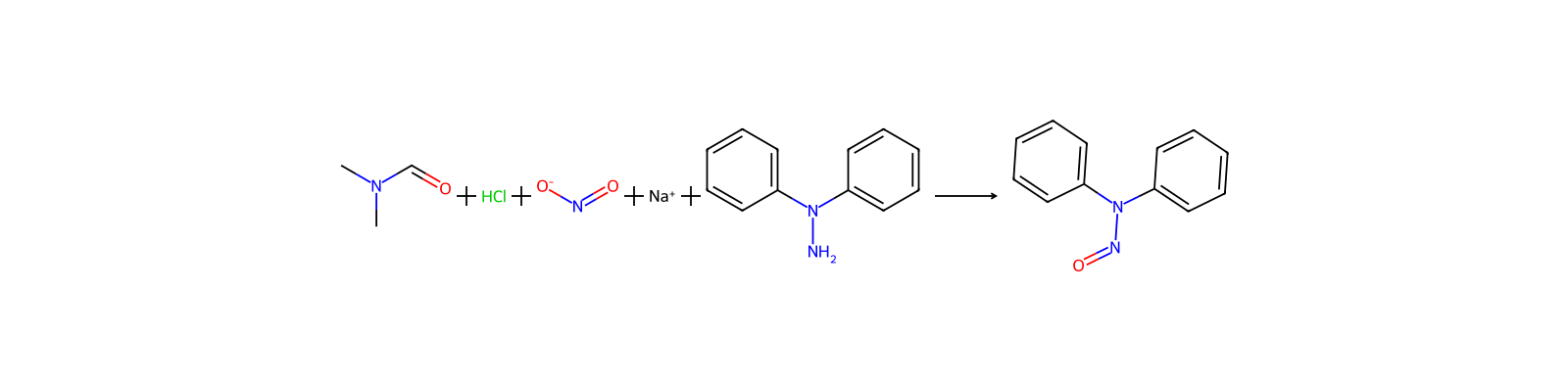
The present study provides the first evidence for in vitro metabolic conversion of a 1,1-disubstituted hydrazine to the corresponding nitrosamine. The study shows that superoxide radical which is generated by NADPH-cytochrome reductase is involved in the oxidation of 1,1-diphenylhydrazine to N-nitrosodiphenylamine catalyzed by rat liver microsomes.
The enzyme systems in rat liver and lung responsible for the oxidative metabolism of hydrazine derivatives were studied to determine whether these enzymes, cytochrome P450 and monoamine oxidase, were responsible for metabolically activating hydrazines to carcinogenic/toxic metabolites. Cytochrome P450 preferentially oxidized the nitrogen to nitrogen bond of 1,2-disubstituted hydrazines and hydrazides, while monoamine oxidase oxidized the nitrogen to nitrogen bond of all the classes of hydrazine derivatives that were tested. Oxidation of the nitrogen to nitrogen bond led to the formation of stable azo intermediates in the case of 1,2-disubstituted hydrazines and to unstable monoazo (diazene) metabolites in the case of monosubstituted hydrazines and hydrazides. /Substituted hydrazines/
By microsomes obtained from bovine ciliary body, 1,1-diphenylhydrazine was oxidized to N-nitrosodiphenylamine in the presence of NADPH. This reaction was stimulated by riboflavin which was recognized to be an electron carrier. The oxidizing activity by microsomes was markedly inhibited by superoxide dismutase, but not by SKF 525-A or carbon monoxide. Similarly, the oxidation of 1,1-diphenylhydrazine to its corresponding nitrosamine occurred in varying degrees when the hydrazine derivative was exposed to visible light in the presence of photosensitizers such as riboflavin, flavin adenine dinucleotide, flavin mononucleotide, lumiflavin, lumichrome, NAD+, NADH, NADP+, or NADPH. The photochemical oxidation was inhibited by active oxygen-scavengers such as superoxide dismutase, L-ascorbic acid or alpha-tocopherol. The superoxide radical involved in the photochemical reaction was determined by measuring the oxidation of epinephrine to adrenochrome. The oxidation of epinephrine was well correlated to that of 1,1-diphenylhydrazine. Thus, the present study provided evidence that the superoxide radical is responsible for the oxidation of a hydrazine derivative to a corresponding nitrosamine by ocular tissue microsomes and by photosensitizers.
The first evidence for the reductive metabolism of a noncyclic nitrosamine to the corresponding hydrazine derivative in vivo and in vitro is provided. Under anaerobic conditions, N-nitrosodiphenylamine was reduced by guinea pig liver 9000 g supernatant to 1,1-diphenylhydrazine in the presence of 2-hydroxypyrimidine or to acetaldehyde diphenylhydrazone in the presence of acetaldehyde. These metabolites were identified unequivocally by comparative study with authentic samples. In addition, the study shows that such reductive reactions of the nitrosamine can be catalyzed by guinea pig and rabbit liver aldehyde oxidase in the presence of its electron donors. When the nitrosamine was given orally to acetaldehyde-treated guinea pigs, a metabolite was detected from plasma and identified as acetaldehyde diphenylhydrazone by comparison with the authentic sample.


All hydrazines should be stored at temperatures well below their boiling points. Hydrazines that are ignitable shall be stored in electrically grounded containers and isolated from ignition sources and oxidants. All containers of hydrazines shall be kept tightly closed when not in use and stored in a cool ventilated room or sheltered outside space. In the containers, a blanket of nitrogen or other inert gas should be placed over the hydrazines. /Hydrazines/
SRP: The most favorable course of action is to use an alternative chemical product with less inherent propensity for occupational exposure or environmental contamination. Recycle any unused portion of the material for its approved use or return it to the manufacturer or supplier. Ultimate disposal of the chemical must consider: the material's impact on air quality; potential migration in soil or water; effects on animal, aquatic, and plant life; and conformance with environmental and public health regulations.
The following wastewater treatment technology has been investigated for 1,1-diphenylhydrazine: Activated carbon.
Inhalation of salt dusts should be avoided. /Hydrazine & derivatives/
Engineering controls, such as process enclosure or local exhaust ventilation, shall be used when needed to keep concentrations of airborne hydrazines within acceptable levels. Ventilation systems shall be designed to prevent accumulation or recirculation of airborne hydrazines in the workplace environment and to remove hydrazines from the breathing zone of workers. /Hydrazine/
SRP: The scientific literature for the use of contact lenses in industry is conflicting. The benefit or detrimental effects of wearing contact lenses depend not only upon the substance, but also on factors including the form of the substance, characteristics and duration of the exposure, the uses of other eye protection equipment, and the hygiene of the lenses. However, there may be individual substances whose irritating or corrosive properties are such that the wearing of contact lenses would be harmful to the eye. In those specific cases, contact lenses should not be worn. In any event, the usual eye protection equipment should be worn even when contact lenses are in place.
...Vinyl coated hand protection, natural or reclaimed rubber protection, rubber aprons, and plastic eye and face protection... used when working with small quantities. Where possibility of gross splashing exists, full protective clothing made of rubber, neoprene or vinyl-coated materials should be worn. For respiratory protection in situations where recommended tolerance limits... exceeded, respiratory protective equipment... must be used. /Hydrazine and derivatives/
All systems or equipment containing the hydrazines shall be designed to minimize the possibility of vapor or aerosol inhalation, skin or eye contact, and spill or leaks; such as full face shields, goggles, and full body protection clothing, including gloves and boots. /Hydrazine/
TERRESTRIAL FATE: Based on a recommended classification scheme(1), an estimated Koc value of 790(SRC), determined from a measured log Kow of 2.8(2) and a regression-derived equation(3), indicates that 1,1-diphenylhydrazine will have low mobility in soil(SRC). Volatilization of 1,1-diphenylhydrazine from moist soil surfaces is not expected to be an important environmental fate process given an estimated Henry's Law constant of 4.1X10⁻⁸ atm-cu m/mole(SRC), calculated using a fragment constant estimation method(4). Based on limited aqueous screening study data, 1,1-diphenylhydrazine is expected to biodegrade in aerobic soils(SRC). Over a 7 day period, 46-100% biodegradation was reported for 1,1-diphenylhydrazine following inoculation with activated sludge(5).
AQUATIC FATE: Based on a classification scheme(1), an estimated Koc value of 790(SRC), determined from a measured log Kow of 2.8(2) and a regression-derived equation(3), indicates that 1,1-diphenylhydrazine is expected to adsorb to suspended solids and sediment in water(SRC). 1,1-Diphenylhydrazine is not expected to volatilize from water surfaces(SRC) based on an estimated Henry's Law constant of 4.1X10⁻⁸ atm-cu m/mole(SRC), developed using a fragment constant estimation method(4). According to a classification scheme(5), an estimated BCF value of 28(SRC), from a measured log Kow(2), and a regression derived equation (6) suggests that bioconcentration in aquatic organisms is low (SRC). Photolysis in sunlit surface waters may be significant since this compound absorbs light above 290 nm(7), but the rate of this reaction is not known(SRC). Based on limited aqueous screening study data, 1,1-diphenylhydrazine is expected to biodegrade in aerobic water(SRC). Over a 7 day period, 46-100% biodegradation was reported for 1,1-diphenylhydrazine following inoculation with activated sludge(8). Although no data are available for 1,1-diphenylhydrazine, hydrazines are degraded rapidly in water containing trace metals such as copper(II) or iron(III)(9).
ATMOSPHERIC FATE: According to a model of gas/particle partitioning of semivolatile organic compounds in the atmosphere(1), 1,1-diphenylhydrazine, which has a vapor pressure of 4.9X10⁻⁴ mm Hg at 25 deg(2), will exist in both the vapor and particulate phases in the ambient atmosphere. Vapor-phase 1,1-diphenylhydrazine is degraded in the atmosphere by reaction with photochemically-produced hydroxyl radicals(SRC); the half-life for this reaction in air is estimated to be about 16 hours(SRC), calculated from its rate constant of 2.5X10⁻¹¹ cu cm/molecule-sec at 25 °C(SRC) that was derived using a structure estimation method(3). Particulate-phase 1,1-diphenylhydrazine may be physically removed from the air by wet and dry deposition(SRC). 1,1-Diphenylhydrazine may undergo direct photolysis(SRC) as it absorbs UV light >290 nm(4), but the rate of this potential reaction is not known(SRC).
Placement medical examinations shall include at least: comprehensive medical and work histories; comprehensive physical examination; specific clinical tests including complete and differential blood count; liver function tests including serum glutamic pyruvic transaminase (SGPT), urinalysis including specific gravity, glucose, protein, and microscopic examination, and a 14 x 17 inch posteroanterior chest roentenogram; a judgement of the worker's ability to use positive pressure respirators; and urobilinogen and serum bilirubin tests shall be considered by the responsible physician. Periodic examinations shall be made available at least annually to those working with hydrazines. /Hydrazines/
The Koc of 1,1-diphenylhydrazine is estimated as 790(SRC), using a measured log Kow of 2.80(1) and a regression-derived equation(2). According to a classification scheme(3), this estimated Koc value suggests that 1,1-diphenylhydrazine has low mobility in soil(SRC).
/SIGNS AND SYMPTOMS/ Diphenylhydrazine and diisopropylhydrazine are active hemolysins. /Diphenylhydrazine/
/SIGNS AND SYMPTOMS/ ...Workers experienced respiratory distress and later, nausea and vomiting after accidental exposure to .../1,1-diphenylhydrazine/ vapor. Others have observed that acute accidental exposures will produce nose and throat irritation, mild conjunctivitis, and nausea.
An estimated BCF value of 28 was calculated for 1,1-diphenylhydrazine(SRC), using a measured log Kow of 2.80(1) and a regression-derived equation(2). According to a classification scheme(3), this BCF value suggests that bioconcentration in aquatic organisms is low(SRC).
The Henry's Law constant for 1,1-diphenylhydrazine is estimated as 4.1X10⁻⁸ atm-cu m/mole(SRC) using a fragment constant estimation method(1). This value indicates that 1,1-diphenylhydrazine will be essentially nonvolatile from water and moist soil surfaces(2). 1,1-Diphenylhydrazine is not expected to volatilize from dry soil surfaces(SRC) based on a vapor pressure of 4.9X10⁻⁴ mm Hg at 25 °C(3).
/LABORATORY ANIMALS: Chronic Exposure or Carcinogenicity/ ...Daily doses of 0.5 mg unsymmetrical 1,1-diphenylhydrazine in water 5 days/wk for 40 weeks /given by gavage/ to a group of 25 female Swiss mice. Lung tumors were found in 1/8 mice (0.25 tumors/mouse) dying between 40 and 45 weeks and in 4/9 mice (2.6 tumors/mouse) dying between 50 and 60 weeks. In 85 controls, 2/37 mice (0.05 tumors/mouse) and 6/42 mice (0.2 tumors/mouse) developed lung tumors within the same periods.
/LABORATORY ANIMALS: Developmental or Reproductive Toxicity/ ...A series of 55 compounds /including 1,1-diphenylhydrazine,/ was administered to timed-pregnant ICR/SIM mice during organogenesis. ...A single dose level, at or near the level producing overt maternal toxicity in preliminary range-finding studies, was administered by gavage on gestation days 8-12. Females were allowed to deliver; litter size and weight on the day of birth and 2 days postpartum were recorded, and stillborns were examined. Dams that had not given birth by gestation days 21 or 22 were killed and their uteri were examined. /No significant (P<0.05) change in maternal body weight between control and treated mice was found. At the treatment concentration (525 mg/kg bw/day), 2 mice died. There were no significant (P<0.05) effects on progeny counts or number of resorptions reported./
/GENOTOXICITY/ After ozonization, 1,1-diphenylhydrazine was weakly mutagenic in Salmonella TA1535 and TA100.
/GENOTOXICITY/ The Friedman-Staub assay was used to study the inhibition of testicular DNA synthesis by 100 compounds. Male mice were administered compound ip or orally. Of the 100 tested substances approximately 86% of the known carcinogens and/or mutagens show up positively in this test, whereas only 10% of noncarcinogenic and nonmutagenic compounds depress DNA synthetic activity significantly. Hydrazine and most of its derivatives inhibited DNA synthesis. 28% inhibition of thymidine incorportion into testicular DNA occurred with n,n-diphenylhydrazine (100 mg/kg, ip).
Pursuant to section 8(d) of TSCA, EPA promulgated a model Health and Safety Data Reporting Rule. The section 8(d) model rule requires manufacturers, importers, and processors of listed chemical substances and mixtures to submit to EPA copies and lists of unpublished health and safety studies. Hydrazine, 1,1-diphenyl- is included on this list.
For the maximum protection of human health from the potential carcinogenic effects of exposure to diphenylhydrazine through ingestion of contaminated water and contaminated aquatic organisms ... the levels which may result in incremented increase of cancer risk over the lifetime are estimated at 1x10⁻⁵, 1x10⁻⁶, and 1x10⁻⁷ the corresponding criteria are: 422 ng/l, 42 ng/l, and 4.2 ng/l respectively. If these estimates are made for consumption of aquatic organisms only, excluding consumption of water, the levels are 5.6 ug/l, 0.56 ug/l, and 0.056 ug/l, respectively. /Diphenylhydrazine/
Toxic pollutant designated pursuant to section 307(a)(1) of the Federal Water Pollution Control Act and is subject to effluent limitations. /Diphenylhydrazine/
Not produced commercially in the US; [HSDB] The hydrochloride compound used as a reagent to detect arabinose and lactose; [Merck Index]
Hydrochloride as reagent for /detection of/ arabinose and lactose. /1,1-Diphenylhydrazine hydrochloride/
(1972) NOT PRODUCED COMMERCIALLY IN THE USA
(1975) NOT PRODUCED COMMERCIALLY IN THE USA
説明Diphenylhydrazine is a man-made chemical that occurs in two isomeric forms: 1,1-diphenylhydrazine and 1,2-diphenylhdrazine. Diphenylhydrazine is produced by the reduction of nitrobenzene. Little or no information is available for 1,1-diphenylhydrazine. Most toxicological and use data pertain to 1,2-diphenylhydrazine.
使用Previously, 1,2-diphenylhydrazine was used for producing benzidine that was used in the synthesis of benzidine-based dyes. However, these dyes are no longer produced in the United States. The primary use of 1,2-diphenylhydrazine is in the production of the anti-inflammatory agent phenylbutazone and sulfinpyrazone, a uricosuric agent.
一般的な説明Yellow crystals. Insoluble in water.
純化方法Purify it via the hydrochloride [530-47-2], which has m 165-170o(dec) after crystallization from aqueous EtOH (+ a few drops of HCl) and recover the free base with aqueous NaOH, extract it into Et2O, dry it (KOH), filter, evaporate and distil the residue under a vacuum. The distillate crystallises on cooling. The benzoyl derivative has m 194o (from Me2CO), and the 4-nitrophenyl hydrazone (with the aldehyde) has m 131-132o. [Koga & Anselme J Org Chem 33 3963 1968, Beilstein 15 IV 55.]