
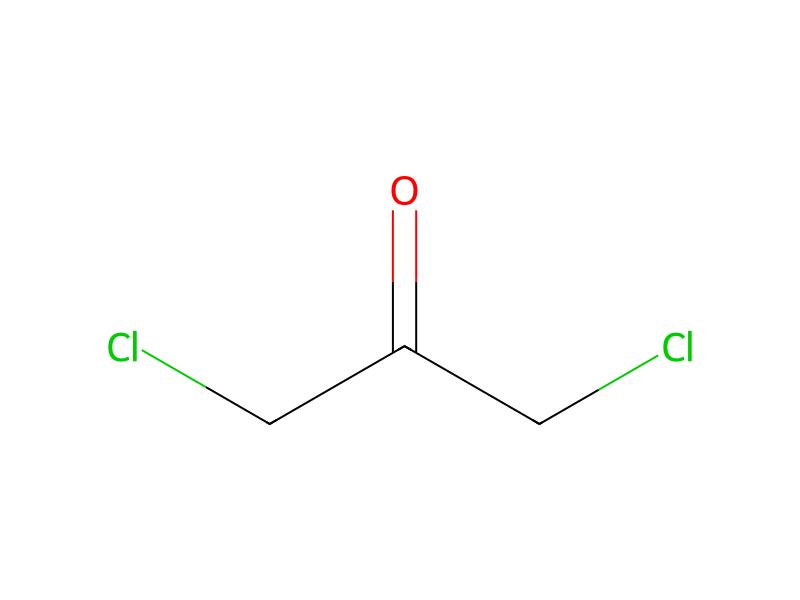
基本情報
- CAS
534-07-6- 標準SMILES
O=C(CCl)CCl- InChIKey
SUNMBRGCANLOEG-UHFFFAOYSA-N- 分子式
- C3H4Cl2O
- 平均分子量
- 126.97 g/mol
- 単同位体質量
- 125.96392011
概要
1,3-dichloroacetone appears as a crystalline solid. Denser than water and insoluble in water. Inhalation of dust or powder may cause adverse health reactions.
名称と識別子
- 優先名称
- 1,3-Dichloroacetone
- IUPAC
- 1,3-dichloropropan-2-one
- 現地名
- 1,3-ジクロロ-2-プロパノン
- 英語名
- 1,3-Dichloroacetone
- 分子式
- C3H4Cl2O
- 分子量
- 126.97
名称と別名
1,3-Dichloroacetone534-07-61,3-Dichloro-2-propanone1,3-Dichloropropanonesym-Dichloroacetone2-Propanone, 1,3-dichloro-BISCHLOROMETHYL KETONEAcetone, 1,3-dichloroalpha,gamma-Dichloroacetone1,3-DichloroacetonaDichloro-1,3 acetoneDTXSID2021577
名称をさらに表示
1,3-ジクロロ-2-プロパノンビス(クロロメチル)ケトンα,γ-ジクロロアセトン1,3-ジクロロアセトンsym-ジクロロアセトン1,3ジクロロアセトン1,1′-ジクロロアセトン1,3‐ジクロロ‐2‐プロパノンDCAdichloroacetone1,3-dichloro-propan-2-one1,3-DCANSC 8745s-Dichloroacetone,-Dichloroacetone
UFH8559WS5NSC-8745alpha,alpha'-DichloroacetoneDTXCID001577CHEBI:156485RefChem:72632208-585-61,3-dichloropropan-2-one
データベース識別子
- CAS
534-07-6- PubChem CID
- 10793
- DTXSID
DTXSID2021577- ChEMBL
CHEMBL1231783- ChEBI
CHEBI:156485- UNII
- UFH8559WS5
- EC Number
- 208-585-6
- Nikkaji
- J1.590C
物性
構造計算による物性
- XLogP
- 1.2
- 極性表面積
- 17.1 Ų
- 水素結合供与体数
- 0
- 水素結合受容体数
- 1
- 回転可能結合数
- 2
- 重原子数
- 6
- 形式電荷
- 0
- 複雑度
- 46.8
実験および物理化学的性質
Chemical ClassesFlammable agents - 2nd degree
SpringerMaterials PropertiesSchoenflies notation
Density
1.3826 at 114.8 °F (EPA, 1998) - Denser than water; will sink
1.3826 at 46 °C/4 °C
1.3826 @ 46°C
Color/Form
Prisms or needles
Plates, needles on distillation
Solubility
> 10% in water
> 10% in ethanol
> 10% in ether
Boiling Point
343 °F at 760 mmHg (EPA, 1998)
173.4 °C
173 °C @760 [mm Hg]
Melting Point
113 °F (EPA, 1998)
45 °C
45 °C
Vapor Density4.38 (EPA, 1998) - Heavier than air; will sink (Relative to Air)
Refractive IndexIndex of refraction: 1.4716 at 40 °C
Physical Description1,3-dichloroacetone appears as a crystalline solid. Denser than water and insoluble in water. Inhalation of dust or powder may cause adverse health reactions.
Other Experimental PropertiesUV: 1-10 (Organic Electronic Spectral Data, Phillips et al, John Wiley & Sons, New York) /1,1-Dichloroacetone/
物理化学的性質
- 融点
- 43 °C · 43 °C
- 沸点
- 73 °C733.4 · 73 °C733.4 mm Hg(lit.)
- 比重(密度)
- 1.383 g/mL · 1.383 g/mL at 25 °C(lit.)
- 蒸気密度
- 4.38 · 4.38 (vs air)
- 蒸気圧
- 0.1 mm · <0.1 mm Hg ( 20 °C)
- 屈折率
- 1.44 · 1.4400
- 闪点
- 193 °F · 193 °F
- 貯蔵温度
- Refrigerator (+4°C) + Poison room
- 溶解性
- アルコール: 非常に溶けやすい
- 外見
- クリスタル
- 色
- 白または無色
- 比重
- 1.383 · 1.383
- PH
- 4.2 · 4.2 (10g/l, H2O, 20℃)
- 水溶解度
- 27.9 g/L · 27.9g/L(20℃)
- Merck
- 14 · 14,3052
- BRN
- 605456 · 605456
- Dielectric constant
- 14 · 14.0(20℃)
- InChI
- 1S/C3H4Cl2O/c4-1-3(6)2-5/h1-2H2
- InChIKey
- SUNMBRGCANLOEG-UHFFFAOYSA-N
- SMILES
- ClCC(=O)CCl
- CAS データベース
- 534 · 534-07-6(CAS DataBase Reference)
- NISTの化学物質情報
- 1 · 1,3-Dichloro-2-propanone(534-07-6)
- EPAの化学物質情報
- Bis(chloromethyl) ketone (534-07-6)
化学的性質
化学的特性White or colorless crystals
安全と法規制
GHS分類
GHS Classification
Danger
H300 (100%): Fatal if swallowed [Danger Acute toxicity, oral]
P203, P260, P262, P264, P264+P265, P270, P271, P273, P280, P284, P301+P316, P301+P330+P331, P302+P352, P302+P361+P354, P304+P340, P305+P354+P338, P316, P317, P318, P320, P321, P330, P361+P364, P363, P391, P403+P233, P405, and P501 (click each P-code to see the statement)
Aggregated GHS information provided per 82 reports by companies from 9 notifications to the ECHA C&L Inventory. Each notification may be associated with multiple companies.
危険有害性情報
Regulatory Information
Chemical: 2-Propanone, 1,3-dichloro-
Status: Active Update: 15-02-2023 https://echa.europa.eu/registration-dossier/-/registered-dossier/17083
1,3-Dichloroacetone: Does not have an individual approval but may be used under an appropriate group standard
The New Jersey Worker and Community Right to Know Act requires public and private employers to provide information about hazardous substances at their workplaces. (N.J.S.A. 34:5A-1 et. seq.)
DOT LabelPoison
Fire Hazards
When heated to decomposition, it emits highly toxic fumes of chlorides. This material may burn but does not ignite readily. Container may explode in heat of fire. (EPA, 1998)
· Combustible material: may burn but does not ignite readily.
Health Hazards
It may be fatal if inhaled, swallowed or absorbed through skin. Contact may cause burns to skin and eyes. Fire may produce irritating or poisonous gases. Runoff from fire control water may give off poisonous gases. Runoff from fire control or dilution water may cause pollution. (EPA, 1998)
· TOXIC and/or CORROSIVE; inhalation, ingestion or skin contact with material may cause severe injury or death.
Hazards Summary
The major hazards encountered in the use and handling of bischloromethyl ketone stem from its toxicologic properties. Toxic by all routes (ie, inhalation, ingestion, and dermal absorption), exposure to this crystalline substance may occur from its use as vesicant or in the synthesis of citric acid. Effects from exposure may include contact burns to the skin and eyes, and even death with sufficiently high concentrations. In activities or situations where over exposure may occur, wear a self-contained breathing apparatus and chemical protective clothing which is specifically recommended by the shipper or producer. If contact should occur. immediately flush affected skin or eyes with running water for at least 15 minutes, and remove contaminated clothing and shoes at the site. While bischloromethyl ketone does not ignite easily, it may burn with the production of irritating and poisonous gases. Also, containers may explode violently in the heat of a fire. Fires involving bischloromethyl ketone may be extinguished with dry chemical, CO2, Halon, water spray, fog, or standard foam. Fight the fire from as far a distance as possible, and dike runoff from fire control water. Containers for international shipment by air and water must bear the labels, "Corrosive" and "Poison", respectively. Small spills of bischloromethyl ketone may be taken up and placed into containers for later disposal (liquid solutions are first absorbed by sand or other noncombustible material). Large liquid spills should be diked far ahead of the spill area for later disposal. Prior to implementing land disposal of bischloromethyl ketone, consult with environmental regulatory agencies for guidance.
DOT ID and Guide2649 153
Reactive GroupHalogenated Organic Compounds
Reactivity Profile
A halogenated ketone. Ketones are reactive with many acids and bases liberating heat and flammable gases (e.g., H2). The amount of heat may be sufficient to start a fire in the unreacted portion of the ketone. Ketones react with reducing agents such as hydrides, alkali metals, and nitrides to produce flammable gas (H2) and heat. Ketones are incompatible with isocyanates, aldehydes, cyanides, peroxides, and anhydrides. They react violently with aldehydes, HNO3, HNO3 + H2O2, and HClO4.
DOT Emergency Guidelines
/GUIDE 153: SUBSTANCES - TOXIC and/or CORROSIVE (Combustible)/ Fire or Explosion: Combustible material: may burn but does not ignite readily. When heated, vapors may form explosive mixtures with air: indoors, outdoors and sewers explosion hazards. Those substances designated with a (P) may polymerize explosively when heated or involved in a fire. Contact with metals may evolve flammable hydrogen gas. Containers may explode when heated. Runoff may pollute waterways. Substance may be transported in a molten form.
/GUIDE 153: SUBSTANCES - TOXIC and/or CORROSIVE (Combustible)/ Health: TOXIC; inhalation, ingestion or skin contact with material may cause severe injury or death. Contact with molten substance may cause severe burns to skin and eyes. Avoid any skin contact. Effects of contact or inhalation may be delayed. Fire may produce irritating, corrosive and/or toxic gases. Runoff from fire control or dilution water may be corrosive and/or toxic and cause pollution.
/GUIDE 153: SUBSTANCES - TOXIC and/or CORROSIVE (Combustible)/ Public Safety: CALL Emergency Response Telephone Number on Shipping Paper first. If Shipping Paper not available or no answer, refer to appropriate telephone number listed on the inside back cover. As an immediate precautionary measure, isolate spill or leak area in all directions for at least 50 meters (150 feet) for liquids and at least 25 meters (75 feet) for solids. Keep unauthorized personnel away. Stay upwind. Keep out of low areas. Ventilate enclosed areas.
/GUIDE 153: SUBSTANCES - TOXIC and/or CORROSIVE (Combustible)/ Protective Clothing: Wear positive pressure self-contained breathing apparatus (SCBA). Wear chemical protective clothing that is specifically recommended by the manufacturer. It may provide little or no thermal protection. Structural firefighters' protective clothing provides limited protection in fire situations ONLY; it is not effective in spill situations where direct contact with the substance is possible.
For more DOT Emergency Guidelines (Complete) data for BISCHLOROMETHYL KETONE (8 total), please visit the HSDB record page.
DOT Hazard Classification
1,3-Dichloroacetone
UN2649
Div 6.1 Poisonous materials (49 eCFR § 173.132)
PG II: the degree of danger presented by the material is medium
Air and Water ReactionsInsoluble in water.
CERCLA Reportable Quantities
Releases of CERCLA hazardous substances are subject to the release reporting requirement of CERCLA section 103, codified at 40 CFR part 302, in addition to the requirements of 40 CFR part 355. Bis(chloromethyl) ketone is an extremely hazardous substance (EHS) subject to reporting requirements when stored in amounts in excess of its threshold planning quantity (TPQ) of 10/10,000 lbs.
安全と保護具
Fire Fighting
Keep unnecessary people away; isolate hazard area and deny entry. Stay upwind; keep out of low areas. Ventilate closed spaces before entering them. Wear positive pressure breathing apparatus and special protective clothing. Remove and isolate contaminated clothing at the site. If water pollution occurs, notify appropriate authorities.
Accidental Release Measures
· CALL 911. Then call emergency response telephone number on shipping paper. If shipping paper not available or no answer, refer to appropriate telephone number listed on the inside back cover.
· ELIMINATE all ignition sources (no smoking, flares, sparks or flames) from immediate area.
First Aid
Warning: Bis(chloromethyl) ketone may be fatal if inhaled, swallowed, or absorbed through skin.
General First Aid:
Exposure Control and Personal Protection· Wear positive pressure self-contained breathing apparatus (SCBA).
Nonfire Spill ResponseExcerpt from ERG Guide 153 [Substances - Toxic and/or Corrosive (Combustible)]:
Disposal Methods
SRP: At the time of review, criteria for land treatment or burial (sanitary landfill) disposal practices are subject to significant revision. Prior to implementing land disposal of waste residue (including waste sludge), consult with environmental regulatory agencies for guidance on acceptable disposal practices.
Isolation and Evacuation
Excerpt from ERG Guide 153 [Substances - Toxic and/or Corrosive (Combustible)]:
Immediate precautionary measure
Protective Action Criteria (PAC)
0.025 [mg/m3]
0.27 [mg/m3]
1.0 [mg/m3]
Personal Protective Equipment (PPE)
For emergency situations, wear a positive pressure, pressure-demand, full facepiece self-contained breathing apparatus (SCBA) or pressure- demand supplied air respirator with escape SCBA and a fully-encapsulating, chemical resistant suit. (EPA, 1998)
Emergency Response Planning GuidelinesSmall Fire
毒性情報
Human Toxicity ExcerptsLacrimator ...
Non-Human Toxicity Excerpts... 1,3-Dichloro-2-propanone is strongly mutagenic without activation.
Probable Routes of Human Exposure... skin ...
法規制情報
CERCLA Reportable Quantities
Releases of CERCLA hazardous substances are subject to the release reporting requirement of CERCLA section 103, codified at 40 CFR part 302, in addition to the requirements of 40 CFR part 355. Bis(chloromethyl) ketone is an extremely hazardous substance (EHS) subject to reporting requirements when stored in amounts in excess of its threshold planning quantity (TPQ) of 10/10,000 lbs.
安全データ
- F
- 19
- wgk
- 3
- tsca
- TSCA listed
- rtecs
- UC1430000
- ridadr
- UN 2649
- 毒性
- mmo-sat 1250 ng/plate MUREAV 157,111,85
- hs_code
- 29147090
- risk_code
- 24-26/28-34-68-36/37/38-11
- 化審法
- (2)-577
- hazard_code
- T+,F
- safety_code
- 26-36/37/39-45-28A-1-28-16
- hazard_class
- 6.1
- packing_group
- II
- Hazard Classifications
- Acute Tox. 1 InhalationAcute Tox. 2 DermalAcute Tox. 2 OralMuta. 2Skin Corr. 1B
- ストレージクラス
- 6.1A - Combustible acute toxic Cat. 1 and 2very toxic hazardous materials
- 有毒物質データの
- 534-07-6(Hazardous Substances Data)
化学と産業
薬理情報
Absorption, Distribution and Excretion... Readily absorbed through the intact skin of rats and humans.
用途と製造
Uses
Vesicant
Synthesis of citric acid based on the reaction of glycerol derived 1,3-dichloroacetone with cyanide.
Methods of ManufacturingPrepd by the oxidation of dichlorohydrin with sodium dichromate.
General Manufacturing Information2-Propanone, 1,3-dichloro-: ACTIVE
応用分野
用途有機合成原料。
使用1,3-Dichloroacetone was used as acceptor substrate in the cross-aldol reaction with donor substrates such as acetone, cyclopentanone and cyclohexanon
一般的な説明A crystalline solid. Denser than water and insoluble in water. Inhalation of dust or powder may cause adverse health reactions.
調製方法
純化方法Crystallise it from CCl4, CHCl3 or *benzene and/or distil under vacuum [Conant & Quayle Org Synth Coll Vol I 211 1941, Hall & Sirel J Am Chem Soc 74 836 1952]. It is dimorphic [Daasch & Kagarise J Am Chem Soc 77 6156 1955]. The oxime has m 130-131o, b 106o/25mm [Arzneimittel-Forsch 8 638 1958]. [Beilstein 1 IV 3219.]
上流・下流製品情報
上流原料
下流製品
関連反応
547 件


化合物ノート
読み込み中…