Methyl Carbamate
データを補完しています。しばらくしてからページを更新すると最新の内容を表示できます
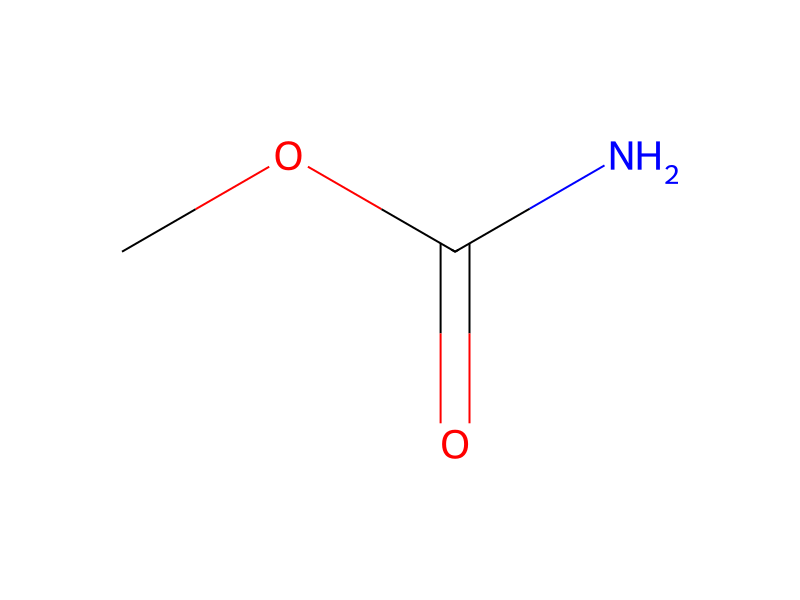
598-55-0COC(N)=OGTCAXTIRRLKXRU-UHFFFAOYSA-NMethyl Carbamate can cause cancer according to The National Toxicology Program.
598-55-0DTXSID8020834CHEMBL1085707CHEBI:76606log Kow = -0.66
-0.64
1.1361 at 133 °F (NTP, 1992) - Denser than water; will sink
1.1361 g/cu cm at 56 °C
WHITE CRYSTALS
NEEDLES
greater than or equal to 100 mg/mL at 66 °F (NTP, 1992)
SOL IN WATER: 217 PARTS IN 100 @ 11 °C
SOL IN ETHANOL: 73 PARTS IN 100 @ 15 °C; SOL IN ETHER
In water, 6.91X10+5 mg/l at 15.5 °C
351 °F at 760 mmHg (NTP, 1992)
177 °C
129 °F (NTP, 1992)
52-54 °C
安全情報は参考情報です。供給元の安全データシート(SDS)、適用法令、専門家による評価に代わるものではありません。
This chemical does not meet GHS hazard criteria for 0.1% (1 of 758) of reports.
Warning
H315 (65.4%): Causes skin irritation [Warning Skin corrosion/irritation]
P203, P261, P264, P264+P265, P271, P280, P302+P352, P304+P340, P305+P351+P338, P318, P319, P321, P332+P317, P337+P317, P362+P364, P403+P233, P405, and P501 (click each P-code to see the statement)
Aggregated GHS information provided per 758 reports by companies from 11 notifications to the ECHA C&L Inventory. Each notification may be associated with multiple companies.
Chemical: Carbamic acid, methyl ester
Hazard Traits - Carcinogenicity
Carbamic acid, methyl ester is listed on the EPA's Chemical Data Reporting (CDR) system. Manufacturers and importers of Carbamic acid, methyl ester are required to report information about their production and use of this chemical to the EPA under the Toxic Substances Control Act (TSCA). (40 eCFR Part 711)
REACH registered substance: Methyl carbamate (EC: 209-939-2)
Carbamic acid, methyl ester: Does not have an individual approval but may be used as a component in a product covered by a group standard. It is not approved for use as a chemical in its own right.
RATS INJECTED IP WITH METHYL CARBAMATE...EXCRETED...CARBAMATE...IN URINE...
DNA BINDING OF...(14)C-METHYL CARBAMATE LABELED IN METHYL GROUP HAS BEEN INVESTIGATED IN MOUSE LIVER & KIDNEY. ... INCORP OF (3)H-METHYL CARBAMATE INTO LIVER-CELL RNA HAS BEEN EXAMINED IN MICE...
Used to make dimethylol methyl carbamate-based resins and pharmaceuticals; Also used in the textile industry as a fabric finish for polyester/cotton blends; [HSDB]
Textiles (Printing, Dyeing, or Finishing) [Category: Industry]
USED IN EUROPE AS PHARMACEUTICAL INTERMEDIATE
An intermediate in the manufacture of dimethylol methyl carbamate-based resins, which are used in the textile industry as durable-press fabric finishes for polyester/cotton blends.
2023: 1,000,000 - <5,000,000 lb
(1975) PROBABLY GREATER THAN 9.1X10+5 GRAMS
FROM SILVER OR MERCURICYANATE WITH H2S & METHANOL: BIRKENBACH, KOLB, BER 68, 901 (1953). FROM UREA & METHANOL: GERMAN PATENT 753,127 (1940 TO IG FARBENIND).
IT CAN...BE PREPD BY REACTION OF AMMONIA WITH METHYL CHLOROFORMATE ... & THIS METHOD IS BELIEVED TO HAVE BEEN USED COMMERCIALLY.
All Other Basic Organic Chemical Manufacturing
Carbamic acid, methyl ester: ACTIVE
読み込み中…
化学的特性Methyl carbamate is a white, adhesive crystal. It is highly soluble in water, as well as in ethanol, acetone, and other organic solvents.
METHYL CARBAMATE is a carbamate ester. Carbamates are chemically similar to, but more reactive than amides. Like amides they form polymers such as polyurethane resins. Carbamates are incompatible with strong acids and bases, and especially incompatible with strong reducing agents such as hydrides. Flammable gaseous hydrogen is produced by the combination of active metals or nitrides with carbamates. Strongly oxidizing acids, peroxides, and hydroperoxides are incompatible with carbamates.
This intermediate /N-carbomethoxymethylimino phosphoryl chloride/ (or its ethyl homolog), produced during prepn of phosphoryl dichloride isocyanate from interaction of phosphorus pentachloride & methyl (or ethyl) carbamate, is unstable. Its decomposition to the required product may be violent or explosive unless moderated by the presence of a halogenated solvent.
EYES: First check the victim for contact lenses and remove if present. Flush victim's eyes with water or normal saline solution for 20 to 30 minutes while simultaneously calling a hospital or poison control center. Do not put any ointments, oils, or medication in the victim's eyes without specific instructions from a physician. IMMEDIATELY transport the victim after flushing eyes to a hospital even if no symptoms (such as redness or irritation) develop.
SMALL SPILLS AND LEAKAGE: If you spill this chemical, you should dampen the solid spill material with water, then transfer the dampened material to a suitable container. Use absorbent paper dampened with water to pick up any remaining material. Seal your contaminated clothing and the absorbent paper in a vapor-tight plastic bag for eventual disposal. Wash all contaminated surfaces with a soap and water solution. Do not reenter the contaminated area until the Safety Officer (or other responsible person) has verified that the area has been properly cleaned.
SRP: At the time of review, criteria for land treatment or burial (sanitary landfill) disposal practices are subject to significant revision. Prior to implementing land disposal of waste residue (including waste sludge), consult with environmental regulatory agencies for guidance on acceptable disposal practices.
RECOMMENDED RESPIRATOR: Where the neat test chemical is weighed and diluted, wear a NIOSH-approved half face respirator equipped with a combination filter cartridge, i.e. organic vapor/acid gas/HEPA (specific for organic vapors, HCl, acid gas, SO2 and a high efficiency particulate filter). (NTP, 1992)
Male CF-1 mice were treated with urethane (0, 0.5, 1.0, 1.5, and 2 g/kg; ip) and 18 hr later hepatic metallothionein concentrations were determined with the cadmium hemoglobin radioassay. Urethane (1 g/kg and higher) significantly increase hepatic metallothionein levels, resulting in a 14 fold increase after 2 g/kg. Time course experiments indicated that metallothionein levels were increased significantly at 6 hr after administration of urethane (1.5 g/kg) and reached a maximum between 12 and 24 hr. Gel filtration, anion exchange chromatography, and UV spectral analysis were used to characterize the protein induced by urethane. Pretreatment with actinomycin-D prevented induction of metallothionein by urethane. Administration of equimolar dosages (20 mmol/kg) of urethane, N-hydroxyurethane, and methyl carbamate indicated that urethane and N-hydroxyurethane induce metallothionein but that methyl carbamate does not. Metallothionein induction was also not observed with (pentobarbital and phenobarbital). Urethane induces hepatic metallothionein but this effect is not related to its anesthetic action, nor is it a common property of all carbamates.
TERRESTRIAL FATE: Based on a recommended classification scheme(1), an estimated Koc value of 10(SRC), determined from a measured log Kow of -0.66(2) and a recommended regression-derived equation(3), indicates that methyl carbamate is expected to have very high mobility in soil(SRC). However, methyl carbamate was determined to adsorb onto the clay mineral montmorillonite(4). Volatilization of methyl carbamate will not be important from moist soil surfaces(SRC) given an estimated Henry's Law constant of 4.0X10⁻⁸ atm-cu m/mole(SRC), using a fragment constant estimation method(5). Hydrolysis of methyl carbamate in moist soils may be catalyzed by adsorption to Na+, Mg2+, Al3+, and Cu2+ montmorillonites(4,SRC). Biodegradation of methyl carbamate in soil may be important(SRC), based on its biodegradation in river and seawater(6).
AQUATIC FATE: Based on a recommended classification scheme(1), an estimated Koc value of 10(SRC), determined from a measured log Kow of -0.66(2) and a recommended regression-derived equation(3), indicates that methyl carbamate is not expected to adsorb to suspended solids and sediment in water(SRC). Methyl carbamate is not expected to volatilize from water surfaces(3,SRC) based on an estimated Henry's Law constant of 4.0X10⁻⁸ atm-cu m/mole(SRC), developed using a fragment constant estimation method(4). According to a classification scheme(5), an estimated BCF value of 0.19(3,SRC), from a measured log Kow(2), suggests that bioconcentration in aquatic organisms is low(SRC). Methyl carbamate was degraded 19 and 18% in river and seawater, respectively, over a three day period(6). Purely aliphatic carbamates are expected to be resistant to hydrolysis under environmental conditions(7); hydrolysis half-lives of 3300 and 330 years at pH values of 7 and 8, respectively, were estimated for methyl carbamate(8,SRC).
ATMOSPHERIC FATE: According to a model of gas/particle partitioning of semivolatile organic compounds in the atmosphere(1), methyl carbamate, which has an estimated vapor pressure of 0.56 mm Hg at 25 °C(2,SRC), is expected to exist solely as a vapor in the ambient atmosphere. Vapor-phase methyl carbamate is degraded in the atmosphere by reaction with photochemically-produced hydroxyl radicals(SRC); the half-life for this reaction in air is estimated to be about 4.8 days(3,SRC).
Methyl carbamate was detected in trace amounts in red and white wines, sherry, whisky, and Armagnac(1). Methyl carbamate was detected in fruit brandy from France and Austria at an average concentration of 28 and 9 ug/kg, respectively(1). Methyl carbamate was detected in various breads, light toast, and dark toast at an average concentration of 3.0, 2.2, and 2.7 ug/kg, respectively(1). Trace levels, 1 to 4 ug/kg, of methyl carbamate were detected in various yogurt samples(1). Soy sauce samples contained minute amounts, 0.1 to 1.1 ug/kg, of methyl carbamate(1).
The following link will take the user to the National Toxicology Program (NTP) Test Agent Search Results page, which tabulates all of the "Standard Toxicology & Carcinogenesis Studies", "Developmental Studies", and "Genetic Toxicity Studies" performed with this chemical. Clicking on the "Testing Status" link will take the user to the status (i.e., in review, in progress, in preparation, on test, completed, etc.) and results of all the studies that the NTP has done on this chemical. [http://ntp-apps.niehs.nih.gov/ntp_tox/index.cfm?fuseaction=ntpsearch.searchresults&searchterm=598-55-0]
The Koc of methyl carbamate is estimated as approximately 10(SRC), using a measured log Kow of -0.66(1) and a regression-derived equation(2,SRC). According to a recommended classification scheme(3), this estimated Koc value suggests that methyl carbamate is expected to have very high mobility in soil(SRC). Methyl carbamate adsorbs on Na+, Mg2+, Al3+, and Cu2+ montmorillonites which catalyze the hydrolysis of methyl carbamate when equilibrated at room temperature and 100% relative humidity(4).
Methyl carbamate
Group 3: Not classifiable as to its carcinogenicity to humans
Volume 12: (1976) Some Carbamates, Thiocarbamates and Carbazides
1987
1987
Methyl Carbamate
An estimated BCF value of 0.19 was calculated for methyl carbamate(SRC), using a measured log Kow of -0.66(1) and a recommended regression-derived equation(2). According to a classification scheme(3), this BCF value suggests that bioconcentration in aquatic organisms is low(SRC).
The Henry's Law constant for methyl carbamate is estimated as 4.0X10⁻⁸ atm-cu m/mole(SRC) using a fragment constant estimation method(1). This value indicates that methyl carbamate will be essentially nonvolatile from water surfaces(2,SRC). Methyl carbamate's Henry's Law constant(1,SRC) indicates that volatilization from moist soil surfaces is not expected to occur(SRC).
用途有機合成原料。
使用Methyl carbamate was used in the synthesis of protected aminocyclopropanes.
一般的な説明Methyl carbamate appears as white to Almost white powder to crystal. It an intermediate in the manufacture of dimethylol methyl carbamate-based resins, which are used in the textile industry as durable-press fabric finishes for polyester/cotton blends.
純化方法Crystallise the carbamate from *benzene or distil it. [Beilstein 3 H 21.]
定義ChEBI: Methyl carbamate is a carbamate ester resulting from the formal condensation of the carboxy group of carbamic acid with methanol.