基本情報
- CAS
1211931-83-7- 標準SMILES
CN(CCN1CCC(OC(=O)Nc2ccccc2-c2ccccc2)CC1)C(=O)c1ccc(CN2CCC(C(N)=O)CC2)cc1- InChIKey
FYDWDCIFZSGNBU-UHFFFAOYSA-N- 分子式
- C35H43N5O4
- 平均分子量
- 597.7 g/mol
- 単同位体質量
- 597.33150486
概要
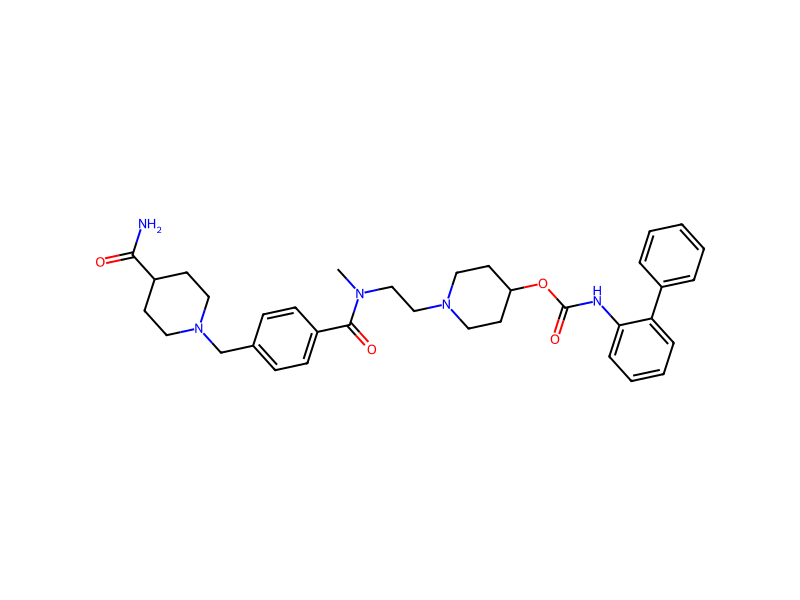
Revefenacin is a novel biphenyl carbamate tertiary amine agent that belongs to the family of the long-acting muscarinic antagonists (LAMA). The labile primary amide in the structure produces a "soft-drug" site that allows rapid systemic clearance and minimizing of the systemically mediated adverse reactions. The LAMA group falls into a parent category known as long-acting inhaled bronchodilators and this type of agents are recommended as a maintenance therapy for chronic obstructive pulmonary disease (COPD). From the LAMA group, revefenacin is the first once-daily nebulized LAMA treatment. It was developed by Theravance Biopharma and FDA approved on November 9, 2018.
名称と識別子
- 優先名称
- Revefenacin
- IUPAC
- [1-[2-[[4-[(4-carbamoylpiperidin-1-yl)methyl]benzoyl]-methylamino]ethyl]piperidin-4-yl] N-(2-phenylphenyl)carbamate
- 現地名
- レベフェナシン
- 英語名
- TD-4208
- 分子式
- C35H43N5O4
- 分子量
- 597.75
名称と別名
Revefenacin864750-70-9TD-4208YupelriGSK-1160724revefenacinarevefenacineGSK1160724G2AE2VE07O[1-[2-[[4-[(4-carbamoylpiperidin-1-yl)methyl]benzoyl]-methylamino]ethyl]piperidin-4-yl] N-(2-phenylphenyl)carbamate1-(2-(4-((4-Carbamoylpiperidin-1-yl)methyl)-N-methylbenzamido)ethyl)piperidin-4-yl N-((1,1'-biphenyl)-2-yl)carbamateDTXSID701027775
名称をさらに表示
レベフェナシン1-(2-(4-((4-carbamoylpiperidin-1-yl)methyl)-N-methylbenzamido)ethyl)piperidin-4-yl [1,1'-biphenyl]-2-ylcarbamatebiphenyl-2-ylcarbamic acid 1-(2-{[4-(4-carbamoylpiperidin-1-ylmethyl)benzoyl]methylamino}ethyl)piperidin-4-ylesterCPDD1221REVENACINRefenaxinLefennaxinRafenexine
Biphenyl-2-ylcarbamic acid, 1-(2-((4-(4-carbamoylpiperidin-1-ylmethyl)benzoyl)methylamino)ethyl)piperidin-4-yl ester1-[2-[[4-[[4-(Aminocarbonyl)-1-piperidinyl]methyl]benzoyl]methylamino]ethyl]-4-piperidinyl N-[1,1'-biphenyl]-2-ylcarbamaterevefenacinum(1-(2-((4-((4-carbamoylpiperidin-1-yl)methyl)benzoyl)-methylamino)ethyl)piperidin-4-yl) N-(2-phenylphenyl)carbamate1-(2-((4-((4-(Aminocarbonyl)-1-piperidinyl)methyl)benzoyl)methylamino)ethyl)-4-piperidinyl N-(1,1'-biphenyl)-2-ylcarbamate1-(2-(1-(4-((4-carbamoylpiperidin-1-yl)methyl)phenyl)-N-methylformamido)ethyl)piperidin-4-yl N-((1,1'-biphenyl)-2-yl)carbamate1-[2-(1-{4-[(4-carbamoylpiperidin-1-yl)methyl]phenyl}-N-methylformamido)ethyl]piperidin-4-yl N-{[1,1'-biphenyl]-2-yl}carbamateRefChem:57759
物性
構造計算による物性
- XLogP
- 4.1
- 極性表面積
- 108 Ų
- 水素結合供与体数
- 2
- 水素結合受容体数
- 6
- 回転可能結合数
- 11
- 重原子数
- 44
- 形式電荷
- 0
- 複雑度
- 918
実験および物理化学的性質
DrugsPharmaceuticals -> Listed in ZINC15
Solubility< 1 mg/ml
Human Drugs
Breast Feeding; Lactation; Milk, Human; Parasympatholytics; Muscarinic Antagonists; Bronchodilator Agents
FDA approved drugs -> Active ingredient
FDA approved drugs -> Active ingredient
物理化学的性質
- 沸点
- 777.5 · 777.5±60.0 °C(Predicted)
- 比重(密度)
- 1.26 · 1.26±0.1 g/cm3(Predicted)
- 貯蔵温度
- -20 °C · Store at -20°C
- 溶解性
- 125 mg/mL · DMSO : ≥ 125 mg/mL (209.12 mM)
- 外見
- Solid
- 酸解離定数(Pka)
- 13.34 · 13.34±0.70(Predicted)
- 色
- White to off-white
- InChIKey
- FYDWDCIFZSGNBU-UHFFFAOYSA-N
- SMILES
- C(OC1CCN(CCN(C(=O)C2=CC=C(CN3CCC(C(N)=O)CC3)C=C2)C)CC1)(=O)NC1=CC=CC=C1C1=CC=CC=C1
安全と法規制
GHS分類
GHS Classification
Warning
H302 (100%): Harmful if swallowed [Warning Acute toxicity, oral]
P264, P270, P301+P317, P330, and P501 (click each P-code to see the statement)
Aggregated GHS information provided per 2 reports by companies from 1 notifications to the ECHA C&L Inventory.
Warning
H302 (100%): Harmful if swallowed [Warning Acute toxicity, oral]
危険有害性情報
Hazard Classes and CategoriesAcute Tox. 4 (100%)
毒性情報
Hepatotoxicity
Like other anticholinergic agents, revefenacin has not been linked to episodes of liver enzyme elevations or clinically apparent liver injury. Another reason for its hepatic safety may relate to its low systemic absorption when administered by inhaler.
Effects During Pregnancy and Lactation◉ Summary of Use during Lactation
安全データ
- 注意喚起語
- 警告
- 危険有害性情報
- コード 危険有害性情報 危険有害性クラス 区分 注意喚起語 シンボル P コード H302
化学と産業
薬理情報
ATC Code
R - Respiratory system
QR - Respiratory system
Protein BindingThe protein binding of revefenacin and its active metabolite is of 71% and 42% respectively.
Pharmacodynamics
Revefenacin has been reported to produce a sustained, long-acting bronchodilation with lower anti-muscarinic-related side effects. In clinical trials, revefenacin demonstrated to be of a long duration of action and low systemic exposure in patients with COPD. Also, it was reported that a dose of 88 mcg can produce a clinically effective bronchodilation measured by through forced expiratory volume in 1s and serial spirometric assessments. In placebo-controlled trials, revefenacin showed a decrease in the use of albuterol rescue inhalers and sustained increases in the peak expiratory flow rate that reached a steady state at a maximum in day 7. As well, there was a reported superior lung selectivity index when compared with other LAMAs such as glycopyrronium and tiotropium which produced a decreased sialagogue effect.
Mechanism of Action
Revefenacin is an inhaled bronchodilator muscarinic antagonist with a long-acting bronchodilation activity. It has been shown to present a high affinity and behaved as a competitive antagonist of the five muscarinic cholinergic receptors. Studies have indicated that revefenacin dissociates significantly slower from the muscarinic receptor M3 (hM3) when compared to the receptor M2 (hM2) which indicates a kinetic selectivity for this subtype. This competitive antagonism produces a suppressive action of the acetylcholine-evoked calcium mobilization and contractile responses in the airway tissue. Lastly, due to the duration of the bronchodilation, revefenacin is considered a long-acting muscarinic antagonist which allows it to be dosed once daily. This response is very important for the therapy of COPD as the main goal is the reduce the frequency and severity of exacerbations which are normally driven by the presence of elevated cholinergic bronchoconstrictor tone mediated by muscarinic receptors on parasympathetic ganglia and airway smooth muscle. Hence, the activity of revefenacin produces a potent and long-lasting protection against the bronchoconstrictor response to acetylcholine or methacholine.
関連反応
0 件
現在のフィルター条件では反応記録がありません。
化合物ノート
読み込み中…