
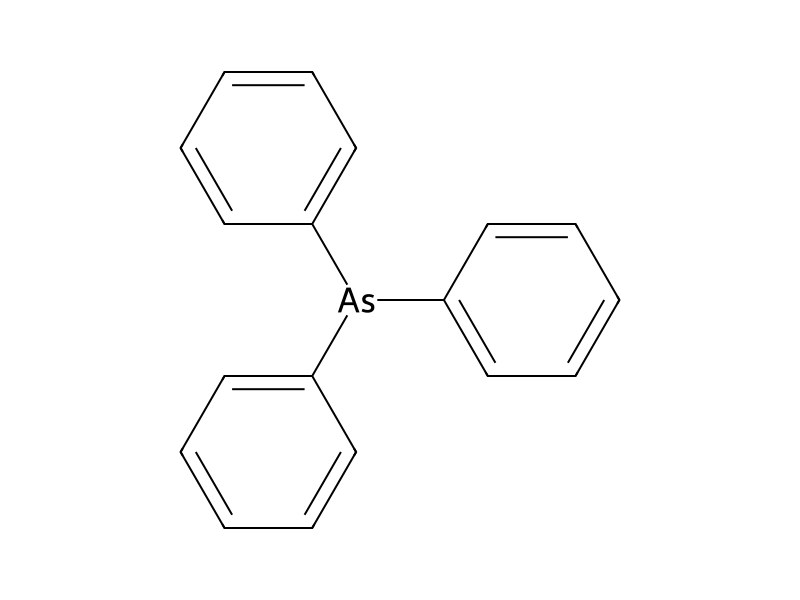
基本情報
- 標準SMILES
c1ccc([As](c2ccccc2)c2ccccc2)cc1- InChIKey
BPLUKJNHPBNVQL-UHFFFAOYSA-N- 分子式
- C18H15As
- 平均分子量
- 306.2 g/mol
- 単同位体質量
- 306.03897
名称と識別子
- 優先名称
- Triphenylarsine
- IUPAC
- triphenylarsane
- 現地名
- トリフェニルアルシン
- 英語名
- Triphenylarsine
- 分子式
- C18H15As
- 分子量
- 306.23
名称と別名
TRIPHENYLARSINETriphenylarsane603-32-7Arsine, triphenyl-TriphenylarseneTriphenyl arsenicMN8EZ3FL74NSC-478DTXSID4060529RefChem:191898DTXCID6042787210-032-9
名称をさらに表示
トリフェニルアルシントリフェニルひ素(III)トリフェニルひ素トリフエニル砒素トリフェニルひ素, 98%トリフェニルひ素, min. 97%Triphenyl-arsanetriphenyl-arsinTriphenylarsine,97%Triphenylarsine,98%
ArsinetriphenylMFCD00002994TriphenylarsenicNSC 478Arsenic triphenylC18H15AsEINECS 210-032-9UNII-MN8EZ3FL74
データベース識別子
- CAS
603-32-7- PubChem CID
- 11773
- DTXSID
DTXSID4060529- UNII
- MN8EZ3FL74
- EC Number
- 210-032-9
- Nikkaji
- J44.111B
物性
構造計算による物性
- 極性表面積
- 0 Ų
- 水素結合供与体数
- 0
- 水素結合受容体数
- 0
- 回転可能結合数
- 3
- 重原子数
- 19
- 形式電荷
- 0
- 複雑度
- 202
実験および物理化学的性質
Vapor Pressure0.0000496 [mmHg]
Physical DescriptionWhite powder; [Alfa Aesar MSDS] Fine colorless crystals; [Aldrich MSDS]
Kovats Retention Index2195
物理化学的性質
- 融点
- 58 · 58-61 °C (lit.)
- 沸点
- 360 °C · 360 °C
- 比重(密度)
- 1 · 1,225 g/cm3
- 屈折率
- 1.6888 · 1.6888
- 闪点
- 265 °C · 265 °C
- 貯蔵温度
- 30 °C · Store below +30°C.
- 外見
- 粉
- 比重
- 1.2225 · 1.2225
- 色
- 白い
- 水溶解度
- メタノールに可溶。水に不溶。
- BRN
- 1842037 · 1842037
- InChI
- 1S/C18H15As/c1-4-10-16(11-5-1)19(17-12-6-2-7-13-17)18-14-8-3-9-15-18/h1-15H
- InChIKey
- BPLUKJNHPBNVQL-UHFFFAOYSA-N
- SMILES
- c1ccc(cc1)[As](c2ccccc2)c3ccccc3
- CAS データベース
- 603 · 603-32-7(CAS DataBase Reference)
- EPAの化学物質情報
- Arsine, triphenyl- (603-32-7)
化学的性質
化学的特性COLOURLESS TO SLIGHTLY YELLOW CRYSTALLINE SOLID
安全と法規制
GHS分類
GHS Classification
Danger
H301 (100%): Toxic if swallowed [Danger Acute toxicity, oral];H331 (100%): Toxic if inhaled [Danger Acute toxicity, inhalation];H400 (90.9%): Very toxic to aquatic life [Warning Hazardous to the aquatic environment, acute hazard];H410 (100%): Very toxic to aquatic life with long lasting effects [Warning Hazardous to the aquatic environment, long-term hazard]
P261, P264, P270, P271, P273, P301+P316, P304+P340, P316, P321, P330, P391, P403+P233, P405, and P501 (click each P-code to see the statement)
Aggregated GHS information provided per 44 reports by companies from 4 notifications to the ECHA C&L Inventory. Each notification may be associated with multiple companies.;Information may vary between notifications depending on impurities, additives, and other factors. The percentage value in parenthesis indicates the notified classification ratio from companies that provide hazard codes. Only hazard codes with percentage values above 10% are shown. For more detailed information, please visit ECHA C&L website.
危険有害性情報
Regulatory Information
Restricted substance: Triphenylarsine;EC: 210-032-9;Restriction condition document: PDF link
Triphenylarsine: Does not have an individual approval but may be used under an appropriate group standard
Hazards Summary
An irritant; Toxic by ingestion and inhalation; [Alfa Aesar MSDS] Almost nothing is known regarding health effects of organic arsenic compounds in humans. Studies in animals show that some simple organic arsenic compounds are less toxic than inorganic forms. Ingestion of methyl and dimethyl compounds can cause diarrhea and damage to the kidneys. [ATSDR ToxProfiles] See Dimethylarsenic acid.
Hazard Classes and CategoriesAcute Tox. 3 (100%);Acute Tox. 3 (100%);Aquatic Acute 1 (90.9%);Aquatic Chronic 1 (100%)
安全と保護具
Minimum Risk LevelAcute Oral: 0.005 mg/kg/day (L134)
Chronic Oral: 0.0003 mg/kg/day (L134)
Chronic Inhalation: 0.01 mg/m3 (L134)
Permissible Exposure Limit (PEL)0.5 [mg/m3], as As
毒性情報
Treatment
Arsenic poisoning can be treated by chelation therapy, using chelating agents such as dimercaprol, EDTA or DMSA. Charcoal tablets may also be used for less severe cases. In addition, maintaining a diet high in sulfur helps eliminate arsenic from the body. (L20)
Health EffectsArsenic poisoning can lead to death from multi-system organ failure, probably from necrotic cell death, not apoptosis. Arsenic is also a known carcinogen, esepcially in skin, liver, bladder and lung cancers. (T1, L20)
Exposure RoutesOral (L2) ; inhalation (L2) ; dermal (L2)
Toxicity Summary
Arsenic and its metabolites disrupt ATP production through several mechanisms. At the level of the citric acid cycle, arsenic inhibits pyruvate dehydrogenase and by competing with phosphate it uncouples oxidative phosphorylation, thus inhibiting energy-linked reduction of NAD+, mitochondrial respiration, and ATP synthesis. Hydrogen peroxide production is also increased, which might form reactive oxygen species and oxidative stress. Arsenic's carginogenicity is influenced by the arsenical binding of tubulin, which results in aneuploidy, polyploidy and mitotic arrests. The binding of other arsenic protein targets may also cause altered DNA repair enzyme activity, altered DNA methylation patterns and cell proliferation. (T1, A17)
Signs and SymptomsExposure to lower levels of arsenic can cause nausea and vomiting, decreased production of red and white blood cells, abnormal heart rhythm, damage to blood vessels, and a sensation of
Carcinogen Classification3, not classifiable as to its carcinogenicity to humans. (L135)
法規制情報
Regulatory Information
Restricted substance: Triphenylarsine;EC: 210-032-9;Restriction condition document: PDF link
Triphenylarsine: Does not have an individual approval but may be used under an appropriate group standard
安全データ
- wgk
- 3
- tsca
- TSCA listed
- rtecs
- CH8942500
- ridadr
- UN 3465 6.1/PG 2
- hs_code
- 2931 90 00
- risk_code
- 23/25-50/53
- 安衛法
- 特化則 特定化学物質(管理第2類)
- hazard_code
- T,N
- safety_code
- 20/21-28-45-60-61
- hazard_class
- 6.1
- packing_group
- II
- 毒劇物取締法
- 毒物
- Hazard Classifications
- Acute Tox. 3 InhalationAcute Tox. 3 OralAquatic Acute 1Aquatic Chronic 1
- ストレージクラス
- 6.1A - Combustible acute toxic Cat. 1 and 2very toxic hazardous materials
化学と産業
薬理情報
Metabolism/Metabolites
Arsenic is absorbed mainly by inhalation or ingestion, as to a lesser extent, dermal exposure. It is then distributed throughout the body, where it is reduced into arsenite if necessary, then methylated into monomethylarsenic (MMA) and dimethylarsenic acid (DMA) by arsenite methyltransferase. Arsenic and its metabolites are primarily excreted in the urine. Arsenic is known to induce the metal-binding protein metallothionein, which decreases the toxic effects of arsenic and other metals by binding them and making them biologically inactive, as well as acting as an antioxidant. (L20)
用途と製造
UsesTriphenylarsine is used as a ligand and a reagent in coordination chemistry and organic synthesis. (L398)
General Manufacturing InformationArsine, triphenyl-: ACTIVE
応用分野
解説トリフェニルアルシン,無色の板状結晶.融点61 ℃,沸点232~234 ℃(1.8 kPa).エーテル,ベンゼンに可溶,冷エタノールに微溶,水に不溶.毒性がある.室温では空気中で安定である.ヨウ化メチルとアルソニウム化合物(C6H5)3(CH3)AsIをつくるが,ヨウ化エチル,そのほかのハロゲン化アルキルとではこの種の反応は起こらない.
用途電子供与体としての性質を備え,遷移金属錯体の配位子として用いられる.
使用Triphenylarsine is used in certain metal-catalyzed coupling reactions. It is a precursor to tetraphenylarsonium chloride a popular precipitating agent.
調製方法
純化方法Recrystallise Ph3As from EtOH or aqueous EtOH [Dahlinger et al. J Chem Soc, Dalton Trans 2145 1986, Boert et al. J Am Chem Soc 109 7781 1987]. [Beilstein 16 H 829, 16 I 431, 16 II 407, 16 III 921, 16 IV 1139.] HIGHLY TOXIC.
上流・下流製品情報
下流製品
サプライヤー49 社
梯希爱(上海)化成工业发展有限公司021-67121386 · [email protected]
北京福源坊科技有限公司010-57903446 15869909019 · [email protected]
Hebei Chuanghai Biotechnology Co., Ltd+86-17732866630 · [email protected]
环生美森医药技术(山东)有限公司0531-88762217 18301471076 · [email protected]
江苏星科元信息科技有限公司400-605-7200 15335295587
Dayang Chem (Hangzhou) Co.,Ltd.+86-0571-88938639 17705817739 · [email protected]
Syntechem Co.,Ltd[email protected]
上海迈瑞尔生化科技有限公司4006356688 18621169109 · [email protected]
北京索莱宝科技有限公司010-50973130 17801761073 · [email protected]
阿法埃莎(中国)化学有限公司400-6106006 · [email protected]
安耐吉化学&3A(安徽泽升科技股份有限公司)400-0056266 · [email protected]
广东元丰化学试剂有限公司0751-2829979 13318593351 · [email protected]
上海瀚鸿科技股份有限公司021-54306202 13764082696 · [email protected]
上海泰坦科技股份有限公司400-6009262 15618770481 · [email protected]
上海毕楷科技有限公司18516304666
上海耐士化工科技有限公司400-188-0725 +86 21 34310725 13611771617
ZHEJIANG JIUZHOU CHEM CO., LTD+86-0576225566889 +86-13454675544 · [email protected];[email protected];[email protected]
TOKYO CHEMICAL INDUSTRY CO., LTD.03-36680489 · [email protected]
河南赢创生物科技有限公司15672878902 · [email protected]
上海麦克林生化科技股份有限公司15221275939 15221275939 · [email protected]
陕西缔都医药化工有限公司+86-29-87569262 +86-15003564040 · [email protected]
Sigma-Aldrich西格玛奥德里奇(上海)贸易有限公司021-61415566 800-8193336 · [email protected]
九鼎化学(上海)科技有限公司4009209199 · [email protected]
上海阿拉丁生化科技股份有限公司6206333 13167063860 · [email protected]
陕西缔都医药化工有限公司029-029-81120477 17792793610 · [email protected]
上海源叶生物科技有限公司13636370518 · [email protected]
山东西亚化学有限公司4009903999 13395398332 · [email protected]
Shanghai Acmec Biochemical Technology Co., Ltd.+86-18621343501 · [email protected]
杭州洁汉化工有限公司+86-571-86217390; +8618058761490 · [email protected]
江苏艾康生物医药研发有限公司025-58859352 13913916777 · [email protected]
厦门盈融达化工有限公司+86-0592-6210733 · [email protected]
天津希恩思生化科技有限公司400-6387771-6039 18920764717 · [email protected]
career henan chemical co+86-0371-86658258 · [email protected]
艾览(上海)化工科技有限公司400-668-9898 · [email protected]
上海吉至生化科技有限公司021-4009004166/18616739031 18616739031 · [email protected]
广东翁江化学试剂有限公司0751-2815688 13927872512 · [email protected]
TCI Chemicals (India) Pvt. Ltd.[email protected]
Aladdin Scientific[email protected]
XIAMEN AMITY INDUSTRY AND TRADE CO., LTD.+8618950047208 · [email protected]
上海凯为化学科技有限公司021-58461859 15821823057 · [email protected]
SHANGHAI KEAN TECHNOLOGY CO., LTD.+8613817748580 · [email protected]
唐缘生命科学(上海)有限公司400-618-1121 17316483629 · [email protected]
南京一览生物科技有限公司13851808754 · [email protected]
北京偶合科技有限公司13552068683 13522913783 · [email protected]
重庆卡兰医药有限公司[email protected]
北京百灵威科技有限公司18210857532 18210857532 · [email protected]
河北贞田食品添加剂有限公司0551-77777777-5 13333333333
Hefei TNJ Chemical Industry Co.,Ltd.+86-0551-65418671 +86-189 4982 3763 · [email protected]
上海阿摩尔生物科技有限公司13370042665 18916960931 · [email protected]
関連反応
190 件







関連ノート
読み込み中…