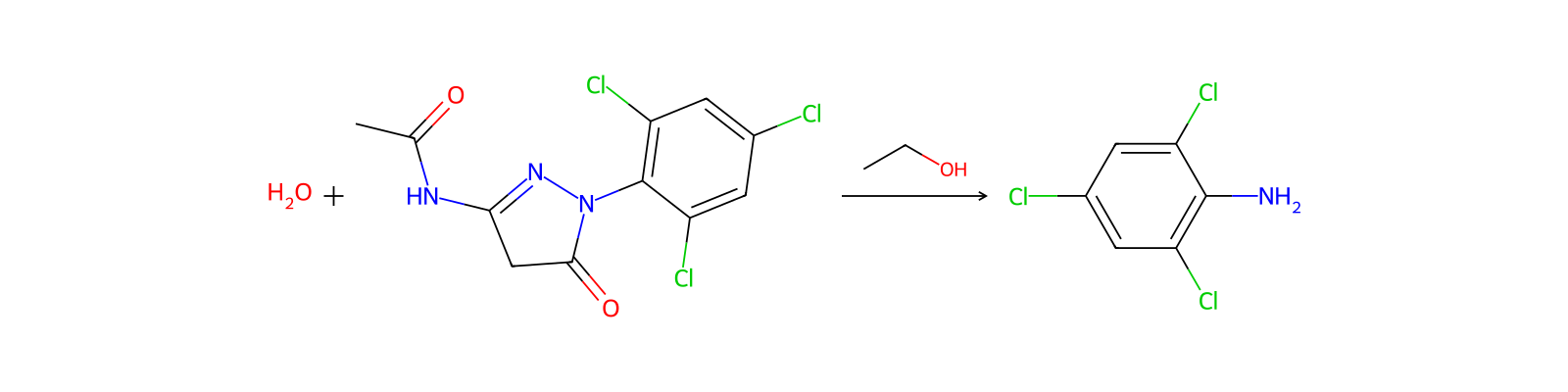
634-93-5Nc1c(Cl)cc(Cl)cc1ClNATVSFWWYVJTAZ-UHFFFAOYSA-NLong needles or fine, light purple fibers. (NTP, 1992)
634-93-5DTXSID6021379CHEMBL1894620less than 1 mg/mL at 70.7 °F (NTP, 1992)
Sol in ethanol, ether, and chloroform
Insoluble in phosphoric acid
40 mg/l in water @ 25 °C
504 °F at 760 mmHg (NTP, 1992)
262 °C @ 746 mm Hg
163 to 167 °F (NTP, 1992)
78.5 °C
1 mmHg at 273.2 °F ; 5 mmHg at 316.0 °F (NTP, 1992)
0.00000015 [mmHg]
1.47X10⁻⁷ mm Hg @ 25 °C
Danger
H301+H311+H331 (35.9%): Toxic if swallowed, in contact with skin or if inhaled [Danger Acute toxicity, oral; acute toxicity, dermal; acute toxicity, inhalation]
P260, P261, P262, P264, P270, P271, P272, P273, P280, P301+P316, P302+P352, P304+P340, P316, P319, P321, P330, P333+P317, P361+P364, P362+P364, P391, P403+P233, P405, and P501 (click each P-code to see the statement)
Aggregated GHS information provided per 78 reports by companies from 9 notifications to the ECHA C&L Inventory. Each notification may be associated with multiple companies.
Warning
H401: Toxic to aquatic life [Hazardous to the aquatic environment, acute hazard]
Chemical: Benzenamine, 2,4,6-trichloro-
Status: Active Update: 30-07-2019 https://echa.europa.eu/registration-dossier/-/registered-dossier/11174
A mutagen and tumorigen; Causes methemoglobinemia, abnormal liver enzymes, and convulsions in lethal-dose feeding studies of rats; [RTECS] Emergency treatment: Aniline. [HSDB] A skin and eye irritant; [CAMEO] An irritant; May induce methemoglobinemia; Effects in high-dose animal studies include methemoglobinemia and convulsions; [MSDSonline]
Pursuant to section 8(d) of TSCA, EPA promulgated a model Health and Safety Data Reporting Rule. The section 8(d) model rule requires manufacturers, importers, and processors of listed chemical substances and mixtures to submit to EPA copies and lists of unpublished health and safety studies. 2,4,6-Trichlorobenzeneamine is included on this list.
YIELDS 3-AMINO-2,4,6-TRICHLOROPHENOL & 4-AMINO-3,5-DICHLOROPHENOL IN RABBITS. /FROM TABLE/
ACARICIDE BENZOYL CHLORIDE PENETRATED SPIDER MITE RAPIDLY & WAS METABOLIZED SLOWLY TO 2,4,6-TRICHLOROANILINE AS ONE OF ITS MINOR METABOLITES.
Used to make benzene derivatives, fungicides, mono-azo dyestuffs, and hexachlorodiphenyl urea; [HSDB]
LABORATORY CHEMICAL
Industrially, 2,4,6-trichloroaniline is important as an intermediate in the manufacture of benzene derivatives, including 1,3,5-trichlorobenzene and is useful in the formation of fungicides, mono-azo dyestuffs, and the preparation of hexachlorodiphenyl urea.
用途顔料中間体
説明Trichloroaniline is particularly important as a chemical intermediate in manufacturing many benzene derivatives and other organic compounds. For instance, 2,4,6-trichloroaniline is an essential precursor of 1,3,5-trichlorobenzene. The latter has been extensively studied and developed for insecticides and fungicides. It, in turn, is a precursor of trichlorodinitrobenzene, which is especially important in combatting crop diseases and is an intermediate for dyestuffs. In military applications, 2,4,6-trichloroaniline is utilized for the preparation of insensitive energetic material that is employed in several Navy weapons systems. The synthesis of 2,4,6-trichloroaniline has almost invariably been accomplished by chlorinating aniline with chlorine or sulfuryl chloride.
読み込み中…
Long needles or fine, light purple fibers. (NTP, 1992)
Solid; [HSDB] Off-white or tan fibers; [MSDSonline]
化学的特性fine purple fibres
Acute Tox. 3 (96.2%)
Hazardous to the aquatic environment (Acute) - Category 2
EYES: First check the victim for contact lenses and remove if present. Flush victim's eyes with water or normal saline solution for 20 to 30 minutes while simultaneously calling a hospital or poison control center. Do not put any ointments, oils, or medication in the victim's eyes without specific instructions from a physician. IMMEDIATELY transport the victim after flushing eyes to a hospital even if no symptoms (such as redness or irritation) develop.
SMALL SPILLS AND LEAKAGE: Should a spill occur while you are handling this chemical, FIRST REMOVE ALL SOURCES OF IGNITION, then you should dampen the solid spill material with 60-70% ethanol and transfer the dampened material to a suitable container. Use absorbent paper dampened with 60-70% ethanol to pick up any remaining material. Seal the absorbent paper, and any of your clothes, which may be contaminated, in a vapor-tight plastic bag for eventual disposal. Solvent wash all contaminated surfaces with 60-70% ethanol followed by washing with a soap and water solution. Do not reenter the contaminated area until the Safety Officer (or other responsible person) has verified that the area has been properly cleaned.
SRP: At the time of review, criteria for land treatment or burial (sanitary landfill) disposal practices are subject to significant revision. Prior to implementing land disposal of waste residue (including waste sludge), consult with environmental regulatory agencies for guidance on acceptable disposal practices.
RECOMMENDED RESPIRATOR: Where the neat test chemical is weighed and diluted, wear a NIOSH-approved half face respirator equipped with an organic vapor/acid gas cartridge (specific for organic vapors, HCl, acid gas and SO2) with a dust/mist filter. (NTP, 1992)
TERRESTRIAL FATE: Based on a classification scheme(1), an estimated Koc value of 2,400(SRC), determined from a structure estimation method(2), indicates that 2,4,6-trichloroaniline is expected to have slight mobility in soil(SRC). There appears a rapid and spontaneous binding to soil organic matter and to purified humic and fulvic acid preparations(3). Therefore, soils containing high levels of organic matter are expected to attenuate soil mobility(SRC). Volatilization of 2,4,6-trichloroaniline from moist soil surfaces is expected to be a slow environmental fate process(SRC) given an estimated Henry's Law constant of 1.34X10⁻⁶ atm-cu m/mole(SRC), using a fragment constant estimation method(4). 2,4,6-Trichloroaniline is not expected to volatilize from dry soil surfaces(SRC) based upon an estimated vapor pressure of 1.47X10⁻⁷ mm Hg(SRC), determined from a fragment constant method(5).
AQUATIC FATE: Based on a classification scheme(1), an estimated Koc value of 2,400(SRC), determined from a structure estimation method(2), indicates that 2,4,6-trichloroaniline is expected to adsorb to suspended solids and sediment in water(SRC). Volatilization from water surfaces is not expected(3) based upon an estimated Henry's Law constant of 1.34X10⁻⁶ atm-cu m/mole(SRC), developed using a fragment constant estimation method(4). According to a classification scheme(5), a BCF of 214(6) suggests bioconcentration in aquatic organisms is high. A measured BCF of 870 was found using activated sludge from a municipal sewage treatment plant over a 5 day period(7).
ATMOSPHERIC FATE: According to a model of gas/particle partitioning of semivolatile organic compounds in the atmosphere(1), 2,4,6-trichloroaniline, which has a vapor pressure of 1.47X10⁻⁷ mm Hg at 25 °C(2), will exist in both the vapor and particulate phases in the ambient atmosphere. Vapor-phase 2,4,6-trichloroaniline is degraded in the atmosphere by reaction with photochemically-produced hydroxyl radicals(SRC); the half-life for this reaction in air is estimated to be 14 days(SRC) from its estimated rate constant of 1.11X10⁻¹² cu cm/molecule sec(3). Particulate-phase 2,4,6-trichloroaniline may be removed from the air by wet and dry deposition(SRC). 2,4,6-Trichloroanilne absorbs light in the environmental spectrum (>290 nm), and may undergo photolysis in the ambient environment. Photo-oxidation of 2,4,6-trichloroaniline was found to occur more readily in fulvic acid as opposed to humic acid(4). However, photo oxidation occurred more readily when not bound to any soil material than bound(5).
Using a structure estimation method based on molecular connectivity indices(1), the Koc for 2,4,6-trichloroaniline can be estimated to be about 2,400(SRC). According to a classification scheme(2), this estimated Koc value suggests that 2,4,6-trichloroaniline is expected to have slight mobility in soil. Also, covalent binding to humic substances is an important process in the formation of soil-bound residues of chlorinated anilines. Additionally, other mechanisms of soil-binding, such as entrapping of residues into cavities within the humus structure, or binding to mineral constituents, may also contribute to the phenomenon of bound residues of anilines in soil(3). Aromatic amines (such as various trichloro aniline isomers) have been observed to undergo rapid and reversible covalent bonding with humic materials in aqueous solution. The initial bonding reaction is followed by a slower and much less reversible reaction believed to represent the addition of the amine to quinoidal structures followed by oxidation of the product to give an amino-substituted quinone. These processes represent pathways by which aromatic amines may be converted to latent forms in the biosphere(4). There appears a rapid and spontaneous binding to soil organic matter and to purified humic and fulvic acid preparations. Therefore, a build up of 2,4,6-trichloroaniline in agricultural soils may occur(5).
2,4,6-Trichloroaniline's production and use as an intermediate in the manufacture of benzene derivatives, including 1,3,5-trichlorobenzene, and in the formulation of fungicides, mono-azo dyestuffs, and the preparation of hexachlorodiphenyl urea(1) may result in its release to the environment through various waste streams.
AEROBIC: Using water samples containing bacteria acclimated to 2,4,6-trichloroaniline, a first-order rate decay of 0.206 day-1 was determined for the degradation of 2,4,6-trichloroaniline(1), with a half-life of 3.36 days(SRC). Negative inductive effects given by chlorosubstitutions in 2,4,6-positions operated strongly and prevented the enzymic conversion of 2,4,6-trichloroaniline using peroxidase enzymes(2). In a soil-bound form, residues of 2,4,6-trichloroaniline underwent aerobic mineralization more readily by soil micro flora than in a free state(3). Chemical binding of aniline residues to the soil organic matter effectively competes with the polymerization process by soil bacteria. Chemical binding to humic compounds acts greatly to retard mineralization(4).
ANAEROBIC: Using sediment-water slurries collected from 9 eutrophic ponds and slow moving streams in the Netherlands, 2,4,6-trichloroaniline underwent reductive dehalogenation forming equimolar amounts of 2,4- and 2,6-dichloroaniline. The lag time for initial degradation was 41 days with a half-life of 143 days(1).
The Henry's Law constant for 2,4,6-trichloroaniline is estimated as 1.34X10⁻⁶ atm-cu m/mole(SRC) from its experimental values for vapor pressure, 1.47X10⁻⁷ mm Hg(1), and water solubility, 40 mg/l(2). This Henry's Law constant indicates that 2,4,6-trichloroaniline is not expected to volatilize from water surfaces(3). 2,4,6-Trichloroaniline is not expected to volatilize from dry soil surfaces(SRC) based upon a vapor pressure of 1.47X10⁻⁷ mm Hg(1).
TESTING OF TWENTY-ONE ENVIRONMENTAL AROMATIC AMINES OR DERIVATIVES FOR LONG-TERM TOXICITY OR CARCINOGENICITY BY DIETARY ADMIN. IN MALE HAM/ICR MICE 2,4,6-TRICHLOROANILINE HAD FAIR DEGREE OF ACTIVITY, /VASCULAR AND LIVER TUMORS/ AS COMPARED TO OTHER COMPOUNDS.
MONO-, DI-, & TRICHLOROANILINES WERE IRRADIATED IN METHANOL & METHANOL-H2O SOLN BY UV RADIATION; PRODUCTS WERE MONO-, DI-, & TRICHLOROAZOBENZENE.
The rate constant for the vapor-phase reaction of 2,4,6-trichloroaniline with photochemically-produced hydroxyl radicals has been estimated as 1.11X10⁻¹² cu cm/molecule-sec at 25 °C(SRC) using a structure estimation method(1). This corresponds to an atmospheric half-life of about 14 days at an atmospheric concentration of 5X10+5 hydroxyl radicals per cu cm(1). 2,4,6-Trichloroaniline is not expected to undergo hydrolysis in the environment due to the lack of hydrolyzable functional groups(3). It may directly photolyze due to absorbance in the environmental UV spectrum. Photooxidation of 2,4,6-trichloroaniline was found to occur more readily in fulvic acid as opposed to humic acid(4). However, photooxidation occurred more readily when not bound to any soil material than bound(5).
Occupational exposure to 2,4,6-trichloroaniline may occur through inhalation and dermal contact with this compound at workplaces where 2,4,6-trichloroaniline is produced or used(SRC). The general population may be exposed to 2,4,6-trichloroaniline via drinking water(1) and dermal contact with this compound in dyestuffs, pigments, and pesticides containing 2,4,6-trichloroaniline(2).
DRINKING WATER: 2,4,6-Trichloroaniline was detected, concentration not specified, in both finished drinking water and finished water from advanced water treatment. Finished drinking water samples originated from Cincinnati, OH, Miami, FL, New Orleans, LA, Ottumwa, IA, Philadelphia, PA, and Seattle, WA while finished water from advanced water treatment originated from Escondido, Lake Tahoe, Orange County and Pomona (California), Dallas, TX and Washington, D.C.
Pursuant to section 8(d) of TSCA, EPA promulgated a model Health and Safety Data Reporting Rule. The section 8(d) model rule requires manufacturers, importers, and processors of listed chemical substances and mixtures to submit to EPA copies and lists of unpublished health and safety studies. 2,4,6-Trichlorobenzeneamine is included on this list.
使用2,4,6-trichloroaniline is important as an intermediate in the manufacture of benzene derivatives, including 1,3,5-trichlorobenzene and is useful in the formation of fungicides, mono-azo dyestuffs, and the preparation of hexachlorodiphenyl urea.Tetrachloronitrobenzene was prepared from 2:4:6-trichloroaniline,which was converted by a Sandmeyer reaction into 1:2:3:5- tetrachlorobenzene.
一般的な説明Long needles or fine, light purple fibers.
純化方法Crystallise the aniline from ligroin. The benzoyl derivative has m 174o (from EtOH). [Beilstein 12 H 627, 12 IV 1281.]