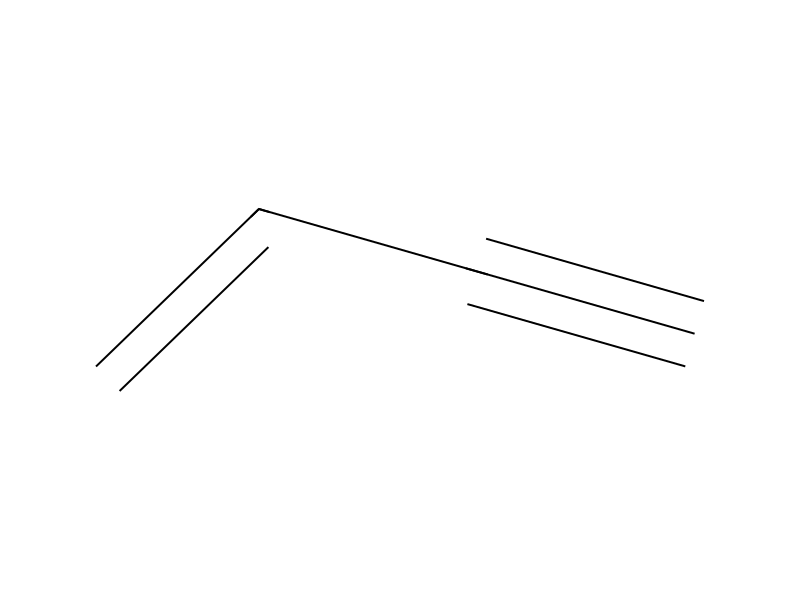
基本情報
- 標準SMILES
C#CC=C- InChIKey
WFYPICNXBKQZGB-UHFFFAOYSA-N- 分子式
- C4H4
- 平均分子量
- 52.07 g/mol
- 単同位体質量
- 52.03130013
概要
1-buten-3-yne appears as a colorless gas or liquid. Derived by the dimerization of acetylene. Used in the synthesis of neoprene and for other organic syntheses.
名称と識別子
- 優先名称
- Vinyl acetylene
- IUPAC
- but-1-en-3-yne
- 英語名
- Vinylacetylene
- 分子式
- C4H4
- 分子量
- 52.07
名称と別名
名称をさらに表示
データベース識別子
- CAS
689-97-4- PubChem CID
- 12720
- DTXSID
DTXSID4029199- ChEBI
CHEBI:48088- UNII
- VW72FM10OQ
- EC Number
- 211-713-3
- Nikkaji
- J1.725F
物性
構造計算による物性
- XLogP
- 1.3
- 極性表面積
- 0 Ų
- 水素結合供与体数
- 0
- 水素結合受容体数
- 0
- 回転可能結合数
- 0
- 重原子数
- 4
- 形式電荷
- 0
- 複雑度
- 51.7
実験および物理化学的性質
Chemical Classes
Other Classes -> Aliphatics, Unsaturated
Flammable agents - 4th degree
Solubility
Sol in benzene
In water, 1.79X10+3 mg/l @ 30 °C
Physical Description
1-buten-3-yne appears as a colorless gas or liquid. Derived by the dimerization of acetylene. Used in the synthesis of neoprene and for other organic syntheses.
Liquid
Colorless gas or liquid; [HSDB]
物理化学的性質
- 沸点
- 5.1 °C · 5.1 °C
- 比重(密度)
- 0.7095 g/cm3 · 0.7095 g/cm3(Temp: 0 °C)
安全と法規制
GHS分類
GHS Classification
Danger
H220 (100%): Extremely flammable gas [Danger Flammable gases]
P203, P210, P222, P280, P377, P381, P403, and P410+P403 (click each P-code to see the statement)
Aggregated GHS information provided per 70 reports by companies from 3 notifications to the ECHA C&L Inventory. Each notification may be associated with multiple companies.
危険有害性情報
Regulatory Information
1-Buten-3-yne is listed on the EPA's Chemical Data Reporting (CDR) system. Manufacturers and importers of 1-Buten-3-yne are required to report information about their production and use of this chemical to the EPA under the Toxic Substances Control Act (TSCA). (40 eCFR Part 711)
1-Buten-3-yne: Does not have an individual approval but may be used as a component in a product covered by a group standard. It is not approved for use as a chemical in its own right.
The New Jersey Worker and Community Right to Know Act requires public and private employers to provide information about hazardous substances at their workplaces. (N.J.S.A. 34:5A-1 et. seq.)
Reactivity Profile
1-BUTEN-3-YNE may react vigorously with strong oxidizing agents. May react exothermically with reducing agents In the presence of various catalysts (such as acids) or initiators, may undergo exothermic addition polymerization reactions. Forms an explosive salt with silver nitrate. Thermally unstable, under pressure, in combination with 1,3-butadiene [Loss Prev., 1971, 5, 67].
Peroxide Forming Chemical
Vinyl acetylene
C: Compounds that autopolymerize due to peroxide formation if inhibitors are depleated or not present
Kelly
Several incidents in the literature where either explosions have occured or explosive levels of peroxide have built up. See Bretherick's
Hennion, G. F. et al., Org. Synth., 1963, Coll. Vol. 4, 684
Hazard Classes and Categories
Flam. Gas 1 (100%)
Flammable agents - 4th degree, Reactive agents - 3rd degree
DHS Chemicals of Interest (COI)
Vinyl acetylene
1
10000
Flammable chemical that can be released at a facility.
安全と保護具
Disposal Methods
SRP: At the time of review, criteria for land treatment or burial (sanitary landfill) disposal practices are subject to significant revision. Prior to implementing land disposal of waste residue (including waste sludge), consult with environmental regulatory agencies for guidance on acceptable disposal practices.
毒性情報
Environmental Fate
TERRESTRIAL FATE: Based on a classification scheme(1), an estimated Koc value of 70(SRC), determined from a measured water solubility of 1,790 mg/l(2) and a regression-derived equation(3), indicates that 1-buten-3-yne is expected to have high mobility in soil(SRC). Volatilization of 1-buten-3-yne from moist soil surfaces is expected to be an important fate process(SRC) given an estimated Henry's Law constant of 0.029(SRC), calculated from its vapor pressure of 1,350 mm Hg(4) and water solubility(2). The potential for volatilization of 1-buten-3-yne from dry soil surfaces may exist(SRC) based upon its vapor pressure(4).
AQUATIC FATE: Based on a classification scheme(1), an estimated Koc value of 70(SRC), determined from a measured water solubility of 1,790 mg/l(2) and a regression-derived equation(3), indicates that 1-buten-3-yne is not expected to adsorb to suspended solids and sediment(SRC). Volatilization from water surfaces is expected(3) based upon an estimated Henry's Law constant of 0.029 atm-cu m/mole(SRC), calculated from its vapor pressure of 1,350 mm Hg(4) and water solubility(2). Using this Henry's Law constant and an estimation method(3), volatilization half-lives for a model river and model lake are 2 and 69 hours, respectively(SRC). According to a classification scheme(5), an estimated BCF of 10(SRC), determined from an estimated log Kow of 1.4(6) and a regression-derived equation(7), suggests the potential for bioconcentration in aquatic organisms is low(SRC).
ATMOSPHERIC FATE: According to a model of gas/particle partitioning of semivolatile organic compounds in the atmosphere(1), 1-buten-3-yne, which has a vapor pressure of 1,350 mm Hg at 25 °C(2), is expected to exist in the gas phase in the ambient atmosphere. Gas-phase 1-buten-3-yne is degraded in the atmosphere by reaction with photochemically-produced hydroxyl radicals(SRC); the half-life for this reaction in air is estimated to be 10 hours(SRC), calculated from its rate constant of 40X10-12 cu cm/molecule-sec at 25 °C(SRC) determined using a structure estimation method(3).
Soil Adsorption/Mobility
The Koc of 1-buten-3-yne is estimated as 70(SRC), using a measured water solubility of 1,790 mg/l(1) and a regression-derived equation(2). According to a classification scheme(3), this Koc value suggests that 1-buten-3-yne is expected to have high mobility in soil.
Environmental Bioconcentration
An estimated BCF of 10 was calculated for 1-buten-3-yne(SRC), using an estimated log Kow of 1.4(1) and a regression-derived equation(2). According to a classification scheme(3), this BCF suggests the potential for bioconcentration in aquatic organisms is low(SRC).
Volatilization from Water/Soil
The Henry's Law constant for 1-buten-3-yne is estimated as 0.029 atm-cu m/mole(SRC) based upon its vapor pressure, 1,350 mm Hg(1), and water solubility, 1,790 mg/l(2). This Henry's Law constant indicates that 1-buten-3-yne is expected to volatilize rapidly from water surfaces(3). Based on this Henry's Law constant, the volatilization half-life from a model river (1 m deep, flowing 1 m/sec, wind velocity of 3 m/sec)(3) is estimated as 2 hours(SRC). The volatilization half-life from a model lake (1 m deep, flowing 0.05 m/sec, wind velocity of 0.5 m/sec)(3) is estimated as 70 hours(SRC). 1-Buten-3-yne's estimated Henry's Law constant indicates that volatilization from moist soil surfaces may occur(SRC). The potential for volatilization of 1-buten-3-yne from dry soil surfaces may exist(SRC) based upon its vapor pressure(1).
Environmental Abiotic Degradation
The rate constant for the vapor-phase reaction of 1-buten-3-yne with photochemically-produced hydroxyl radicals has been estimated as 40X10-12 cu cm/molecule-sec at 25 °C(SRC) using a structure estimation method(1). This corresponds to an atmospheric half-life of about 10 hours at an atmospheric concentration of 5X10+5 hydroxyl radicals per cu cm(1). The rate constant for the vapor-phase reaction of 1-buten-3-yne with ozone has been estimated as 0.2X10⁻¹⁷ cu cm/molecule-sec at 25 °C(SRC) using a structure estimation method(1). This corresponds to an atmospheric half-life of about 6 days at an atmospheric concentration of 7X10+11 ozone molecules per cu cm(2). 1-Buten-3-yne is not expected to undergo hydrolysis in the environment due to the lack of hydrolyzable functional groups(3).
Environmental Fate/Exposure Summary
1-Buten-3-yne's production and use as chemical intermediate may result in its release to the environment through various waste streams. If released to air, a vapor pressure of 1,350 mm Hg at 25 °C indicates 1-buten-3-yne will exist as a gas in the ambient atmosphere. Gas-phase 1-buten-3-yne will be degraded in the atmosphere by reaction with photochemically-produced hydroxyl radicals and ozone. The half-life for the reaction with hydroxyl radicals in air is estimated to be 10 hours. The half-life for the reaction with ozone is estimated to be 6 days. If released to soil, 1-buten-3-yne is expected to have high mobility based upon an estimated Koc of 70. Volatilization from moist soil surfaces is expected to be an important fate process based upon an estimated Henry's Law constant of 0.029 atm-cu m/mole. 1-Buten-3-yne may volatilize from dry soil surfaces based upon its vapor pressure. If released into water, 1-buten-3-yne is not expected to adsorb to suspended solids and sediment based upon its estimated Koc. Volatilization from water surfaces is expected to be an important fate process based upon this compound's estimated Henry's Law constant. Estimated volatilization half-lives for a model river and model lake are 2 and 69 hours, respectively. An estimated BCF of 10 suggests the potential for bioconcentration in aquatic organisms is low. Hydrolysis is not expected to be an important environmental fate process due to a lack of hydrolyzable functional groups. Occupational exposure to 1-buten-3-yne may occur through inhalation and dermal contact with this compound at workplaces where 1-buten-3-yne is produced or used. (SRC)
Antidote and Emergency Treatment
Basic treatment: Establish a patent airway. Suction if necessary. Watch for signs of respiratory insufficiency and assist ventilations if necessary. Administer oxygen by nonrebreather mask at 10 to 15 L/min. Monitor for shock and treat if necessary ... . Anticipate seizures and treat if necessary ... . For eye contamination, flush eyes immediately with water. Irrigate each eye continuously with normal saline during transport ... . Do not use emetics. For ingestion, rinse mouth and administer 5 ml/kg up to 200 ml of water for dilution if the patient can swallow, has a strong gag reflex, and does not drool. Administer activated charcoal ... . /Aliphatic hydrocarbons and related compounds/
Advanced treatment: Consider orotracheal or nasotracheal intubation for airway control in the patient who is unconscious or in respiratory rest. Positive pressure ventilation techniques with a bag-valve-mask device may be beneficial. Monitor cardiac rhythm and treat arrhythmias as necessary ... . Start an IV with D5W /SRP: "To keep open", minimal flow rate/. Use lactated Ringer's if signs of hypovolemia are present. Watch for signs of fluid overload. Consider drug therapy for pulmonary edema ... . Treat seizures with diazepam (Valium) ... . Use proparacaine hydrochloride to assist eye irrigation ... . /Aliphatic hydrocarbons and related compounds/
法規制情報
DHS Chemicals of Interest (COI)
Vinyl acetylene
1
10000
Flammable chemical that can be released at a facility.
化学と産業
用途と製造
Uses
Used as an intermediate in the manufacture of neoprene and other organic compounds; [HSDB]
Intermediate in mfr of neoprene and for various organic syntheses
General Manufacturing Information
Petroleum Refineries
1-Buten-3-yne: ACTIVE
サプライヤー23 社
関連反応
現在のフィルター条件では反応記録がありません。
関連ノート
読み込み中…