
基本情報
- CAS
1309-60-0- 標準SMILES
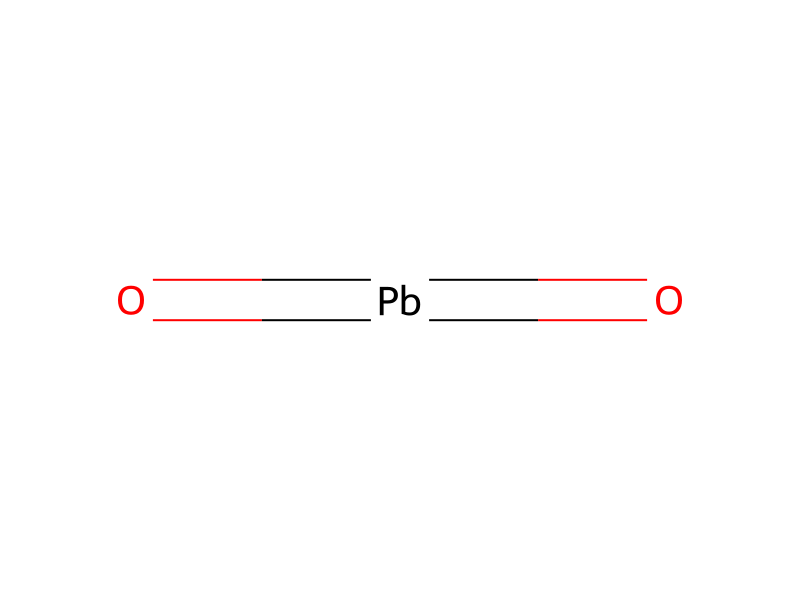
[O]=[Pb]=[O]- InChIKey
YADSGOSSYOOKMP-UHFFFAOYSA-N- 分子式
- O2Pb
- 平均分子量
- 239 g/mol
- 単同位体質量
- 239.96648134
概要
Lead dioxide appears as brown, hexagonal crystals. Insoluble in water. Used in matches, explosives, electrodes.
名称と識別子
- 優先名称
- Lead dioxide
- IUPAC
- dioxolead
- 現地名
- 二酸化鉛
- 英語名
- Lead dioxide
- 分子式
- O2Pb
- 分子量
- 239.2
名称と別名
LEAD DIOXIDE1309-60-0Lead(IV) oxideLead peroxideLead superoxideLead BrownLead oxide (PbO2)Lead Oxide BrownplumbanedioneBioxyde de plombLead peroxide (PbO2)Peroxyde de plomb
名称をさらに表示
過酸化鉛鉛ブラウンプラットナーアイト酸化第二鉛二酸化鉛酸化鉛(IV)鉛オキシドブラウン鉛スーパーオキシド鉛ジオキシド鉛(IV)ジオキシド酸化鉛(茶色)二酸化酸化鉛(Ⅳ)酸化鉛(IV) ACS REAGENT,≥97.0%LEAD(IV) OXIDE, PURATRONIC®, 99.995% (METALS BASIS)酸化鉛(IV), ACS, 97.0% MIN酸化鉛(IV), 97%酸化鉛(IV), 97+% (ACS)酸化鉛(IV), Puratronic®, 99.995% (metals basis)Lead oxide, diPbO2PlattneriteLeproLP-100ci77580c.i.77580leadbrowndioxolead
CI 77580C.I. 775807JJD3ICL6ADTXSID5025497RefChem:152633DTXCID805497215-174-5Plumbic oxide
データベース識別子
- CAS
1309-60-0- PubChem CID
- 14793
- DTXSID
DTXSID5025497- EC Number
- 215-174-5
- Nikkaji
- J43.840E
物性
構造計算による物性
- 極性表面積
- 34.1 Ų
- 水素結合供与体数
- 0
- 水素結合受容体数
- 2
- 回転可能結合数
- 0
- 重原子数
- 3
- 形式電荷
- 0
- 複雑度
- 18.3
実験および物理化学的性質
Chemical Classes
Metals -> Lead Compounds, Inorganic
Carcinogens
SpringerMaterials Propertieselectron density of states
Density
9.375 at 66 °F (NTP, 1992) - Denser than water; will sink
9.375 g/cu cm
9.38 g/cm³
9.64 @25 °C
Color/Form
Brown, hexagonal crystals
Dark-brown powder
Brownish black crystalline powder consisting of fine crystalline flakes in either alpha- or beta-form.
Solubility
Insoluble (NTP, 1992)
In water, <11.3 ug/L at 25 °C, pH 6-7
Insoluble in water
Soluble in hydrochloric acid with evolution of chlorine; in dilute nitric acid in presence of hydrogen peroxide, oxalic acid, or other reducers; soluble in alkali iodide solutions with liberation of iodine; soluble in hot caustic alkali solutions
Soluble in glacial acetic acid; insoluble in alcohol
Presumably soluble in acidic gastric juice
Decomposition
When heated to decomposition it emits toxic fumes of /lead/.
Lead dioxide decomposes at 290 °C. /From table/
290 °C. This produces oxygen and toxic fumes. Reacts violently with combustible substances, organic compounds, sulfur, hydrogen peroxide and phosphorus. This generates fire hazard.
Melting Point
554 °F (decomposes) (NTP, 1992)
290 °C, decomposition
Refractive IndexIndex of refraction: omega 2.3 (Li /lamp/)
Physical Description
Lead dioxide appears as brown, hexagonal crystals. Insoluble in water. Used in matches, explosives, electrodes.
Other Solid; Wet Solid; Dry Powder
Brown crystals that are insoluble in water; [CAMEO]
BROWN CRYSTALS OR POWDER.
Stability/Shelf LifeStable under recommended storage conditions.
Other Experimental Properties
An oxidizing agent
Evolves oxygen when heated, first forming Pb3O4, at high temperature, PbO.
Decomposes rather easily to the lower oxide, releasing oxygen when heated to 290 °C and above
Heat capacity: 61.5 J/mol-K at 27 °C
物理化学的性質
- 融点
- 290 °C · 290 °C
- 比重(密度)
- 9 · 9,38 g/cm3
- 外見
- 粉
- 比重
- 9.38 · 9.38
- 色
- ブラウンからブラック
- 水溶解度
- 不溶性
- 比熱容量
- 0.27 J/ · Cp(crystal): 0.27 J/(g·K), at 25℃
- 晶系
- 直方
- Merck
- 14 · 14,5407
- 空间群
- Pbcn
- 晶格常数
- 30.4948 · a/nmb/nmc/nmα/oβ/oγ/oV/nm30.49480.59510.54979090900.1619
- InChI
- InChI=1S/2O.Pb
- InChIKey
- YADSGOSSYOOKMP-UHFFFAOYSA-N
- SMILES
- [Pb](=O)=O
- CAS データベース
- 1309 · 1309-60-0(CAS DataBase Reference)
- NISTの化学物質情報
- Lead dioxide(1309-60-0)
- EPAの化学物質情報
- Lead dioxide (1309-60-0)
化学的性質
化学的特性Lead dioxide is a dark brown crystalline solid or powder.
安全と法規制
GHS分類
GHS Classification
Danger
H272 (91.3%): May intensify fire; oxidizer [Danger Oxidizing liquids; Oxidizing solids]
P203, P210, P220, P260, P261, P264, P270, P271, P273, P280, P301+P317, P304+P340, P317, P318, P319, P330, P370+P378, P391, P405, and P501 (click each P-code to see the statement)
Aggregated GHS information provided per 242 reports by companies from 27 notifications to the ECHA C&L Inventory. Each notification may be associated with multiple companies.
Danger
H272: May intensify fire; oxidizer [Danger Oxidizing liquids; Oxidizing solids]
危険有害性情報
Regulatory Information
Chemical: Lead oxide (PbO2)
Lead oxide (PbO2) is listed on the EPA's Chemical Data Reporting (CDR) system. Manufacturers and importers of Lead oxide (PbO2) are required to report information about their production and use of this chemical to the EPA under the Toxic Substances Control Act (TSCA). (40 eCFR Part 711)
Status: Active Update: 04-09-2018 https://echa.europa.eu/registration-dossier/-/registered-dossier/7459
Restricted substance: Lead dioxide
Lead oxide: HSNO Approval: HSR001285 Approved with controls
The New Jersey Worker and Community Right to Know Act requires public and private employers to provide information about hazardous substances at their workplaces. (N.J.S.A. 34:5A-1 et. seq.)
Other Safety InformationIMAP assessments - Lead oxides: Human health tier II assessment
DOT LabelOxidizer
Fire Hazards
Excerpt from ERG Guide 140 [Oxidizers]:
CAUTION: Ammonium nitrate products may explode if involved in fire or contaminated with hydrocarbons (fuels), organic matter, other contaminants or when hot molten and contained. Treat as an explosive (GUIDE 112).
Not combustible but enhances combustion of other substances. Gives off irritating or toxic fumes (or gases) in a fire. Risk of fire and explosion on contact with combustible substances or reducing agents.
Fire Potential
Lead dioxide does not burn but it will increase the intensity of a fire.
Dangerous fire risk in contact with organic materials.
Health Hazards
Excerpt from ERG Guide 140 [Oxidizers]:
· Inhalation, ingestion or contact (skin, eyes) with vapors or substance may cause severe injury, burns or death.
Hazards SummarySee Lead and linked occupational diseases.
DOT ID and Guide1872 140
Reactive GroupOxidizing Agents, Strong
EC ClassificationSymbol: T, N; R: 61-20/22-33-62-50/53; S: 53-45-60-61; Note: A, E
UN ClassificationUN Hazard Class: 5.1; UN Pack Group: III
Special Reports
DHHS/ATSDR; Toxicological Profile for Lead (August 2007).[Available from, as of May 3, 2016: http://www.atsdr.cdc.gov/toxprofiles/tp13.pdf]
National Toxicology Program; Report on Carcinogens, Thirteenth Edition (2014). The Report on Carcinogens is an informational scientific and public health document that identifies and discusses substances (including agents, mixtures, or exposure circumstances) that may pose a carcinogenic hazard to human health. Lead and Lead Compounds are listed as reasonably anticipated to be human carcinogens. /Lead and Lead Compounds/[Available from, as of May 3, 2016: http://ntp.niehs.nih.gov/pubhealth/roc/roc13/]
安全と保護具
Fire Fighting
Excerpt from ERG Guide 140 [Oxidizers]:
In case of fire in the surroundings, use appropriate extinguishing media.
First Aid Measures
Fresh air, rest.
Remove contaminated clothes. Rinse and then wash skin with water and soap.
First rinse with plenty of water for several minutes (remove contact lenses if easily possible), then refer for medical attention.
Rinse mouth. Give one or two glasses of water to drink. Refer for medical attention .
Accidental Release Measures
· CALL 911. Then call emergency response telephone number on shipping paper. If shipping paper not available or no answer, refer to appropriate telephone number listed on the inside back cover.
· Keep combustibles (wood, paper, oil, etc.) away from spilled material.
First Aid
EYES: First check the victim for contact lenses and remove if present. Flush victim's eyes with water or normal saline solution for 20 to 30 minutes while simultaneously calling a hospital or poison control center. Do not put any ointments, oils, or medication in the victim's eyes without specific instructions from a physician. IMMEDIATELY transport the victim after flushing eyes to a hospital even if no symptoms (such as redness or irritation) develop.
General First Aid:
Safe StorageSeparated from food and feedstuffs and incompatible materials. See Chemical Dangers.
Firefighting HazardsLead is combustible in powder form when exposed to heat or flame. /Inorganic lead/
Exposure Control and Personal Protection
· Wear positive pressure self-contained breathing apparatus (SCBA).
Biological Exposure Indices (BEI) [ACGIH] - Lead in blood = 200 ug/L (20 ug/100 ml); sampling time not critical; [ACGIH]
Fire Fighting Procedures
Suitable extinguishing media: Use water spray, alcohol-resistant foam, dry chemical or carbon dioxide.
Advice for firefighters: Wear self-contained breathing apparatus for firefighting if necessary.
Use water spray to cool unopened containers.
Use extinguisher suitable for surrounding fire. ... If material or contaminated runoff enters waterways, notify downstream users of potentially contaminated waters. Notify local health and fire officials and pollution control agencies. From a secure, explosion-proof location, use water spray to cool exposed containers. If cooling streams are ineffective (venting sound increases in volume and pitch, tank discolors, or shows any signs of deforming), withdraw immediately to a secure position.
For more Fire Fighting Procedures (Complete) data for Lead(IV) Oxide (8 total), please visit the HSDB record page.
Storage Conditions
Keep container tightly closed in a dry and well-ventilated place. Keep in a dry place. Storage class (TRGS 510): Oxidizing hazardous materials.
Store in a location separate from other materials, especially flammables and combustibles. ... Lead dioxide must be stored to avoid contact with oxidizers (such as perchlorates, peroxides, permagnanates, chlorates and nitrates) and chemically active metals (such as potassium, sodium, magnesium and zinc), since violent reactions occur. Store in tightly closed containers in a cool, well-ventilated area away from combustible materials, such as wood, paper, and oil. Lead dioxide is regulated by OSHA Standard 1910.1025. All requirements of the standard must be followed.
Cleanup Methods
ACCIDENTAL RELEASE MEASURES: Personal precautions, protective equipment and emergency procedures: Use personal protective equipment. Avoid dust formation. Avoid breathing vapors, mist or gas. Ensure adequate ventilation. Evacuate personnel to safe areas. Avoid breathing dust. Environmental precautions: Prevent further leakage or spillage if safe to do so. Do not let product enter drains. Discharge into the environment must be avoided. Methods and materials for containment and cleaning up: Sweep up and shovel. Contain spillage, and then collect with an electrically protected vacuum cleaner or by wetbrushing and place in container for disposal according to local regulations. Keep in suitable, closed containers for disposal.
Evacuate persons not wearing protective equipment from area of spill or leak until cleanup is complete. Remove all ignition sources. Collect powdered material in the most convenient and safe manner and deposit in sealed containers. Ventilate area after cleanup is complete. Keep combustibles (wood, paper, oil) away from spilled material. It may be necessary to contain and dispose of this chemical as a hazardous waste. If material or contaminated runoff enters waterways, notify downstream users of potentially contaminated waters.
SRP: Wastewater from contaminant suppression, cleaning of protective clothing/equipment, or contaminated sites should be contained and evaluated for subject chemical or decomposition product concentrations. Concentrations shall be lower than applicable environmental discharge or disposal criteria. Alternatively, pretreatment and/or discharge to a permitted wastewater treatment facility is acceptable only after review by the governing authority and assurance that "pass through" violations will not occur. Due consideration shall be given to remediation worker exposure (inhalation, dermal and ingestion) as well as fate during treatment, transfer and disposal. If it is not practicable to manage the chemical in this fashion, it must be evaluated in accordance with EPA 40 CFR Part 261, specifically Subpart B, in order to determine the appropriate local, state and federal requirements for disposal.
The following wastewater treatment technologies have been investigated for lead: Concentration process: Biological treatment. /Lead/
For more Cleanup Methods (Complete) data for Lead(IV) Oxide (18 total), please visit the HSDB record page.
Nonfire Spill ResponseExcerpt from ERG Guide 140 [Oxidizers]:
Disposal Methods
Generators of waste (equal to or greater than 100 kg/mo) containing this contaminant, EPA hazardous waste number D008, must conform with USEPA regulations in storage, transportation, treatment and disposal of waste.
SRP: Wastewater from contaminant suppression, cleaning of protective clothing/equipment, or contaminated sites should be contained and evaluated for subject chemical or decomposition product concentrations. Concentrations shall be lower than applicable environmental discharge or disposal criteria. Alternatively, pretreatment and/or discharge to a permitted wastewater treatment facility is acceptable only after review by the governing authority and assurance that "pass through" violations will not occur. Due consideration shall be given to remediation worker exposure (inhalation, dermal and ingestion) as well as fate during treatment, transfer and disposal. If it is not practicable to manage the chemical in this fashion, it must be evaluated in accordance with EPA 40 CFR Part 261, specifically Subpart B, in order to determine the appropriate local, state and federal requirements for disposal.
Product: Burn in a chemical incinerator equipped with an afterburner and scrubber but exert extra care in igniting as this material is highly flammable. Offer surplus and non-recyclable solutions to a licensed disposal company. Contact a licensed professional waste disposal service to dispose of this material. Dissolve or mix the material with a combustible solvent and burn in a chemical incinerator equipped with an afterburner and scrubber; Contaminated packaging: Dispose of as unused product.
Conversion to soluble salt, precipitation as sulfide, and return to supplier.
For more Disposal Methods (Complete) data for Lead(IV) Oxide (7 total), please visit the HSDB record page.
毒性情報
TreatmentLead poisoning is usually treated with chelation therapy using DMSA, EDTA, or dimercaprol. (L21)
Health Effects
Lead is a neurotoxin and has been known to cause brain damage and reduced cognitive capacity, especially in children. Lead exposure can result in nephropathy, as well as blood disorders such as high blood pressure and anemia. Lead also exhibits reproductive toxicity and can results in miscarriages and reduced sperm production. (L21)
Environmental Fate
TERRESTRIAL FATE: Lead(IV) dioxide is not expected to leach in soil because of its low solubility(SRC). The downward movement of inorganic lead compounds from soil to groundwater by leaching is very slow under most natural conditions(1).
AQUATIC FATE: If released into water, lead(IV) dioxide should mostly precipitate out due to its low solubility. (SRC)
ATMOSPHERIC FATE: In the atmosphere, non-organic compounds of lead exist primarily in the particulate form and, therefore, lead(IV) dioxide is expected to exist solely in the particulate phase in the ambient atmosphere. Upon release to the atmosphere, lead particles are dispersed and ultimately removed from the atmosphere by wet or dry deposition(1).
Adverse EffectsNeurotoxin - Predominantly motor
Exposure Routes
The substance can be absorbed into the body by inhalation and by ingestion.
Oral (L136) ; inhalation (L136); dermal (L136)
Toxicity Summary
IDENTIFICATION AND USE: Lead dioxide is a dark-brown powder. It is used in electrodes in batteries; as oxidizing agent in manufacture dyes; as discharge in dyeing with indigo; manufacture rubber substitutes; with amorphous phosphorus as ignition surface for matches; pyrotechnics; manufacture pigments; in analytical chemistry. HUMAN EXPOSURE AND TOXICITY: Exposure can cause headache, irritability, and muscle and joint pain. Lead dioxide may damage the nervous system. Exposure may cause kidney and brain damage, and anemia. Repeated exposure to lead dioxide can cause lead poisoning. Symptoms include metallic taste, poor appetite, weight loss, colic, nausea, vomiting, and muscle cramps. Higher levels can cause muscle and joint pain, and weakness. High or repeated exposure may damage the nerves causing weakness, "pins and needles," and poor coordination in the arms and legs. Lead exposure increases the risk of high blood pressure. ANIMAL STUDIES: There are no data available.
Lead mimics other biologically important metals, such as zinc, calcium, and iron, competing as cofactors for many of their respective enzymatic reactions. For example, lead has been shown to competitively inhibit calcium's binding of calmodulin, interferring with neurotransmitter release. It exhibits similar competitive inhibition at the NMDA receptor and protein kinase C, which impairs brain microvascular formation and function, as well as alters the blood-brain barrier. Lead also affects the nervous system by impairing regulation of dopamine synthesis and blocking evoked release of acetylcholine. However, it's main mechanism of action occurs by inhibiting delta-aminolevulinic acid dehydratase, an enzyme vital in the biosynthesis of heme, which is a necesssary cofactor of hemoglobin. (T4, A20, A22, L136)
Signs and Symptoms
Abdominal pain. Nausea. Vomiting.
Symptions of chronic lead poisoning include reduced cognitive abilities, nausea, abdominal pain, irritability, insomnia, metal taste in the mouth, excess lethargy or hyperactivity, chest pain, headache and, in extreme cases, seizures, comas, and death. There are also associated gastrointestinal problems, such as constipation, diarrhea, vomiting, poor appetite, weight loss, which are common in acute poisoning. (A2, L21)
Ongoing Test Status
The following link will take the user to the National Toxicology Program (NTP) Test Agent Search Results page, which tabulates all of the "Genetic Toxicology Studies" performed with this chemical. Clicking on the "Testing Status" link will take the user to the status (i.e., in review, in progress, in preparation, on test, completed, etc.) and results of all the studies that the NTP has done on this chemical.[Available from, as of May 12, 2016: http://ntp.niehs.nih.gov/testing/status/agents/ts-10131-s.html]
Effluent ConcentrationsLead (IV)dioxide has been detected in coal combustion flue gas emissions(1); if the combustion temperature reaches 1800K, lead(IV) dioxide becomes the predominant lead compound in the particulate phase(1).
ICSC Environmental DataBioaccumulation of this chemical may occur in plants and mammals. It is strongly advised not to let the chemical enter into the environment.
Soil Adsorption/MobilityThe downward movement of inorganic lead compounds from soil to groundwater by leaching is very slow under most natural conditions(1). /Lead compounds/
Natural Pollution Sources
Lead(IV) dioxide occurs in nature as the mineral plattnerite(1). A plattnerite mineral sample from the Ojuela mine in Mexico assayed PbO2 99.6% and CuO 0.1%(2). Plattnerite occurs in weathered hydrothermal base-metal deposits, oxidized typically in arid climates(2). In the US, large plattnerite masses occur from the Coeur d'Alene district, Shoshone Co., and in the Democrat mine, Gilmore district, Lemhi Co., Idaho; from the Goodsprings district, Clark Co., and the Diamond mine, near Eureka, Eureka Co., Nevada. In the 79 mine, Gila Co., the Defiance mine, Gleeson, Cochise Co., the Glove mine, Santa Cruz Co., and elsewhere in Arizona; at the Mex-Tex mine, near Bingham, Hansonburg district, Socorro Co., and Granite Gap, San Simon district, Hidalgo Co., New Mexico(2).
法規制情報
RCRA Requirements
D008; A solid waste containing lead may or may not become characterized as a hazardous waste when subjected to the Toxicity Characteristic Leaching Procedure listed in 40 CFR 261.24, and if so characterized, must be managed as a hazardous waste. /Lead/
TSCA Requirements
Pursuant to section 8(d) of TSCA, EPA promulgated a model Health and Safety Data Reporting Rule. The section 8(d) model rule requires manufacturers, importers, and processors of listed chemical substances and mixtures to submit to EPA copies and lists of unpublished health and safety studies. Lead oxide (PbO2) is included on this list. Effective date: February 28, 2008; Sunset date: April 28, 2008.
Atmospheric Standards
National primary and secondary ambient air quality standards for lead and its compounds, measured as elemental lead by a reference method based on appendix G to this part, or by an equivalent method, are: 1.5 ug/cu m, maximum arithmetic mean averaged over a calendar quarter. /Lead and its compounds, as Pb/
Listed as a hazardous air pollutant (HAP) generally known or suspected to cause serious health problems. The Clean Air Act, as amended in 1990, directs EPA to set standards requiring major sources to sharply reduce routine emissions of toxic pollutants. EPA is required to establish and phase in specific performance based standards for all air emission sources that emit one or more of the listed pollutants. Lead compounds are included on this list. /Lead compounds/
Clean Water Act RequirementsToxic pollutant designated pursuant to section 307(a)(1) of the Federal Water Pollution Control Act and is subject to effluent limitations. /Lead and compounds/
State Drinking Water Standards(AZ) ARIZONA 50 ug/L. /Lead/
State Drinking Water Guidelines
(AZ) ARIZONA 20 ug/L /Lead/
(ME) MAINE 10 ug/L /Lead/
Federal Drinking Water StandardsEPA 15 ug/L (Action Level). /Lead/
Federal Drinking Water GuidelinesMaximum Contaminant Level Goal (MCLG): zero mg/L. /Lead/
安全データ
- wgk
- 3
- tsca
- TSCA listed
- rtecs
- OG0700000
- ridadr
- UN 1872
- 毒性
- LD50 i.p. in guinea pigs: 220 mg/kg (Venugopal, Luckey)
- PRTR法
- 第1種指定化学物質(特定物質)
- hs_code
- 28249090
- risk_code
- 61-8-20/22-33-50/53-62
- 化審法
- 一般化学物質
- 安衛法
- 鉛中毒予防規則該当物質,57,57-2
- hazard_code
- O,T,N
- safety_code
- 53-45-60-61
- hazard_class
- 5.1
- packing_group
- III
- 毒劇物取締法
- III
- Hazard Classifications
- Acute Tox. 4 InhalationAcute Tox. 4 OralAquatic Acute 1Aquatic Chronic 1Ox. Sol. 3Repr. 1ASTOT RE 2
- ストレージクラス
- 5.1B - Oxidizing hazardous materials
- 有毒物質データの
- 1309-60-0(Hazardous Substances Data)
化学と産業
薬理情報
Metabolism/Metabolites
Lead is absorbed following inhalation, oral, and dermal exposure. It is then distributed mainly to the bones and red blood cells. In the blood lead may be found bound to serum albumin or the metal-binding protein metallothionein. Organic lead is metabolized by cytochrome P-450 enzymes, whereas inorganic lead forms complexes with delta-aminolevulinic acid dehydratase. Lead is excreted mainly in the urine and faeces. (L136)
Absorption, Distribution and Excretion
This solubility was studied in vitro for the six following metal oxides: Cd, Cr, Fe, Mn, Pb, Zn, by holding particle oxides in suspension into human plasma at 37 degrees C, during variable time. The experimentation was realized on particles which belong to two categories which sizes are 0.45-2 and 2-5 mu. The evolution of metal oxide dissolved level according to time have enabled exponential relation parameters to be calculated. These parameters translate the particle oxide dissolution into plasma and have permitted to classify metal oxide in decreasing solubility order: Cd, Zn, PbO, Fe2O3, Fe3O4, Mn, PbO2, Pb3O4 and Cr2O3.
用途と製造
Uses
Used in matches, explosives, and electrodes; [CAMEO] Used to make dyes, matches, pyrotechnics, polysulfide polymers, and other chemicals; [Ullmann]
Oxidizing agent, electrodes, lead-acid storage batteries, curing agent for polysulfide elastomers, textiles (mordant, discharge in dyeing with indigo), matches, explosives, analytical reagent.
Manufacturing rubber substitutes; with amorphous phosphorus as ignition surface for matches; pyrotechny; manufacturing pigments.
Curing agent for polysulfide, low-molecular weight butyl and polyisoprene; used as an oxidizer in the manufacture of dyes and to control burning in incendiary fuses.
Other applications of lead dioxide include antifriction compositions for plastic sliding bearings, ballistic modifers in high-energy propellants, electrodes for seawater electrolysis, filters for desulfurization of waste gases, and vulcanizing agents for butyl rubber puncture-sealing layers inside tires.
Lead dioxide is found in lead-acid batteries. (L413)
U.S. Production
2023: 16,585,984 lb
Non-confidential 2012 Chemical Data Reporting (CDR) information on the production and use of chemicals manufactured or imported into the United States. Chemical: Lead oxide (PbO2). National Production Volume: 1,025,938 lb/yr.
Consumer UsesOxidizing agent
Industry UsesOther
Methods of Manufacturing
Lead dioxide can be produced by anodic oxidation of solutions of lead salts or, commercially, by the oxidation of red lead, Pb3O4, in alkaline slurry with chlorine.
By adding bleaching powder to an alkaline solution of lead hydroxide.
Lab preparation from lead acetate and calcium hypochlorite ... ; by hydrolysis of lead acetate ... .
Formulations/PreparationsACS and industrial grades.
General Manufacturing Information
Electrical Equipment, Appliance, and Component Manufacturing
Lead oxide (PbO2): ACTIVE
Occurs in nature as the mineral, plattnerite.
応用分野
解説PbO2(239.20).酸化鉛(Ⅳ)ともいう.二酸化鉛は,鉛(Ⅱ)塩を臭素水などの酸化剤で酸化すると得られる.黒褐色の等軸晶系の粉末.結晶構造はルチル型構造.密度9.38 g cm-3.熱,冷水,エタノールに不溶,濃硫酸,硝酸に微溶.カセイアルカリの濃水溶液に溶けて鉛酸塩を生じる.光分解を受けて四酸化三鉛と酸素を,加熱すると三酸化二鉛と酸素を,塩化水素を作用させると塩化鉛(Ⅱ),水,塩素を生じる.過酸化水素によって還元されて酸化鉛(Ⅱ)となり,硫黄やリンとはげしく反応してこれらを酸化する.酸化剤,鉛蓄電池(バッテリー)の正極板,マッチ,爆薬,媒染剤,染料製造,プラスチック硬化剤などに用いられる.有毒.森北出版「化学辞典(第2版)
説明Lead dioxide, PbO2, also plumbic oxide, is an odorless dark-brown crystalline powder which is nearly insoluble in water. It exists in two crystalline forms. The a phase has orthorhombic symmetry, lattice constants a=0.497 nm, b=0.596 nm, c= 0.544 nm, Z=4 (four formula units per unit cell).
天然物の起源Lead dioxide occurs in nature as the mineral plattnerite. It is used as an oxidizing agent in manufacturing dyes and intermediates. It also is used as a source of oxygen in matches, pyrotechnics, and explosives. In matches, the oxide is combined with amorphous phosphorus as an ignition surface. It also is used in making lead pigments, liquid polysulfide polymers and rubber substitutes. Lead dioxide electrodes are used in lead storage batteries in which lead dioxide accumulates on positive plates.
使用Lead dioxide occurs in nature as the mineral plattnerite. It is used as an oxidizing agent in manufacturing dyes and intermediates. It also is used as a source of oxygen in matches, pyrotechnics, and explosives. In matches, the oxide is combined with amorphous phosphorus as an ignition surface. It also is used in making lead pigments, liquid polysulfide polymers and rubber substitutes. Lead dioxide electrodes are used in lead storage batteries in which lead dioxide accumulates on positive plates.
一般的な説明Brown, hexagonal crystals. Insoluble in water. Used in matches, explosives, electrodes.
調製方法
製造方法Lead dioxide is produced by oxidizing an alkaline slurry of lead monoxide with chlorine, sodium hypochlorite, or bleaching powder. Alternatively, it is obtained by passing chlorine into a hot aqueous suspension of lead sulfate and magnesium hydroxide. The ionic reaction is: Pb(OH)3ˉ +ClOˉ → PbO2 + Clˉ+ OHˉ + H2O It also is produced by electrolysis of acidic solutions of lead salts using a lead or platinum electrode. In such electrolytic process, lead dioxide is deposited on the anode of the cell. Insoluble powdered lead dioxide also may be obtained when lead tetroxide is heated with nitric acid: Pb3 O4 + 4HNO3 → 2Pb(N)3)2 + PbO2 + 2H2O Lead dioxide also can be prepared by fusing lead monoxide with a mixture of sodium nitrate and sodium chlorate.
上流・下流製品情報
上流原料
下流製品
サプライヤー102 社
国药集团化学试剂有限公司86-21-63210123 · [email protected]
北京华美互利生物化工010-56205725 · [email protected]
上海阿拉丁生化科技股份有限公司400-6206333 13167063860 · [email protected]
武汉欣扬瑞和化学科技有限公司13720274133 · [email protected]
廊坊乾耀科技有限公司0316-2617888 17301291189 · [email protected]
四川华南无机盐有限公司15223036127 · [email protected]
武汉欣扬瑞和化学科技有限公司153-07155313 15307155313 · [email protected]
杭州品高化工有限公司0571-87658025 · [email protected]
宁波化工原料有限公司13306607903;13306607903 · [email protected]
武汉零加一化工有限公司15972036926 15972036926 · [email protected]
武汉吉业升化工有限公司027-83360216 18040558719 · [email protected]
武汉绿景丰华生物科技有限公司19972070065 · [email protected]
Shenyang Simchoice Chemical Co.,Ltd+86-024-23769576 +86-15040101888 · [email protected]
上海迈瑞尔生化科技有限公司4006356688 18621169109 · [email protected]
武汉吉业升化工有限公司15387013945 · [email protected]
江苏普乐司生物科技有限公司0513-66017706 18551496367 · [email protected]
上海晶抗生物工程有限公司021-54721350 13524668266 · [email protected]
阿法埃莎(中国)化学有限公司400-6106006 · [email protected]
安耐吉化学&3A(安徽泽升科技股份有限公司)400-0056266 · [email protected]
武汉吉业升化工有限公司13545274181 · [email protected]
广东云星生物技术有限公司0751-18902340975/189023400307 18902340307 · [email protected]
上海瀚鸿科技股份有限公司021-54306202 13764082696 · [email protected]
武汉市皇臻生物化工有限公司13795480948 · [email protected]
山东西亚化学有限公司13355009207 13355009207 · [email protected]
广东大小化工有限公司1866-171603 18666171603 · [email protected]
玛雅试剂+86 (573) 82222445 (0)18006601000 452520369 · [email protected]
四川库利南科技有限公司400-1166-196 18981987031 · [email protected]
天津希恩思生化科技有限公司400 638 7771 · [email protected]
武汉吉业升化工有限公司027-13545242311 13545242311 · [email protected]
斯百全化学(上海)有限公司021-021-021-67601398-809-809-809 15221380277 · [email protected]
艾科试剂4008-755-333 18080918076 · [email protected]
赛默飞世尔科技(中国)有限公司800-810-5118 · [email protected]
北京伊诺凯科技有限公司400-810-7969 010-59572699 · [email protected]
北京京土恒盛化工科技有限公司00-13911456598 13911456598 · [email protected]
武汉吉业升化工有限公司15927657268 · [email protected]
北京环宇世纪化学科技有限公司hysj_bj.com
上海将来实业股份有限公司021-61552785 · [email protected]
成都零六生物科技有限公司400-1166-196 13458535857 · [email protected]
雷丁试剂0510-85629785 18013409632 · [email protected]
上海御略医药科技有限公司021-60345187 13671753212 · [email protected]
上海麦克林生化科技股份有限公司15221275939 15221275939 · [email protected]
杭州杰恒化工有限公司0571-87396432 · [email protected]
陕西缔都医药化工有限公司029-81024372 17792795018 · [email protected]
成都润泽本土化工有限公司13096311329 028-88469284 616445927 · [email protected]
池州凯隆进出口贸易有限公司[email protected]
Sigma-Aldrich西格玛奥德里奇(上海)贸易有限公司021-61415566 800-8193336 · [email protected]
九鼎化学(上海)科技有限公司4009209199 · [email protected]
广东翁江化学试剂有限公司0751-2815987 13927875076 · [email protected]
武汉吉业升化工有限公司13343438917 · [email protected]
上海玻尔化学试剂有限公司19102157732 · [email protected]
関連反応
26 件


化合物ノート
読み込み中…