ホームMCPワークベンチSkills
ホームワークベンチ通知マイページ
llms.txt · MCPガイドプライバシーポリシー · 利用規約 · サポートv1.8.0
  1. ホーム
  2. /化合物

五硫化リン

Phosphorus sulfide (P2S5)
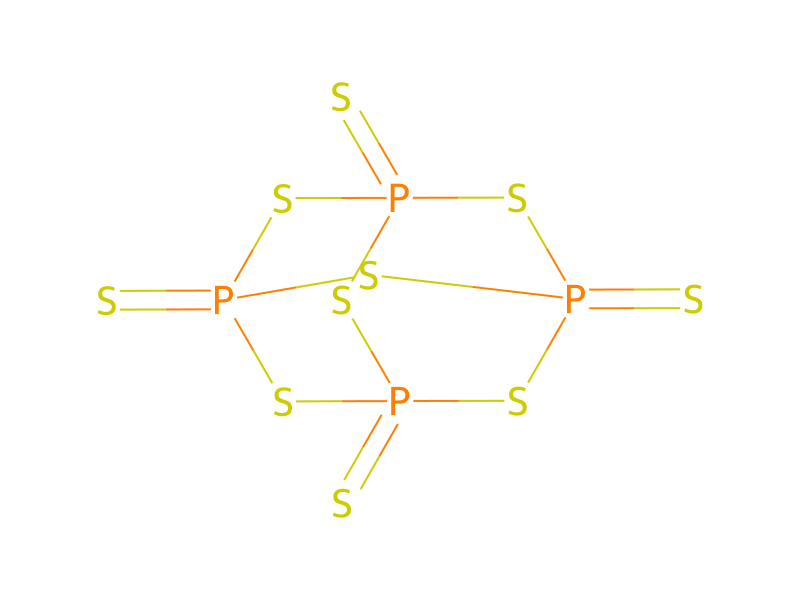
HCID 14817
ノートを作成反応を作成見積依頼を出す
印刷プレビュー
基本情報概要名称と識別子物性安全と法規制化学と産業関連反応化合物ノート
部分構造検索類似構造を探す

基本情報

CAS
1314-80-3
標準SMILES
S=P12SP3(=S)SP(=S)(S1)SP(=S)(S2)S3
InChIKey
CYQAYERJWZKYML-UHFFFAOYSA-N
分子式
P4S10
平均分子量
444.6 g/mol
単同位体質量
443.61575652

概要

Phosphorus pentasulfide, free from yellow and white phosphorus appears as a greenish yellow solid with an odor of rotten eggs that may paralyze the sense of smell at hazardous concentrations in air. Density 2.04 g / cm3. It is used for making lube oil additives, insecticides, flotation agents, safety matches, blown asphalt, and other products and chemicals.

名称と識別子

優先名称
Phosphorus sulfide (P2S5)
IUPAC
1,3,5,7-tetrakis(sulfanylidene)-2,4,6,8,9,10-hexathia-1λ5,3λ5,5λ5,7λ5-tetraphosphatricyclo[3.3.1.13,7]decane
現地名
五硫化リン
英語名
Phosphorus pentasulfide
分子式
PS5
分子量
191.3

名称と別名

Sulfur phosphideTetraphosphorus decasulfidePhosphoric sulfideDiphosphorus pentasulfidePhosphorus persulfideThiophosphoric anhydrideDiphosphorus pentasulphidePhosphorus pentasulfide (P4S10)Sirnik fosforecnyRCRA waste number U189HJ1X20J1DXPentasulfure de phosphore
名称をさらに表示
五硫化二りん五硫化りん十硫化四りん硫化りん(V)P2S5PHOSPHORUS PENTASULPHIDEPhosphorous PentasulfidePhosphorus Pentasulfide PowdersulfurphosphidePhosphorussulfidsirnikfosforecnyPhospher SulfidePhosphoricsulfide
DTXSID0051659RefChem:173921DTXCID8030213215-242-41314-80-3Phosphorus pentasulfidePhosphorus sulfidePhosphorus sulfide (P2S5)

データベース識別子

物性

構造計算による物性

XLogP
6.9
極性表面積
280 Ų
水素結合供与体数
0
水素結合受容体数
10
回転可能結合数
0
重原子数
14
形式電荷
0
複雑度
327

実験および物理化学的性質

Chemical Classes · 2 件

Other Classes -> Phosphorus Compounds

Reactive agents - 2nd degree

Odor · 3 件

Odor of rotten eggs

Odor similar to hydrogen sulfide

Peculiar odor

Density · 6 件

2.03 at 68 °F (USCG, 1999) - Denser than water; will sink

2.03 g/cu cm

2.1 g/cm³

2.03

2.09 @25 °C

2.09

Color/Form · 5 件

Gray to yellow-green crystals

Light yellow, triclinic crystals

Greenish-gray to yellow, crystalline solid

Solid flakes or powder

Greenish-yellow, or light-yellow crystalline mass

Solubility · 6 件

Reacts with water (NIOSH, 2024)

INSOL IN COLD WATER; SOL IN CARBON DISULFIDE: 0.22 G/100 CC.

Sol in carbon disulfide, aqueous soln of alkali hydroxides

In water, 1.17X10⁻⁶ mg/L at 25 °C

Solubility in water: reaction

Reacts

Boiling Point · 6 件

957 °F at 760 mmHg (USCG, 1999)

515 °C

513-515 °C

957 °F

514 °C @760 [mm Hg]

957 °F

Decomposition · 2 件

安全と法規制

安全情報は参考情報です。供給元の安全データシート(SDS)、適用法令、専門家による評価に代わるものではありません。

GHS分類

GHS Classification · 6 件

Danger

H228: Flammable solid [Danger Flammable solids]

P210, P223, P231+P232, P240, P241, P261, P264, P270, P271, P273, P280, P301+P317, P302+P335+P334, P304+P340, P317, P330, P370+P378, P391, P402+P404, and P501 (click each P-code to see the statement)

Danger

H228 (100%): Flammable solid [Danger Flammable solids]

P210, P223, P231+P232, P240, P241, P260, P261, P262, P264, P264+P265, P270, P271, P273, P280, P301+P316, P301+P317, P301+P330+P331, P302+P335+P334, P302+P352, P302+P361+P354, P304+P340, P305+P351+P338, P305+P354+P338, P316, P317, P321, P330, P337+P317, P361+P364, P363, P370+P378, P391, P402+P404, P403+P233, P405, and P501 (click each P-code to see the statement)

危険有害性情報

Regulatory Information · 5 件

Chemical: Phosphorus sulfide (P2S5)

Phosphorus sulfide (P2S5) is listed on the EPA's Chemical Data Reporting (CDR) system. Manufacturers and importers of Phosphorus sulfide (P2S5) are required to report information about their production and use of this chemical to the EPA under the Toxic Substances Control Act (TSCA). (40 eCFR Part 711)

Status: Active Update: 13-09-2016 https://echa.europa.eu/registration-dossier/-/registered-dossier/13413

Diphosphorus pentasulphide: HSNO Approval: HSR003063 Approved with controls

The New Jersey Worker and Community Right to Know Act requires public and private employers to provide information about hazardous substances at their workplaces. (N.J.S.A. 34:5A-1 et. seq.)

DOT LabelDangerous When Wet Flammable Solid
Fire Hazards · 2 件

Special Hazards of Combustion Products: Products of combustion include sulfur dioxide and phosphorus pentoxide, which are irritating, toxic and corrosive. (USCG, 1999)

Flammable. Gives off irritating or toxic fumes (or gases) in a fire. Risk of fire and explosion on contact with water. Finely dispersed particles form explosive mixtures in air.

化学と産業

薬理情報

Metabolism/MetabolitesIn the body, phosphorus is converted to phosphates. /Phosphorus/
Absorption, Distribution and ExcretionUrinary excretion, the chief mode of elimination, is largely an organic and inorganic phosphate. /Phosphorus/

用途と製造

Uses · 6 件

Used to make lubricant additives, insecticides, matches, and other organic chemicals; [ACGIH]

Toxic Gas from Spilling Chemical in Water [Category: Other]

In manufacture of lube oil additives and pesticides... safety matches, ignition compounds, and for introducing sulfur into organic compounds.

Organic chemistry (reagent).

... Used as a desiccating agent.

Intermediate for lubricating oil additives, insecticides (chiefly parathion and malathion), flotation agents, safety matches, ignition compounds, sulfonation.

U.S. Exports · 3 件

(1972) 1.81-3.63X10+9 grams

(1984) 4.95X10+9 g

CHEMICAL PROFILE: Phosphorus Pentasulfide. US Exports: 2000: 6,000 short tons; 2001: 5,100 short tons.

U.S. Imports · 2 件

(1972) Negligible

CHEMICAL PROFILE: Phosphorus Pentasulfide. US Imports: 2000: 0 short tons; 2001: 100 short tons.

U.S. Production · 6 件

2023: 17,498,856 lb

(1972) 5.55X10+10 grams

(1975) 5.58X10+10 grams

(1984) 6.74X10+10 g

Production volumes for non-confidential chemicals reported under the Inventory Update Rule. [Table#3069]

For more U.S. Production (Complete) data for Phosphorus sulfide (11 total), please visit the HSDB record page.

Consumption Patterns · 5 件

74% is used in lubricating oil additives as the precursor of organic derivatives which impart antiwear and corrosion-inhibiting properties; 23% is used to produce phosphorothioate pesticides, chiefly Parathion, Malathion; 3% in flotation agents (1972).

関連反応

1,118 件
反応記録を作成
HRID 1512 の反応式
HRID 1512反応物としてuspto-grants-1998_03
HRID 1580 の反応式
HRID 1580反応物としてuspto-grants-1998_03
HRID 2085 の反応式
HRID 2085反応物としてuspto-grants-1998_03
HRID 2126 の反応式
HRID 2126反応物としてuspto-grants-1998_03
HRID 2184 の反応式
HRID 2184反応物としてuspto-grants-1998_03
HRID 4603 の反応式
HRID 4603反応物としてuspto-grants-1988_02
HRID 4804 の反応式
HRID 4804反応物としてuspto-grants-1988_02
HRID 4805 の反応式
HRID 4805反応物としてuspto-grants-1988_02
1 / 140 ページ

化合物ノート

読み込み中…

このページの内容基本情報概要名称と識別子物性安全と法規制化学と産業関連反応化合物ノート
その他の操作
ノートを作成反応を作成見積依頼を出す
CAS
1314-80-3
PubChem CID
14817
DTXSID
DTXSID0051659
UNII
HJ1X20J1DX
EC Number
215-242-4

Decomp on contact with water to phosphoric acid, sulfur dioxide, and hydrogen sulfide.

When heated to decomposition it emits highly toxic fumes of /sulfur and phosphorus oxides/.

Melting Point · 5 件

527 °F (USCG, 1999)

285 °C

286-290 °C

527 °F

550 °F

Odor ThresholdOdor Threshold Low: 0.0047 [mg/m3]
Vapor Pressure · 4 件

1 mmHg at 572 °F (NIOSH, 2024)

VP: 1 mm Hg at 300 °C

1 mmHg at 572 °F

(572 °F): 1 mmHg

Heat of Combustion-10,890 BTU/LB= -6.050 CAL/G= -253.3X10+5 J/KG
Heat of Vaporization178 kJ/mol

物理化学的性質

融点
286 °C · 286 °C
沸点
514 °C · 514°C
比重(密度)
2.09 g/mL · 2.09 g/mL at 25 °C(lit.)
貯蔵温度
Flammables area
溶解性
2 O; · reacts with H2O; soluble in CS2
外見
粉
色
黄色から緑色
PH
1 · 1 (10g/l, H2O, 20℃)
臭い (Odor)
腐った卵の臭い
水溶解度
反応する
晶系
三斜
空间群
1 · P1
晶格常数
30.9072 · a/nmb/nmc/nmα/oβ/oγ/oV/nm30.90720.91990.923692.58100.9110.180.7053
安定性
Hygroscopic, Moisture Sensitive
InChI
1S/P2S5/c3-1(4)7-2(5)6
InChIKey
HWVAJUNEPOKXLF-UHFFFAOYSA-N
SMILES
S=P(=S)SP(=S)=S
CAS データベース
1314 · 1314-80-3(CAS DataBase Reference)
EPAの化学物質情報
Phosphorus pentasulfide (1314-80-3)

化学的性質

化学的特性Phosphorus pentasulfide is a greenish-gray to yellow, crystalline solid with an odor of rotten eggs. The Odor Threshold is 0.005 ppm.

Fire Potential · 3 件

Combustible solid. Evolves hydrogen sulfide and may ignite on contact with water, acids ... May heat and ignite spontaneously.

May be ignited by spark, friction, or static discharge.

Dangerous fire hazard in the form of dust when exposed to heat or flame. Spontaneous heating in the presence of moisture. Moderate explosion hazard in solid form by spontaneous chemical reaction.

Health HazardsHydrogen sulfide gas formed by reaction with moisture can cause death by respiratory failure. The gas also irritates eyes and respiratory system. The solid irritates skin and eyes; the symptoms may be delayed several hours. (USCG, 1999)
Hazards Summary · 1 件

Hepatic and renal failure are prominent in deaths due to acute phosphorus poisoning. Eye and respiratory irritation occur due to the hydrolysis products hydrogen sulfide and phosphoric acid. The TLV and STEL recommended correspond to those of phosphoric acid. [ACGIH] If left on clothing, can cause reddening of skin; [CHRIS] Corrosive to eyes; A severe skin and respiratory tract irritant; [ICSC] A lachrymator; [CHEMINFO] Reacts violently with water evolving toxic and flammable gases that may spontaneously ignite; A skin and strong eye irritant; Harmful by ingestion; [Honeywell MSDS]

DOT ID and Guide1340 139
Reactive GroupSulfides, Inorganic
EC ClassificationSymbol: F, Xn, N; R: 11-20/22-29-50; S: (2)-61
UN ClassificationUN Hazard Class: 4.3; UN Subsidiary Risks: 4.1; UN Pack Group: II
Special Reports · 1 件

European Commission, ESIS; IUCLID Dataset, Diphosphorus pentasulfide (1314-80-3) p.17 (2000 CD-ROM edition) contains information on use, toxicology, and environmental effects of this chemical as supplied to the European Union by industry.[Available from the Database Query page at: as of October 1, 2009: http://esis.jrc.ec.europa.eu/]

RCRA Requirements · 1 件

U189; As stipulated in 40 CFR 261.33, when phosphorus sulfide as a commercial chemical product or manufacturing chemical intermediate or an off-specification commercial chemical product or a manufacturing chemical intermediate, becomes a waste, it must be managed according to Federal and/or State hazardous waste regulations. Also defined as a hazardous waste is any residue, contaminated soil, water, or other debris resulting from the cleanup of a spill, into water or on dry land, of this waste. Generators of small quantities of this waste may qualify for partial exclusion from hazardous waste regulations (40 CFR 261.5).

安全と保護具

Fire Fighting · 2 件

Excerpt from ERG Guide 139 [Substances - Water-Reactive (Emitting Flammable and Toxic Gases)]:

Use dry powder, carbon dioxide, dry sand. NO water.

First Aid Measures · 4 件

Fresh air, rest. Half-upright position. Refer for medical attention.

Remove contaminated clothes. Rinse skin with plenty of water or shower. Refer for medical attention .

First rinse with plenty of water for several minutes (remove contact lenses if easily possible), then refer for medical attention.

Rinse mouth. Refer for medical attention .

First Aid · 2 件

Excerpt from NIOSH Pocket Guide for Phosphorus pentasulfide:

(General first aid procedures)

Safe StorageSeparated from incompatible materials. See Chemical Dangers. Dry. Well closed. Keep in a well-ventilated room.
Firefighting HazardsFumes from fires are irritating to repsiratory passages, eyes, skin, and may contain hydrogen sulfide, phosphine, sulfur dioxide, phosphorus pentoxide, phosphoric acid.
Exposure Control and Personal Protection · 1 件

TIH (Toxic Inhalation Hazard) - Term used to describe gases and volatile liquids that are toxic when inhaled. Some are TIH materials themselves, e.g., chlorine, and some release TIH gases when spilled in water, e.g., chlorosilanes. [ERG 2016].

Fire Fighting Procedures · 4 件

If material on fire or involved in fire: Do not use water. Use dry chemical or carbon dioxide.

Use dry chemical, carbon dioxide, sodium chloride based Class D extinguishers. DO NOT use water. Fire or explosion may result. Carefully use water spray to knock down acid vapors.

... Notify local health and fire officials and pollution control agencies. Containers may explode in fire. From a secure, explosion-proof location, use water spray to cool exposed containers. If cooling streams are ineffective (venting sound increase in volume and pitch, tank discolors or shows any signs or deforming), withdraw immediately to a secure position.

Wear self contained breathing apparatus for fire fighting if necessary.

Storage Conditions · 3 件

Store in tightly closed containers in a cool, well ventilated area away from moisture, water, alcohols, strong oxidizers, acids, alkalies. Where possible, automatically transfer material from drums or other storage containers to process containers. Sources of ignition such as smoking and open flames are prohibited where this chemical is handled, used, or stored. Metal containers involving the transfer of this chemical should be grounded and bonded. Wherever this chemical is used, handled, manufactured, or stored, use explosion-proof electrical equipment and fittings.

Store in a cool, dry, well-ventilated location. Separate from acids, alkalies, organic compounds. Always keep container closed.

Keep tightly closed.

Cleanup Methods · 5 件

SRP: Wastewater from contaminant suppression, cleaning of protective clothing/equipment, or contaminated sites should be contained and evaluated for subject chemical or decomposition product concentrations. Concentrations shall be lower than applicable environmental discharge or disposal criteria. Alternatively, pretreatment and/or discharge to a permitted wastewater treatment facility is acceptable only after review by the governing authority and assurance that "pass through" violations will not occur. Due consideration shall be given to remediation worker exposure (inhalation, dermal and ingestion) as well as fate during treatment, transfer and disposal. If it is not practicable to manage the chemical in this fashion, it must be evaluated in accordance with EPA 40 CFR Part 261, specifically Subpart B, in order to determine the appropriate local, state and federal requirements for disposal.

Wear respiratory protection. Avoid dust formation. Avoid breathing dust. Ensure adequate ventilation. Remove all sources of ignition. Evacuate personnel to safe areas. Prevent further leakage or spillage if safe to do so. Do not let product enter drains. Discharge into the environment must be avoided. Contain spillage, and then collect with an electrically protected vacuum cleaner or by wet-brushing and place in container for disposal according to local regulations. Keep in suitable, closed containers for disposal.

If material or contaminated runoff enters waterways, notify downstream users of potentially contaminated waters.

Evacuate persons not wearing protective equipment from area of spill or leak until clean-up is complete. Remove all ignition sources. Collect powdered material in the most convenient and safe manner and deposit in sealed containers. Ventilate area after clean-up is complete. It may be necessary to contain and dispose of this chemical as a hazardous waste. If material or contaminated runoff enters waterways, notify downstream users of potentially contaminated waters ...

For more Cleanup Methods (Complete) data for Phosphorus sulfide (8 total), please visit the HSDB record page.

Nonfire Spill ResponseExcerpt from ERG Guide 139 [Substances - Water-Reactive (Emitting Flammable and Toxic Gases)]:
Disposal Methods · 3 件

Generators of waste (equal to or greater than 100 kg/mo) containing this contaminant, EPA hazardous waste number U189, must conform with USEPA regulations in storage, transportation, treatment and disposal of waste.

Burn in a chemical incinerator equipped with an afterburner and scrubber but exert extra care in igniting as this material is highly flammable. Observe all federal, state, and local environmental regulations. Contact a licensed professional waste disposal service to dispose of this material.

A potential candidate for rotary kiln incineration at a temperature range of 820 to 1,600 °C and residence times of seconds for liquids and gases, and hours for solids. A potential candidate for fluidized bed incineration at a temperature range of 450 to 980 °C and residence times of seconds for liquids and gases, and longer for solids.

Spillage Disposal · 1 件

Personal protection: particulate filter respirator adapted to the airborne concentration of the substance. Remove all ignition sources. Sweep spilled substance into covered dry, sealable containers. Do NOT let this chemical enter the environment.

毒性情報

Target OrgansEyes, skin, respiratory system, central nervous system
Adverse EffectsOccupational hepatotoxin - Secondary hepatotoxins: the potential for toxic effect in the occupational setting is based on cases of poisoning by human ingestion or animal experimentation.
Exposure Routes · 2 件

The substance can be absorbed into the body by inhalation and by ingestion.

inhalation, ingestion, skin and/or eye contact

Signs and Symptoms · 5 件

Cough. Sore throat.

Redness. Pain.

Redness. Pain. Severe deep burns.

Nausea. Vomiting. Abdominal pain.

irritation eyes, skin, respiratory system; apnea, coma, convulsions; conjunctivitis pain, lacrimation (discharge of tears), photophobia (abnormal visual intolerance to light), kerato-conjunctivitis, corneal vesiculation; dizziness; headache; lassitude (weakness, exhaustion); irritability, insomnia; gastrointestinal disturbance

ICSC Environmental DataThis substance may be hazardous to the environment. Special attention should be given to aquatic organisms.
Human Toxicity Excerpts · 3 件

/SIGNS AND SYMPTOMS/ Lachrymator., Stench. ... Prolonged skin contact may cause skin irritation and/or dermatitis.

/SIGNS AND SYMPTOMS/ Cough, shortness of breath, headache, nausea, vomiting, pulmonary edema. Effects may be delayed. Hydrogen sulfide is strongly bound to methemoglobin in a manner similar to cyanide. Toxicologically, its reaction with enzymes in the blood stream inhibits cell respiration resulting in pulmonary paralysis, sudden collapse, and death. It is recognized by its characteristic odor of rotten eggs. The detectable, minimum perceptible odor occurs at 0.13 ppm, rapid olfactory fatigue can occur at high concentrations (> 100 ppm). At concentrations of 20 ppm hydrogen sulfide begins acting as an irritant on the mucous membranes of the eyes and respiratory tract and increases with concentration and exposure time. Eye irritation is characterized by irritation of the conjunctiva with photophobia to keratoconjunctivitis and vesiculation of the cornea epithelium. Prolonged exposure to moderate concentrations (250 ppm) may cause pulmonary edema. At concentrations over 500 ppm, drowsiness, dizziness, excitement, headache, unstable gait, and other systemic symptoms occur within a few minutes. Sudden loss of consciousness without premonition, anxiety, or sense of struggle are characteristic of acute exposure at concentrations above 700 ppm. At concentrations of 1000-2000 ppm hydrogen sulfide is rapidly absorbed through the lung into the blood. In this range a single inhalation may cause coma and may be rapidly fatal. Initially hyperpnea occurs, followed by rapid collapse and respiratory inhibition. At higher concentrations, hydrogen sulfide exerts an immediate paralyzing effect on the respiratory centers. When concentration reaches 5000 ppm, imminent death almost always results. /Hydrogen sulfide/

/SIGNS AND SYMPTOMS/ Potential symptoms of overexposure are irritation of eyes, skin, and respiratory system; apnea, coma, and convulsions; conjunctival pain, lacrimation, photophobia, kerato-conjunctivitis, and corneal vasiculation; dizziness; headache; fatigue; irritability, insomnia; GI disturbance.

Non-Human Toxicity Excerpts · 2 件

/LABORATORY ANIMALS: Acute Exposure/ Rabbit: moderately irritating to the skin. Moderately irritating to the eye.

/LABORATORY ANIMALS: Subchronic or Prechronic Exposure/ In rats (strain and sex unspecified) administered 100 mg/kg bw for 43 days, there were no effects on behavior, ... body weight, digestion, blood tests, and no macroscopic or histological signs of injury.

Probable Routes of Human Exposure · 3 件

NIOSH (NOES Survey 1981-1983) has statistically estimated that 5,372 workers (446 of these were female) were potentially exposed to phosphorus pentasulfide in the US(1).

The U.S. Department of Transportation ranked phosphorus pentasulfide 34th on their list of hazardous materials information systems, commodity summaries by major injuries in 1998, due to 1 major injury being reported in 1998(1).

Occupational exposure involves acetyl cellulose makers, bronze alloy makers, munitions workers, smoke bomb and incendiary makers, pesticide rat poison workers, fertilizer makers, electroluminescent-coating makers, and semiconductor workers. /Phosphorus/

Antidote and Emergency Treatment · 3 件

Immediate first aid: Ensure that adequate decontamination has been carried out. If patient is not breathing, start artificial respiration, preferably with a demand-valve resuscitator, bag-valve-mask device, or pocket mask, as trained. Perform CPR as necessary. Immediately flush contaminated eyes with gently flowing water. Do not induce vomiting. If vomiting occurs, lean patient forward or place on left side (head-down position, if possible) to maintain an open airway and prevent aspiration. Keep patient quiet and maintain normal body temperature. Obtain medical attention. /Phosphorus and related compounds/

Basic treatment: Establish a patent airway (oropharyngeal or nasopharyngeal airway, if needed). Suction if necessary. Watch for signs of respiratory insufficiency and assist ventilations if necessary. Administer oxygen by nonrebreather mask at 10 to 15 L/min. Monitor for pulmonary edema and treat if necessary ... . Monitor for shock and treat if necessary ... . Anticipate seizures and treat if necessary ... . For eye contamination, flush eyes immediately with water. Irrigate each eye continuously with 0.9% saline (NS) during transport ... . Do not use emetics. For ingestion, rinse mouth and administer 5 ml/kg up to 200 ml of water for dilution if the patient can swallow, has a strong gag reflex, and does not drool ... . Administer activated charcoal ... . If product was ingested, protect yourself from contact with vomitus as it may cause burns. /Phosphorus and related compounds/

Advanced treatment: Consider orotracheal or nasotracheal intubation for airway control in the patient who is unconscious, has severe pulmonary edema, or is in severe respiratory distress. Positive-pressure ventilation techniques with a bag valve mask device may be beneficial. Consider drug therapy for pulmonary edema ... . Monitor cardiac rhythm and treat arrhythmias if necessary ... . Start IV administration of D5W /SRP: "To keep open", minimal flow rate/. Use 0.9% saline (NS) or lactated Ringer's (LR) if signs of hypovolemia are present. For hypotension with signs of hypovolemia, administer fluid cautiously. Watch for signs of fluid overload ... . Treat seizures with diazepam or lorazepam ... . Monitor for signs of hypoglycemia (decreased LOC, tachycardia, pallor, dilated pupils, diaphoresis, and/or dextrose stick or glucometer readings below 50 mg/dl) and administer 50% dextrose if necessary. Draw blood sample before administration ... . Use proparacaine hydrochloride to assist eye irrigation ... . /Phosphorus and related compounds/

Non-Human Toxicity Values · 3 件

LD50 Dermal rabbit 3.160 mg/kg

LD50 Mouse oral 750 mg/kg

LD50 Rat oral 389 mg/kg

法規制情報

RCRA Requirements · 1 件

U189; As stipulated in 40 CFR 261.33, when phosphorus sulfide as a commercial chemical product or manufacturing chemical intermediate or an off-specification commercial chemical product or a manufacturing chemical intermediate, becomes a waste, it must be managed according to Federal and/or State hazardous waste regulations. Also defined as a hazardous waste is any residue, contaminated soil, water, or other debris resulting from the cleanup of a spill, into water or on dry land, of this waste. Generators of small quantities of this waste may qualify for partial exclusion from hazardous waste regulations (40 CFR 261.5).

CERCLA Reportable Quantities · 1 件

Persons in charge of vessels or facilities are required to notify the National Response Center (NRC) immediately, when there is a release of this designated hazardous substance, in an amount equal to or greater than its reportable quantity of 100 lb or 45.4 kg. The toll free number of the NRC is (800) 424-8802. The rule for determining when notification is required is stated in 40 CFR 302.4 (section IV.D.3.b).

Clean Water Act Requirements · 1 件

Phosphorus pentasulfide is designated as a hazardous substance under section 311(b)(2)(A) of the Federal Water Pollution Control Act and further regulated by the Clean Water Act Amendments of 1977 and 1978. These regulations apply to discharges of this substance. This designation includes any isomers and hydrates, as well as any solutions and mixtures containing this substance.

DHS Chemicals of Interest (COI) · 4 件

Phosphorus pentasulfide

A Commercial Grade

A Placarded Amount

Chemical or material that can be mixed with readily available materials.

安全データ

F
13-21
OEB
C
OEL
TWA: 1 mg/m3, STEL: 3 mg/m3
wgk
3
IDLA
250 mg/m3
tsca
TSCA listed
rtecs
TH4375000
ridadr
UN 1340 (PHOSPHORUS PENTASULPHIDE, free from yellow and white phosphorus)
毒性
LD50 orally in Rabbit: 389 mg/kg LD50 dermal Rabbit 3160 mg/kg
hs_code
28139000
risk_code
11-20/22-29-50
化審法
1-564
安衛法
57,57-2
消防法
危-2-PS-II
hazard_code
F,Xn,N
safety_code
61
hazard_class
4.3
packing_group
II
毒劇物取締法
II
自然発火温度
142 °C
Hazard Classifications
Acute Tox. 4 InhalationAcute Tox. 4 OralAquatic Acute 1Flam. Sol. 1Water-react 1
ストレージクラス
4.3 - Hazardous materials, which set free flammable gases upon contact with water
有毒物質データの
1314-80-3(Hazardous Substances Data)

Lubricant additives, 50%; organophosphate pesticides, 40%; ore flotation agents, 5%; misc, 5% (1984 estimate).

CHEMICAL PROFILE: Phosphorus Pentasulfide. End-use pattern for phosphorus pentasulfide in 1987.

CHEMICAL PROFILE: Phosphorus Pentasulfide. End-use pattern for phosphorus pentasulfide in 1990.

For more Consumption Patterns (Complete) data for Phosphorus sulfide (14 total), please visit the HSDB record page.

Industry UsesIntermediate
Methods of Manufacturing · 5 件

Addition of molten white (yellow) phosphorus to molten sulfur, with subsequent purification of the product by washing with carbon disulfide to remove small amounts of phosphorus sesquisulfide and free sulfur.

Conveniently prepared by fusing red phosphorus with sulfur.

By reaction of phosphorus and sulfur.

Phosphorus pentasuflide is produced by the direct union of phosphorus and sulfur at elevated temperatures in an inert gas atmosphere. Vaporized product is condensed and refluxed to the reactor unless distilled for purification. Phosphorus pentasulfide is produced principally as a flaked solid, some is ground to powder.

For more Methods of Manufacturing (Complete) data for Phosphorus sulfide (6 total), please visit the HSDB record page.

Formulations/Preparations · 2 件

Grades: technical; distilled

Grades or purity: "regular" (low reactivity), "reactive" (high reactivity), distilled, undistilled: all 99+%.

General Manufacturing Information · 6 件

Not Known or Reasonably Ascertainable

Phosphorus sulfide (P2S5): ACTIVE

Occidental Chemical put 17,000 tons of capacity at Columbus, MS, on standby in January 1985, and now supplies the merchant market with material obtained from others. Stauffer operates the Mount Pleasant plant to produce non-distilled product for internal use. Stauffer ships to the merchant market from Morrisville., PA.

Generally exists as P4S10

World production in 1989 was 150-200 tons /Tetraphosphorus trisulfide/

CHEMICAL PROFILE: Phosphorus Pentasulfide. The most widely used phosphorus containing oil additives are ZDDPs (Zinc dithiophosphates). These additives are used as antioxidants, as antiwear and extreme-pressure agents and to a lesser extent as corrosion inhibitors. ZDDP compounds protect metal surfaces by forming a phosphorus-based coating that prevents direct metal-to-metal contact. Finished motor oils currently contain an average of about 1 percent ZDDP by weight. The consumption of phosphorus pentasulfide for ZDDP produced for US consumption appears to have stabilized and little change is expected during the forecast period to 2005 as US demand for lubricants is expected to show only flat to modest growth during this period.

応用分野 · 3 件

説明Phosphorus pentasulfide, is a nonmetallic inorganic compound . It is a yellow to greenish-yellow crystalline mass with an odor similar to hydrogen sulfide. It is a dangerous fire risk and ignites by friction or in contact with water. Boiling point is 995°F (535°C) and ignition temperature is 287°F (141°C). It decomposes upon contact with water or moist air, liberating toxic and flammable hydrogen-sulfide gas. Specific gravity is 2.09, so it is heavier than water. It is toxic by inhalation, with a TLV of 1 mg/m3 of air. The four-digit UN identification number is 1340. The NFPA 704 designation is health 2, flammability 1, and reactivity 2. Primary uses are in insecticides, safety matches, ignition compounds, and sulfonation.

使用Phosphorus pentasulfide is used in the manufacture of lubricant additives, pesticides, safety matches, and flotation agents.

一般的な説明A greenish yellow solid with an odor of rotten eggs that may paralyze the sense of smell at hazardous concentrations in air. Density 2.04 g / cm3. Phosphorus pentasulfide is used for making lube oil additives, insecticides, flotation agents, safety matches, blown asphalt, and other products and chemicals.

調製方法 · 1 件

純化方法Purify P2S5 by extraction and crystallisation with CS2, using a Soxhlet extractor, and is heated in a CO2 atmosphere at 150o to remove solvent. It liberates H2S in moist air. HARMFUL VAPOURS. [Klements in Handbook of Preparative Inorganic Chemistry (Ed. Brauer) Academic Press Vol I p 568 1963.]

上流・下流製品情報

上流原料

硫黄SulphurIntermediate slot黄リンマッチりん

下流製品

クロロチオりん酸ジメチル1,3-ジヒドロ-7-クロロ-5-フェニル-2H-1,4-ベンゾジアゼピン-2-チオン4-Sulfanylnicotinic acidチオりん酸O,O-ジメチルO-(2-クロロ-4-ニトロフェニル)Dimethylphenyl dithiophosphate,sodium salt6-メルカプトプリン(2-(トリフルオロメチル)チアゾール-5-イル)メタノールトルレスタットジチオりん酸O,O-ジエチルS-[(4-クロロフェニルチオ)メチル]2,4-ジメチルチアゾールジチオりん酸O,O-ジエチルS-(6-クロロ-2-オキソベンゾオキサゾール-3(2H)-イル)メチルα,β-ジチオ二りん酸Oα,Oα,Oβ,Oβ-テトラエチルチオりん酸ジエチル4-ニトロフェニル5,6-ジアミノピリミジン-4(1H)-チオン3-メチル-2-ベンゾチアゾリノンヒドラゾン塩酸塩一水和物チオ酢酸ホスホロジチオ酸O-エチルO-[4-(メチルチオ)フェニル]S-プロピル6-(Methylthio)pyrimidine-4,5-diamineヘプタメチレンイミン2,5-ジメチルチオフェンクアゼパムホスメット4-ヒドロキシベンゾニトリル2-メチルチアゾリンO,O-dialkyl thiophosphoryl chloride6-メルカプトプリン 水和物チオりん酸O,O-ジメチルO-[p-シアノフェニル]チオアセトアミドMalathion emulsifiable concentrateローソン試薬ジチオりん酸 O,O-ジエチルチオりん酸O,O-ジメチルO-(3,5,6-トリクロロ-2-ピリジニル)6-メトキシ-2-メチルベンゾチアゾール5-フルオロ-2-メチルベンゾチアゾールAntioxidant and antiseptic agent T202ジチオりん酸水素O,O-ジメチルジチオりん酸O-(2,4-ジクロロフェニル)O-エチルS-プロピルフルフリルメルカプタンブロチゾラム7-(トリフルオロメチル)-4-キノリンチオール