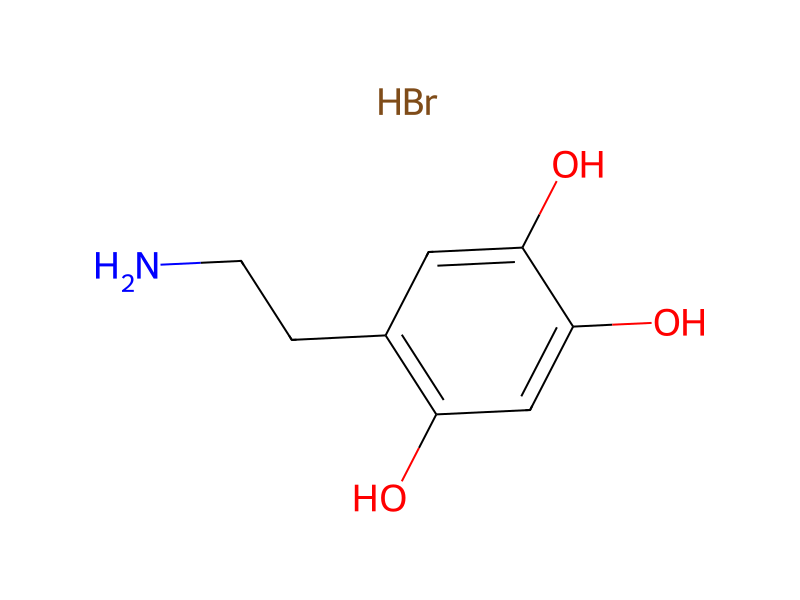
基本情報
- 標準SMILES
Br.NCCc1cc(O)c(O)cc1O- InChIKey
MLACDGUOKDOLGC-UHFFFAOYSA-N- 分子式
- C8H12BrNO3
- 平均分子量
- 250.09 g/mol
- 単同位体質量
- 249.00005534
概要
See also: 6-Hydroxydopamine (annotation moved to); Hydroxydopamine (annotation moved to).
名称と識別子
- 優先名称
- 1,2,4-Benzenetriol, 5-(2-aminoethyl)-, hydrobromide (1:1)
- IUPAC
- 5-(2-aminoethyl)benzene-1,2,4-triol;hydrobromide
- 現地名
- 6-ヒドロキシドーパミン·臭化水素酸塩
- 英語名
- 6-HYDROXYDOPAMINE HYDROBROMIDE
- 分子式
- C8H12BrNO3
- 分子量
- 250.09
名称と別名
名称をさらに表示
データベース識別子
- CAS
636-00-0- PubChem CID
- 176170
- DTXSID
DTXSID30212972- ChEMBL
CHEMBL1718398- UNII
- TWC1D4W0WB
- EC Number
- 211-247-0
物性
構造計算による物性
- 極性表面積
- 86.7 Ų
- 水素結合供与体数
- 5
- 水素結合受容体数
- 4
- 回転可能結合数
- 2
- 重原子数
- 13
- 形式電荷
- 0
- 複雑度
- 142
物理化学的性質
- 融点
- 216 · 216-220 °C(lit.)
- 貯蔵温度
- -20 °C · -20°C
- 溶解性
- DMSO(微量)、メタノール(微量)、水(微量)
- 外見
- 個体
- 色
- 黄褐色から茶色
- BRN
- 3713280 · 3713280
- 安定性
- 吸湿性、光感受性
- InChI
- InChI=1S/C8H11NO3.BrH/c9-2-1-5-3-7(11)8(12)4-6(5)10;/h3-4,10-12H,1-2,9H2;1H
- InChIKey
- MLACDGUOKDOLGC-UHFFFAOYSA-N
- SMILES
- C(C1C=C(O)C(O)=CC=1O)CN.Br
- CAS データベース
- 636 · 636-00-0(CAS DataBase Reference)
化学的性質
化学的特性beige to brown crystalline powder
安全と法規制
GHS分類
GHS Classification
Warning
H315 (100%): Causes skin irritation [Warning Skin corrosion/irritation]
P261, P264, P264+P265, P271, P280, P302+P352, P304+P340, P305+P351+P338, P319, P321, P332+P317, P337+P317, P362+P364, P403+P233, P405, and P501 (click each P-code to see the statement)
Aggregated GHS information provided per 40 reports by companies from 3 notifications to the ECHA C&L Inventory. Each notification may be associated with multiple companies.
危険有害性情報
安全データ
- F
- 3-10
- wgk
- 3
- rtecs
- DC4600000
- risk_code
- 36/37/38
- hazard_code
- Xi
- safety_code
- 26-36
- Hazard Classifications
- Eye Irrit. 2Skin Irrit. 2STOT SE 3
- ストレージクラス
- 11 - Combustible Solids
化学と産業
薬理情報
MeSH Pharmacological Classification
Drugs that inhibit the actions of the sympathetic nervous system by any mechanism. The most common of these are the ADRENERGIC ANTAGONISTS and drugs that deplete norepinephrine or reduce the release of transmitters from adrenergic postganglionic terminals (see ADRENERGIC AGENTS). Drugs that act in the central nervous system to reduce sympathetic activity (e.g., centrally acting alpha-2 adrenergic agonists, see ADRENERGIC ALPHA-AGONISTS) are included here.
Drugs that act on adrenergic receptors or affect the life cycle of adrenergic transmitters. Included here are adrenergic agonists and antagonists and agents that affect the synthesis, storage, uptake, metabolism, or release of adrenergic transmitters.
応用分野
説明6-OHDA is a catecholaminergic neurotoxin that has been used to induce dopaminergic lesions and parkinsonian symptoms as a model of Parkinson''s disease in rodents. It induces locomotor impairment in mice and loss of tyrosine hydroxylase-reactive neurons in mouse brain when administered into the substantia nigra, medial forebrain bundle (MFB), or striatum at doses of 9, 6, and 18 μg, respectively. Intracisternal administration of 6-OHDA (200 μg) decreases dopamine and norepinephrine levels in rat brain. It induces apoptosis in primary rat cortical cells and PC12 rat adrenal cells when used at a concentration of 50 μM. 6-OHDA (75 μM) activates caspase-3, -8, and -9 in a time-dependent manner and increases the level of intracellular reactive oxygen species (ROS) in PC12 cells and induces apoptosis in rat substantia nigra when stereotaxically injected into the right MFB.
使用6-Hydroxydopamine is a selective catecholaminergic neurotoxin. Studies show that 6-Hydroxydopamine can be used to create an animal model of Parkinson''s disease as it causes almost complete destruction of nigral dopaminergic neurons and their striatal terminals when injected into the substantia nigra of rats. 6-Hydroxydopamine induces apoptosis in PC12 cells.
一般的な説明Solutions should be freshly prepared and protected from exposure to light.
サプライヤー50 社
関連反応
現在のフィルター条件では反応記録がありません。
関連ノート
読み込み中…