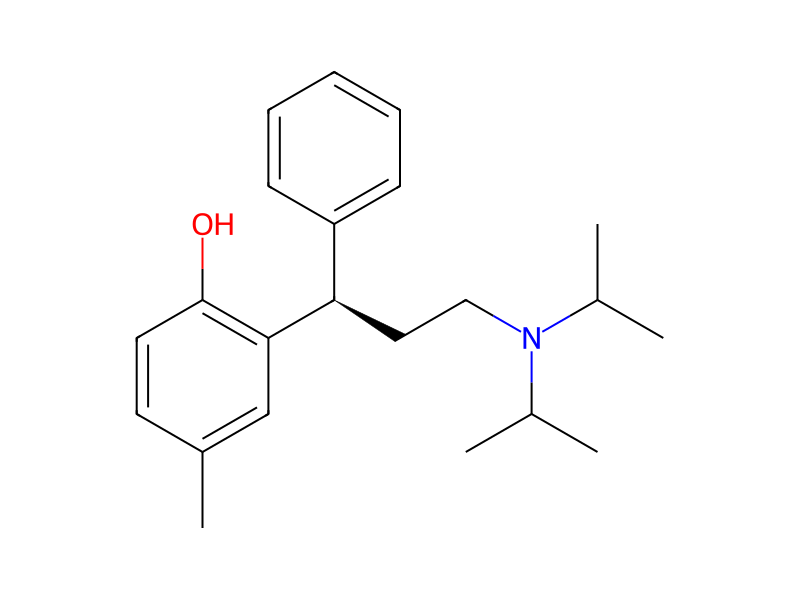
基本情報
- CAS
88407-28-7- 標準SMILES
Cc1ccc(O)c([C@H](CCN(C(C)C)C(C)C)c2ccccc2)c1- InChIKey
OOGJQPCLVADCPB-HXUWFJFHSA-N- 分子式
- C22H31NO
- 平均分子量
- 325.5 g/mol
概要
Tolterodine is a tertiary amine. It has a role as a muscarinic antagonist, a muscle relaxant and an antispasmodic drug. It is functionally related to a p-cresol.
名称と識別子
- 優先名称
- Tolterodine
- IUPAC
- 2-[(1R)-3-[di(propan-2-yl)amino]-1-phenylpropyl]-4-methylphenol
- 英語名
- Tolterodine Impurity 1
- 分子式
- C22H31NO
- 分子量
- 325.48764
名称と別名
名称をさらに表示
データベース識別子
- CAS
88407-28-7- ChEMBL
CHEMBL1382- ChEBI
CHEBI:9622- UNII
- WHE7A56U7K
- EC Number
- 805-304-4
- Nikkaji
- J561.859B
物性
構造計算による物性
- XLogP
- 5.6
- 極性表面積
- 23.5 Ų
- 水素結合供与体数
- 1
- 水素結合受容体数
- 2
- 回転可能結合数
- 7
- 重原子数
- 24
- 形式電荷
- 0
- 複雑度
- 340
実験および物理化学的性質
安全と法規制
GHS分類
GHS Classification
Danger
H301 (100%): Toxic if swallowed [Danger Acute toxicity, oral]
P203, P264, P270, P280, P301+P316, P318, P321, P330, P405, and P501 (click each P-code to see the statement)
The GHS information provided by 1 company from 1 notification to the ECHA C&L Inventory.
危険有害性情報
毒性情報
Hepatotoxicity
In multiple randomized controlled trials of tolterodine in patients with overactive bladder syndrome, serum aminotransferase and alkaline phosphatase elevations were not common, arising in less than 1% of treated subjects and in a similar proportion of placebo recipients. In these clinical trials there were no reports of clinically apparent liver injury or jaundice. Since the approval of tolterodine in 1998 and its widescale use (with more than 1 million prescriptions filled yearly in the United States), there has been only one published case report of liver injury with symptoms and jaundice attributed to its use (Case 1). Thus, acute symptomatic liver injury due to tolterodine must be very rare, if it occurs at all.
Toxicity Summary
To prevent toxicity, patients with hepatic impairment should be given a lower dose since the drug's elimination is lower than that of healthy patients. Additionally, tolterodine demonstrated higher concentrations in patients with renal impairment. Therefore, recommendations include a decrease in drug dosage in both patients with hepatic or renal impairment.
Drug Induced Liver Injury
Drug-Induced Liver Injury Severity and Toxicity (DILIst)
tolterodine
DILI Negative
Oral
DOI:10.1016/j.drudis.2019.09.022
化学と産業
薬理情報
ATC Code
G04BD07
G - Genito urinary system and sex hormones
QG - Genito urinary system and sex hormones
Pharmacodynamics
Tolterodine is a competitive muscarinic receptor antagonist. Both urinary bladder contraction and salivation are mediated via cholinergic muscarinic receptors. After oral administration, tolterodine is metabolized in the liver, resulting in the formation of the 5-hydroxymethyl derivative, a major pharmacologically active metabolite. The 5-hydroxymethyl metabolite, which exhibits an antimuscarinic activity similar to that of tolterodine, contributes significantly to the therapeutic effect. Both tolterodine and the 5-hydroxymethyl metabolite exhibit a high specificity for muscarinic receptors, since both show negligible activity or affinity for other neurotransmitter receptors and other potential cellular targets, such as calcium channels. Tolterodine has a pronounced effect on bladder function. The main effects of tolterodine are an increase in residual urine, reflecting an incomplete emptying of the bladder, and a decrease in detrusor pressure, consistent with an antimuscarinic action on the lower urinary tract.
Mechanism of Action
Both tolterodine and its active metabolite, 5-hydroxymethyltolterodine, act as competitive antagonists at muscarinic receptors. This antagonism results in inhibition of bladder contraction, decrease in detrusor pressure, and an incomplete emptying of the bladder.
FDA Pharmacological Classification
WHE7A56U7K
TOLTERODINE
Established Pharmacologic Class [EPC] - Cholinergic Muscarinic Antagonist
Mechanisms of Action [MoA] - Cholinergic Muscarinic Antagonists
Tolterodine is a Cholinergic Muscarinic Antagonist. The mechanism of action of tolterodine is as a Cholinergic Muscarinic Antagonist.
TOLTERODINE
MeSH Pharmacological Classification
Drugs that bind to but do not activate MUSCARINIC RECEPTORS, thereby blocking the actions of endogenous ACETYLCHOLINE or exogenous agonists. Muscarinic antagonists have widespread effects including actions on the iris and ciliary muscle of the eye, the heart and blood vessels, secretions of the respiratory tract, GI system, and salivary glands, GI motility, urinary bladder tone, and the central nervous system.
Drugs used in the treatment of urological conditions and diseases such as URINARY INCONTINENCE and URINARY TRACT INFECTIONS.
Absorption, Distribution and Excretion
Following administration of a 5-mg oral dose of 14C-tolterodine solution to healthy volunteers, 77% of radioactivity was recovered in urine and 17% was recovered in feces in 7 days.
113 ± 26.7 L
用途と製造
サプライヤー7 社
関連反応
現在のフィルター条件では反応記録がありません。
化合物ノート
読み込み中…