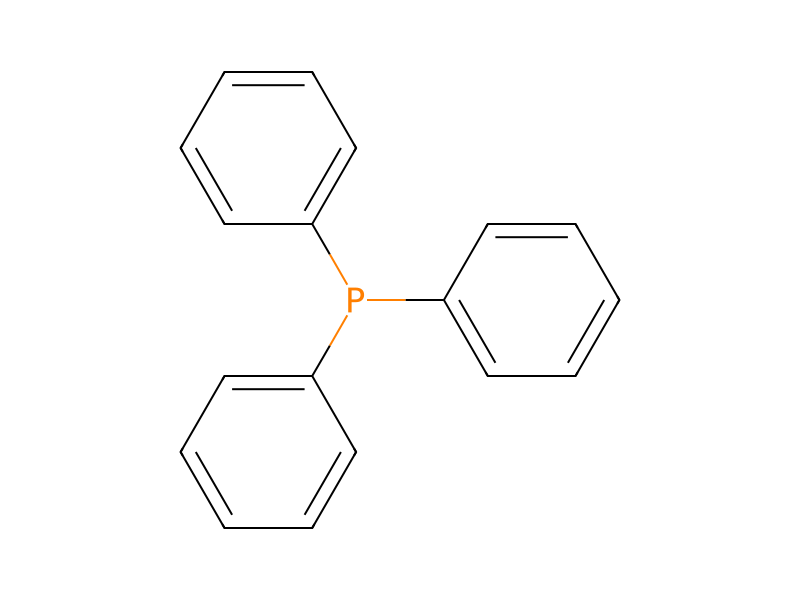
基本情報
- CAS
39319-11-4- 標準SMILES
c1ccc(P(c2ccccc2)c2ccccc2)cc1- InChIKey
RIOQSEWOXXDEQQ-UHFFFAOYSA-N- 分子式
- C18H15P
- 平均分子量
- 262.3 g/mol
概要
Triphenyl phosphine appears as white crystals. (NTP, 1992)
名称と識別子
- 優先名称
- Triphenylphosphine
- IUPAC
- triphenylphosphane
- 現地名
- トリフェニルホスフィン樹脂
- 英語名
- Triphenylphosphine resin
- 分子式
- C18H15P
- 分子量
- 262.285461
名称と別名
TRIPHENYLPHOSPHINE603-35-0TriphenylphosphaneTriphenyl phosphinePhosphine, triphenyl-TriphenylphosphorusTriphenylphosphideTrifenylfosfinPP 360DTXSID5026251NSC-1026D26OA393
名称をさらに表示
トリフェニルホスフィン樹脂トリフェニルホスフィン、ポリマー担持POLYMER-BOUND TRIPHENYLPHOSPHINEPOLYMER SUPPORTED TRIPHENYLPHOSPHINEDIPHENYLPHOSPHINO-POLYSTYRENETRIPHENYLPHOSPHINE POLYSTYRENETRIPHENYLPHOSPHINE POLYMER BOUNDTRIPHENYLPHOSPHINE POL. BOUND, 100-200 M ESH, ~1.6 MMOL/GPL-TPP RESIN-C6H4P(C6H5)2PL-TPP MP-RESINPOLYSTYRENE-PPH2
NSC-215203DTXCID906251CHEBI:183318RefChem:6333210-036-0Triphenylphosphine resintriphenyl-phosphane39319-11-4
データベース識別子
- CAS
39319-11-4- ChEMBL
CHEMBL1448331- ChEBI
CHEBI:183318- UNII
- 26D26OA393
- EC Number
- 210-036-0
- Nikkaji
- J1.652G
物性
構造計算による物性
- XLogP
- 4.6
- 極性表面積
- 0 Ų
- 水素結合供与体数
- 0
- 水素結合受容体数
- 0
- 回転可能結合数
- 3
- 重原子数
- 19
- 形式電荷
- 0
- 複雑度
- 202
実験および物理化学的性質
Chemical ClassesOther Classes -> Phosphorus Compounds
SpringerMaterials PropertiesSchoenflies notation
LogP
5.69
5.69
OdorODORLESS
Density
1.194 at 77 °F (NTP, 1992) - Denser than water; will sink
1.075 @ 80 °C/4 °C
1.1 g/cm³
1.194 @25 °C
Color/Form
MONOCLINIC PLATELETS OR PRISMS FROM ETHER
WHITE CRYSTALLINE SOLID
Solubility
Insoluble (NTP, 1992)
FREELY SOL IN ETHER; SOL IN BENZENE, CHLOROFORM, GLACIAL ACETIC ACID; LESS SOL IN ALCOHOL; PRACTICALLY INSOL IN WATER
SOL IN CARBON TETRACHLORIDE
Solubility in water, mg/l at 25 °C: 0.09 (very poor)
Flash Point
356 °F (NTP, 1992)
180 °C OC.
182 °C c.c.
Endocrine DisruptorsPotential endocrine disrupting compound
Boiling Point
安全と法規制
GHS分類
GHS Classification
This chemical does not meet GHS hazard criteria for 0.5% (6 of 1290) of reports.
Danger
H302 (97.1%): Harmful if swallowed [Warning Acute toxicity, oral]
P260, P261, P264, P264+P265, P270, P272, P273, P280, P301+P317, P302+P352, P305+P354+P338, P317, P319, P321, P330, P333+P317, P362+P364, and P501 (click each P-code to see the statement)
Aggregated GHS information provided per 1290 reports by companies from 56 notifications to the ECHA C&L Inventory. Each notification may be associated with multiple companies.
Danger
危険有害性情報
Regulatory Information
Chemical: Phosphine, triphenyl-
Phosphine, triphenyl- is listed on the EPA's Chemical Data Reporting (CDR) system. Manufacturers and importers of Phosphine, triphenyl- are required to report information about their production and use of this chemical to the EPA under the Toxic Substances Control Act (TSCA). (40 eCFR Part 711)
Status: Active Update: 14-04-2023 https://echa.europa.eu/registration-dossier/-/registered-dossier/13659
Triphenylphosphine: Does not have an individual approval but may be used under an appropriate group standard
Other Safety InformationIMAP assessments - Phosphine, triphenyl-: Human health tier II assessment
DOT LabelClass 9
Fire Hazards
This compound is combustible. (NTP, 1992)
Combustible. Gives off irritating or toxic fumes (or gases) in a fire. Finely dispersed particles form explosive mixtures in air.
Health HazardsACUTE/CHRONIC HAZARDS: Toxic; when heated to decomposition, emits highly toxic fumes of phosphine and POx. (NTP, 1992)
Hazards Summary
Decomposed by heating forming phosphine and phosphorous oxides; A skin, eye, and respiratory tract irritant; [ICSC] Causes convulsions at lethal doses in animal experiments; [RTECS] A strong reducing agent; [CAMEO] Harmful if ingested; May cause skin sensitization; [Aldrich MSDS] See Phosphine.
化学と産業
用途と製造
Uses
Used as a polymerization initiator and an intermediate to make pharmaceuticals, phosphonium salts, and other phosphorus compounds; [HSDB]
ORGANIC SYNTHESIS; POLYMERIZATION INITIATOR
SYNTHESIS OF PHOSPHONIUM SALTS, OTHER PHOSPHORUS COMPOUNDS
CHEMICAL INTERMEDIATE, EG, FOR PHARMACEUTICALS
U.S. Exports
(1977) No Data
(1979) No Data
U.S. Imports
(1977) 2.72X10+7 G (PRINCPL CUSTMS DISTS)
(1979) 7.58X10+7 G (PRINCPL CUSTMS DISTS)
U.S. Production
2023: 1,000,000 - <2,500,000 lb
(1977) No Data
(1979) No Data
Consumer UsesCatalyst
Industry UsesCatalyst
Methods of Manufacturing
REACTION OF PHENYLMAGNESIUM BROMIDE AND PHOSPHORUS TRICHLORIDE
FROM PHENYLMAGNESIUM BROMIDE & PHOSPHORUS TRICHLORIDE: PFEIFFER, PIETSCH, BER 37, 4621 (1904); SAUVAGE COMPT REND 139, 675 (1904); DODONON, MEDOX, BER 61, 910 (1928); DENNEY ET AL, J AM CHEM SOC 83, 1729 (1961).
BY A MODIFIED GRIGNARD SYNTHESIS.
General Manufacturing Information
Synthetic Rubber Manufacturing
Phosphine, triphenyl-: ACTIVE
応用分野
使用Triphenylphosphine resin is used for the preparation of polymer bound ylids which are useful for Wittig reactions.
サプライヤー41 社
関連反応
0 件
現在のフィルター条件では反応記録がありません。
化合物ノート
読み込み中…